True or False Reading Passages Worksheets
About This Worksheet Collection
True or false reading passages help students develop accurate reading comprehension by teaching them to evaluate statements against information presented in a text. Rather than simply remembering what they have read, learners must examine specific details, recognize whether a claim is supported or contradicted, and determine when additional information is needed to reach a conclusion. This process strengthens literal comprehension, close reading, factual recall, and textual evidence identification while encouraging students to distinguish between accurate information and misleading statements. More advanced activities introduce important distinctions between false claims, information that is not stated, personal opinions, and interpretations that extend beyond the available evidence. Understanding these differences helps students become more careful and independent readers who can evaluate written information, recognize inconsistencies, and explain the reasoning behind their answers.
This collection of True or False Reading Passages Worksheets provides a variety of short narratives and informational texts paired with activities that encourage careful reading and thoughtful statement evaluation. Students explore familiar settings such as a fire station, bakery, garden, library, and skate park, along with science-related passages about weather, desert observations, astronomy, and environmental research. Exercises begin with identifying true and false statements before introducing tasks that require learners to highlight supporting words, copy evidence from a passage, correct inaccurate information, and distinguish details that are not mentioned in the text. Additional activities focus on evaluating character motivations, interpreting central themes, understanding vocabulary through context clues, and separating verifiable facts from personal opinions. More challenging passages ask students to identify misleading interpretations and explain errors in reasoning, making these resources useful for guided reading, independent practice, literacy centers, homeschooling, tutoring, homework, and reading comprehension assessments.
Working through these activities develops close reading, textual evidence analysis, factual verification, vocabulary interpretation, inferential reasoning, and critical thinking. Students learn to examine statements carefully, recognize how small changes in wording can alter meaning, and support their conclusions with specific information rather than unsupported assumptions. Opportunities to correct false statements and provide textual proof also strengthen written communication, sentence construction, and the ability to explain why an answer is accurate. As learners progress from straightforward factual questions to evaluating themes, opinions, and logical interpretations, they develop greater awareness of how information can be presented, misunderstood, or misrepresented. These skills provide a foundation for more advanced literary analysis, informational text comprehension, research, media literacy, and the thoughtful evaluation of written claims across academic subjects and everyday situations.
Detailed Descriptions Of These Worksheets
Bakery Clues
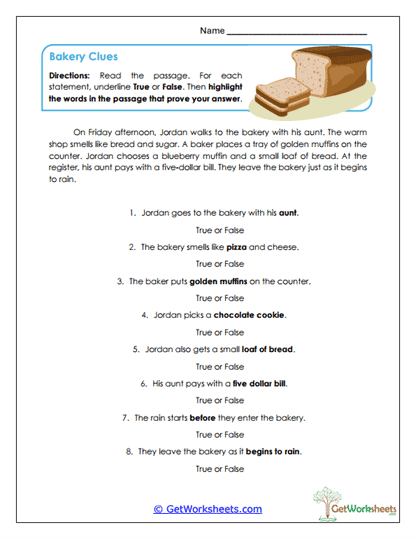
Bakery Clues strengthens evidence-based reading comprehension through a short passage about Jordan visiting a bakery with his aunt. Students examine eight statements about the visit, determine whether each is true or false, and highlight the specific words in the passage that support their decisions. Details involving baked goods, purchases, character actions, and changing weather encourage learners to recognize how even small differences can make a statement inaccurate. By requiring students to locate textual proof, the activity reinforces close reading, factual comparison, and the importance of supporting answers with information directly provided in a text.
Desert Data
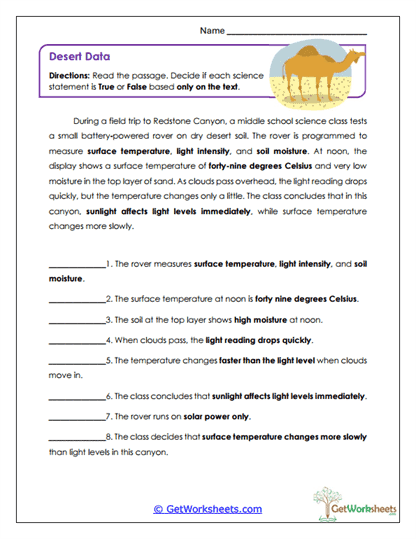
Desert Data combines informational reading comprehension with scientific observations from a middle school field experiment in Redstone Canyon. After reading about a battery-powered rover measuring surface temperature, light intensity, and soil moisture, learners evaluate eight statements to determine whether they accurately represent the passage. The exercises require careful attention to numerical measurements, scientific vocabulary, experimental conditions, and conclusions about how sunlight affects the desert environment. This cross-curricular activity strengthens factual verification, informational text analysis, and the ability to distinguish accurate scientific findings from misleading claims.
Firehouse Fun
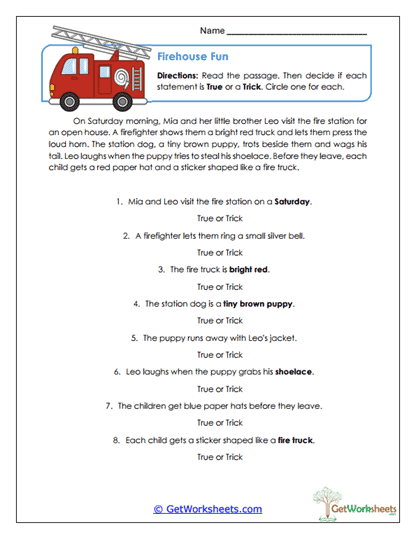
Firehouse Fun introduces basic statement verification through an engaging story about Mia and her younger brother Leo visiting a fire station during an open house. The children encounter a bright red fire truck, meet a playful puppy, and receive firefighter-themed souvenirs before leaving. Students review eight statements about the experience and classify each as True or Trick by comparing the claims with details from the passage. Some statements accurately describe the events, while others change information involving colors, objects, or character actions. The simple response format helps developing readers practice literal comprehension, careful information retrieval, and recognition of misleading details.
Garden Watch
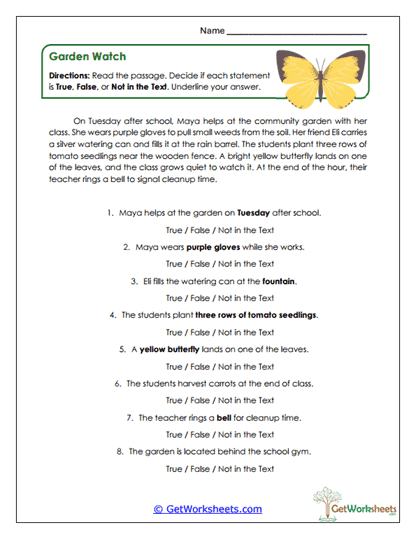
Garden Watch expands traditional true or false comprehension by introducing a third response category: Not in the Text. Through a passage about Maya and her classmates caring for a community garden, students examine eight statements and determine whether each is supported, contradicted, or not addressed by the reading. Details about planting tomato seedlings, watering the garden, observing a butterfly, and cleaning up provide opportunities for precise factual comparison. The activity teaches learners that an unmentioned detail is not necessarily false, strengthening their understanding of textual evidence, information gaps, and accurate statement classification.
Library Choices
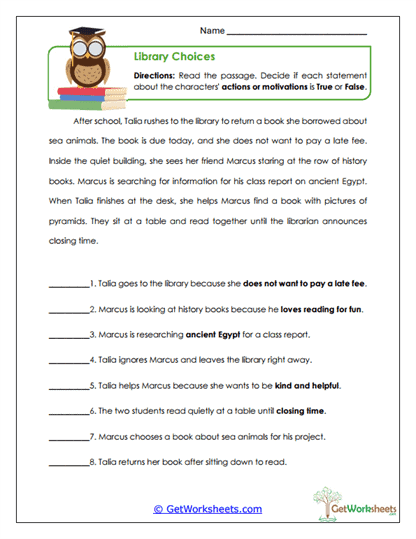
Library Choices encourages students to examine character behavior and motivation through a story about Talia and Marcus spending time at a library. After reading about Talia returning a borrowed book and helping Marcus research ancient Egypt, learners classify eight statements about the characters' actions and possible reasons for their decisions. The activity combines factual recognition with inferential comprehension, requiring readers to distinguish directly stated information from reasonable interpretations and unsupported claims. By analyzing the characters' interactions, students strengthen close reading, motivation analysis, and evidence-based reasoning while exploring themes of cooperation and helpfulness.
Lighthouse Proof
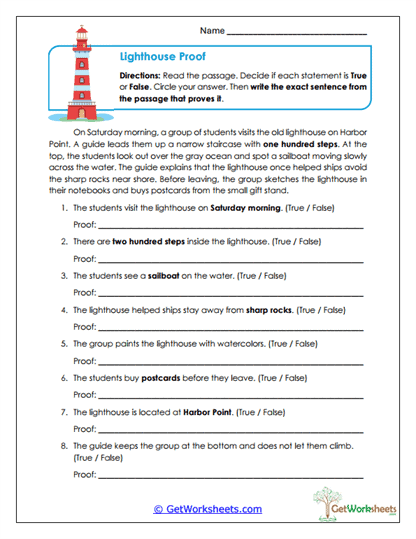
Lighthouse Proof challenges learners to support their true or false decisions with exact textual evidence from a passage about students touring a historic lighthouse at Harbor Point. Eight statements examine details such as the lighthouse's staircase, its surroundings, the guide's explanations, and the activities students complete during their visit. After identifying each statement as true or false, students locate and copy the sentence from the passage that proves their answer. This additional requirement encourages careful reading and reinforces the relationship between a conclusion and the information supporting it. The activity develops factual verification, sentence identification, accurate evidence selection, and written justification skills that are valuable in more advanced comprehension assignments.
Planetarium Puzzles
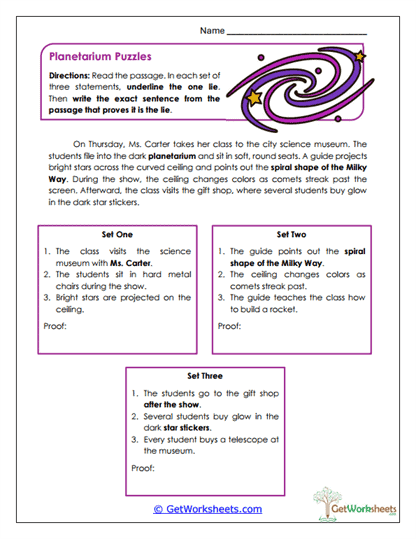
Planetarium Puzzles introduces a structured error-detection activity through a passage about a class visiting a science museum's planetarium. Students read about a presentation featuring projected stars, the spiral shape of the Milky Way, and a comet before examining three sets of statements. Each set contains one inaccurate claim that learners must identify and underline, followed by a space for copying the exact sentence that proves it is false. The combination of statement comparison and textual proof strengthens literal comprehension, factual accuracy, and evidence-based reasoning while connecting reading practice with an engaging astronomy topic.
Pond Observation
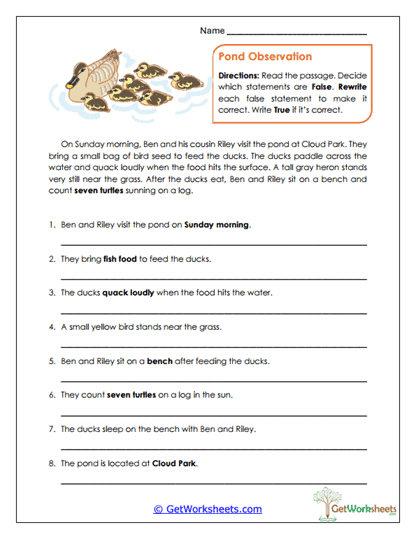
Pond Observation develops comprehension and sentence correction skills through a nature-themed passage about Ben and Riley visiting a pond at Cloud Park. Students evaluate eight statements involving ducks, a gray heron, turtles, and the children's activities, rewriting any false claims to make them accurate. Rather than simply recognizing mistakes, learners must return to the passage, retrieve the correct information, and express it clearly in writing. This approach reinforces textual verification, factual recall, sentence construction, and precise reading of descriptive details.
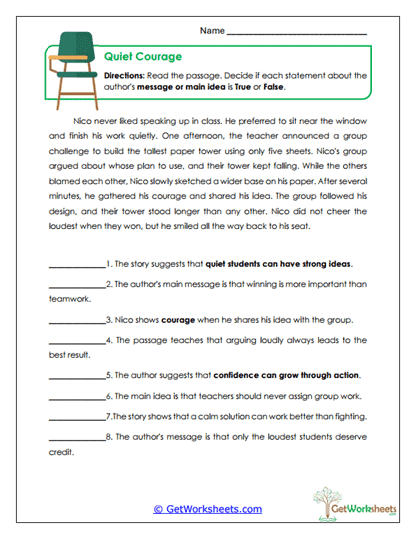
Quiet Courage
Quiet Courage moves beyond factual recall by asking students to evaluate statements about the underlying themes and main ideas of a narrative. The passage follows Nico, a quiet student whose thoughtful design helps his classmates succeed during a paper tower challenge. Learners classify eight statements as true or false based on whether they accurately reflect the story's messages about confidence, courage, cooperation, and meaningful participation. Some claims offer reasonable interpretations, while others distort the author's message or emphasize ideas that the story does not support. By comparing thematic statements with character actions and outcomes, students strengthen inferential comprehension, main idea recognition, and evidence-supported literary analysis.
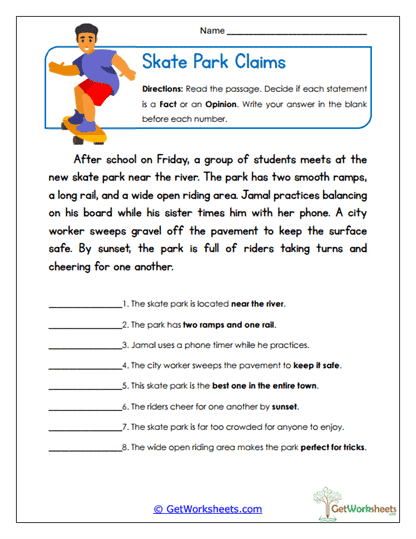
Skate Park Claims
Skate Park Claims introduces the important distinction between fact and opinion through a passage about students enjoying a new skate park near a river. After reading descriptions of the park's ramps, rail, riding area, and visitors, learners classify eight statements according to whether they express verifiable information or subjective judgment. Claims about the park's features and activities are contrasted with opinions involving popularity, crowding, and whether the location is ideal for performing tricks. The activity helps students recognize opinion-based language, understand how factual claims can be checked, and evaluate statements according to their purpose. These skills support reading comprehension, persuasive text analysis, and introductory media literacy.
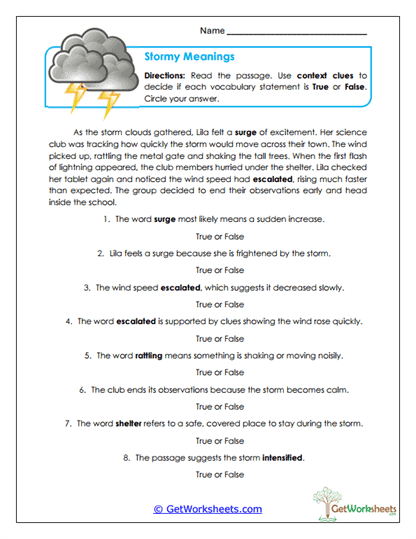
Stormy Meanings
Stormy Meanings combines vocabulary development with true or false comprehension through a descriptive passage about Lila and her science club encountering a powerful storm. Students examine eight statements involving word meanings and contextual interpretations, including expressions such as surge, escalated, rattling, and shelter. The surrounding narrative provides clues about increasing wind, changing weather conditions, and the characters' responses, helping learners determine whether each interpretation is accurate. By connecting vocabulary meanings with specific events and descriptions, the activity strengthens contextual inference, semantic understanding, and careful evaluation of language within a passage.
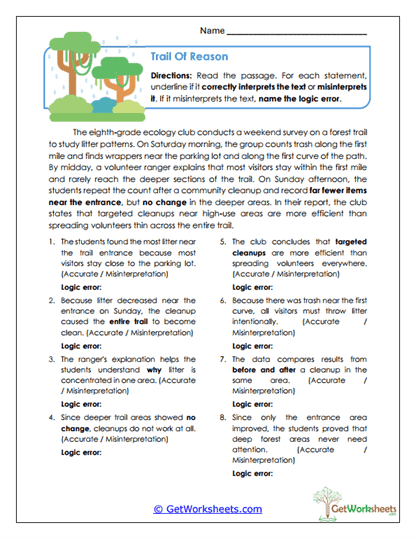
Trail Of Reason
Trail Of Reason develops higher-level critical reading through an informational passage about an eighth-grade ecology club investigating litter patterns along a forest trail. After reviewing the students' observations, a ranger's explanation of visitor behavior, and the results of a cleanup effort, learners evaluate eight statements to determine whether each accurately interprets the findings or misrepresents the text. Statements involving litter distribution, cleanup effectiveness, and volunteer placement require students to distinguish reasonable conclusions from exaggerations and unsupported assumptions. When an interpretation is misleading, learners must identify the logical error rather than simply mark the statement as incorrect. This additional reasoning task strengthens evidence evaluation, cause-and-effect analysis, critical interpretation, and the ability to recognize conclusions that extend beyond the available information. The activity prepares students for more advanced informational reading, argumentative analysis, and thoughtful evaluation of claims in academic and everyday contexts.
Bookmark Us Now!
New, high-quality worksheets are added every week! Do not miss out!