Sequencing Reading Passages Worksheets
About This Worksheet Collection
Sequencing is one of the most important reading comprehension skills because it helps students understand how ideas, actions, and events are connected over time. As readers learn to identify what happens first, next, and last, they begin to recognize patterns, follow complex narratives, understand procedures, and explain cause-and-effect relationships more clearly. Strong sequencing skills also support summarizing, predicting, retelling, and analyzing an author's organizational choices, making them essential for success in both fiction and nonfiction reading.
This collection of sequencing reading passages worksheets gives students opportunities to practice organizing events in chronological order through engaging stories, informational texts, historical passages, scientific procedures, and argumentative writing. Learners create timelines, identify transition words, repair missing steps, compare parallel storylines, evaluate event importance, and explore how authors use sequence to shape meaning. These ready-to-use activities are ideal for classroom instruction, literacy centers, intervention groups, tutoring sessions, homework, and homeschool learning, providing meaningful practice across a variety of reading contexts.
As students complete the collection, they strengthen reading comprehension, chronological thinking, summarizing, transition-word recognition, cause-and-effect reasoning, procedural analysis, author's craft, argument evaluation, and evidence-based writing. The activities encourage learners to move beyond simply recalling events by analyzing why order matters and how changing a sequence can affect meaning. By mastering these foundational skills, students become more confident readers who are better equipped to understand increasingly complex texts across every subject area.
Detailed Descriptions Of These Worksheets
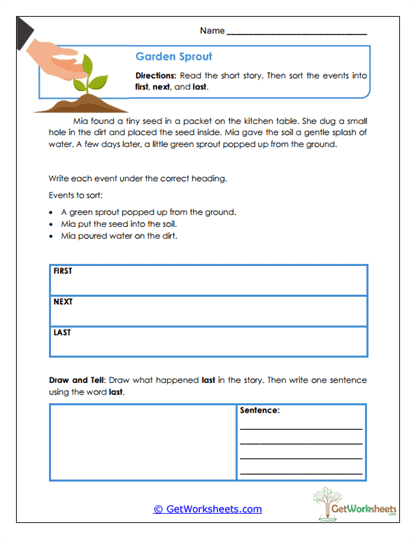
Garden Sprout
Young readers follow Mia's gardening adventure by identifying what happened first, next, and last in the story. After arranging the events, they reinforce their understanding by illustrating the ending and writing a sentence that correctly uses the word last. The activity builds confidence with story structure while helping children connect actions in a logical sequence. It provides an engaging introduction to chronological thinking for early elementary learners.
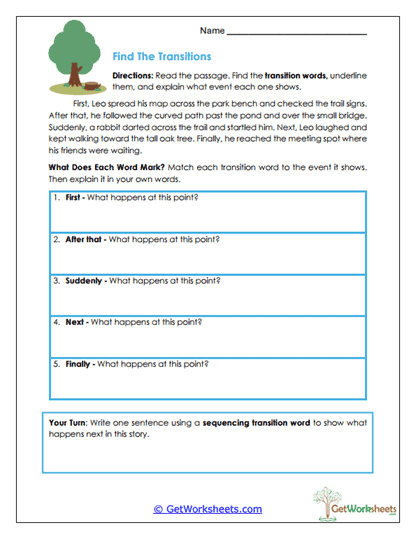
Find the Transitions
This worksheet helps students discover how transition words guide readers from one event to the next. By locating sequencing language within a passage and explaining its purpose, learners gain a better understanding of how authors organize ideas. Students then apply the skill by writing their own sentence using an appropriate transition word. The activity strengthens both reading comprehension and written communication.
River Race
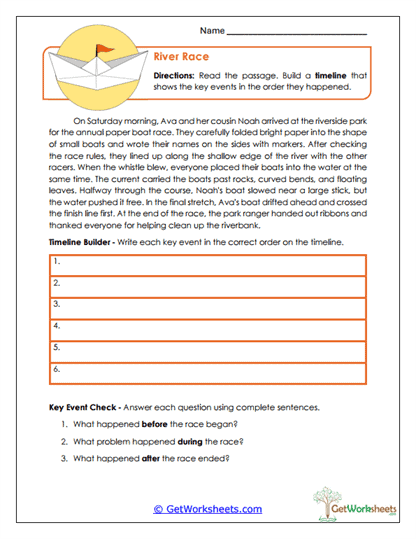
Students organize the major events from a paper boat race into a complete timeline before answering questions about what occurred before, during, and after the competition. Sorting several connected events encourages careful reading and thoughtful analysis rather than simple recall. The completed timeline also serves as a useful visual tool for retelling the story. This worksheet strengthens sequencing, summarizing, and narrative comprehension.
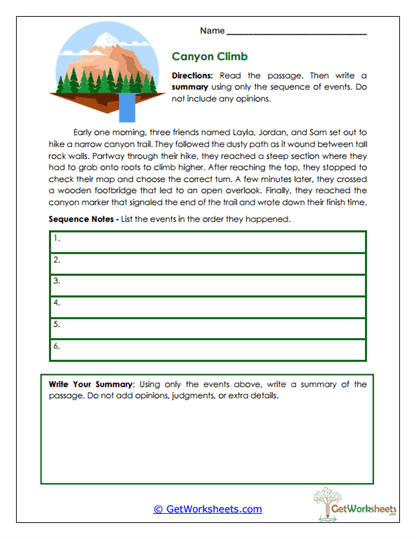
Canyon Climb
After reading about a canyon hike, learners identify the most important events and place them in chronological order before writing an objective summary. The sequence they create becomes a planning tool that helps them focus on the essential details instead of personal opinions. Students practice organizing information clearly while learning the difference between summarizing and retelling. This activity supports stronger nonfiction and narrative writing skills.
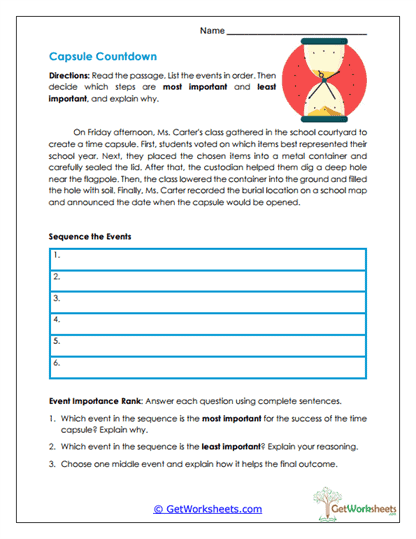
Capsule Countdown
Students examine the sequence of a classroom time capsule project and then evaluate which events had the greatest impact on the final outcome. Instead of simply listing actions, learners consider how each step contributed to the project's success. Supporting their choices with evidence encourages deeper thinking and stronger written explanations. This worksheet blends sequencing with higher-level analysis and reasoning.
Sequence Repair
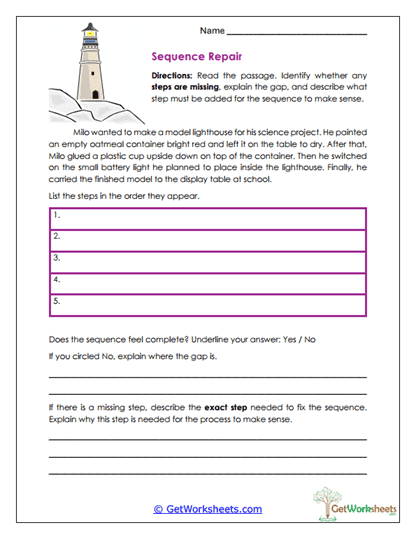
Learners review the steps used to build a model lighthouse and determine whether an important action has been left out. After locating the missing step, they explain why it is necessary for the sequence to make logical sense. The activity encourages students to read critically instead of accepting every procedure at face value. It also strengthens procedural comprehension and problem-solving skills.
Memory Shift
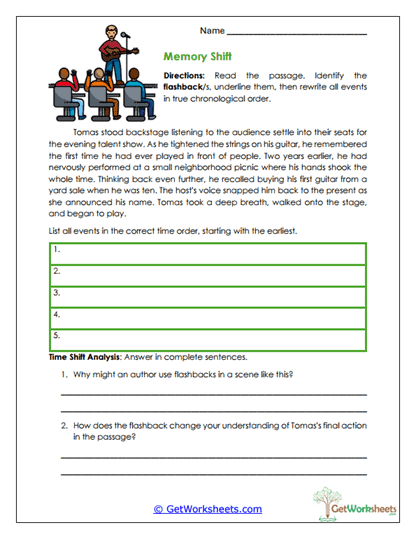
This worksheet introduces students to flashbacks by asking them to separate remembered events from present-day action. Learners reorganize the story into true chronological order and explain why the author included a flashback. Understanding the difference between narrative order and actual event order builds stronger literary analysis skills. Students also develop confidence reading more sophisticated story structures.
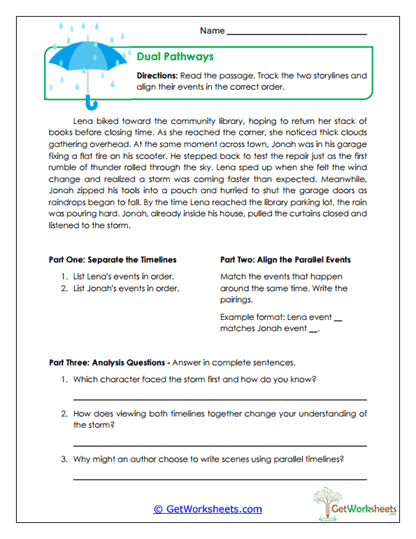
Dual Pathways
Students track two characters experiencing the same storm from different locations and build separate timelines for each storyline. After organizing both sequences, they compare events that occur simultaneously to better understand the shared experience. The activity helps readers keep multiple narratives organized without confusion. It also develops perspective-taking and analytical reading skills.
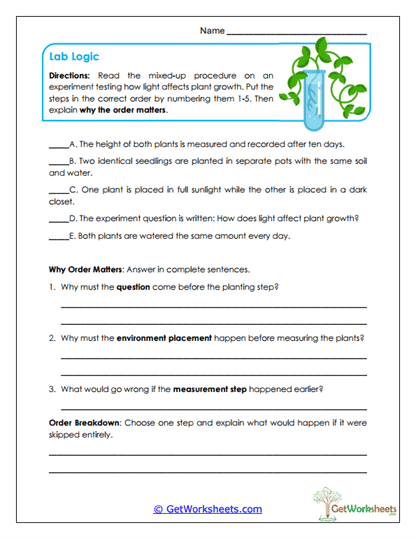
Lab Logic
Learners place the steps of a plant-growth experiment into the proper procedural order before explaining why each stage depends on the one before it. They also consider how skipping or rearranging steps would affect the investigation's reliability. Connecting reading comprehension with scientific reasoning gives students practical experience analyzing real-world procedures. The worksheet reinforces logical thinking alongside literacy skills.
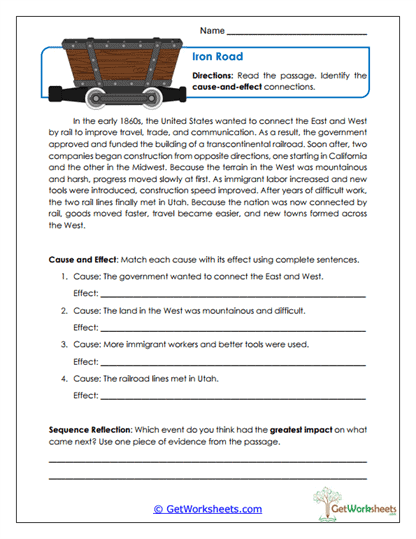
Iron Road
Students explore the construction of the transcontinental railroad by connecting important causes with their resulting effects. They also evaluate which event had the greatest influence on the project's overall success and defend their answer using evidence from the passage. The activity demonstrates how historical events unfold through connected actions and consequences. It strengthens sequencing, historical understanding, and evidence-based reasoning.
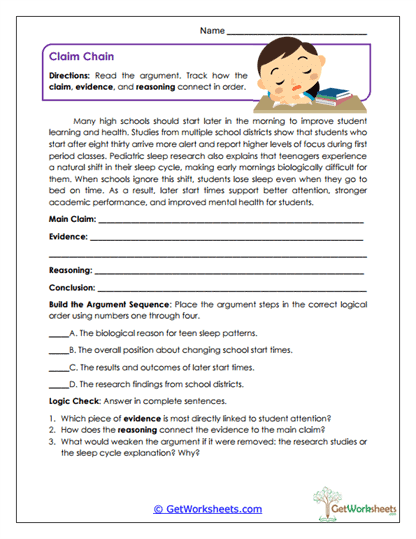
Claim Chain
This activity helps students break apart an argumentative passage by identifying the claim, supporting evidence, reasoning, and conclusion. Learners arrange these components into a logical sequence while evaluating how effectively the evidence supports the author's position. Understanding the structure of an argument prepares students for both analytical reading and persuasive writing. It also encourages thoughtful evaluation rather than simple agreement or disagreement.
Order Shift
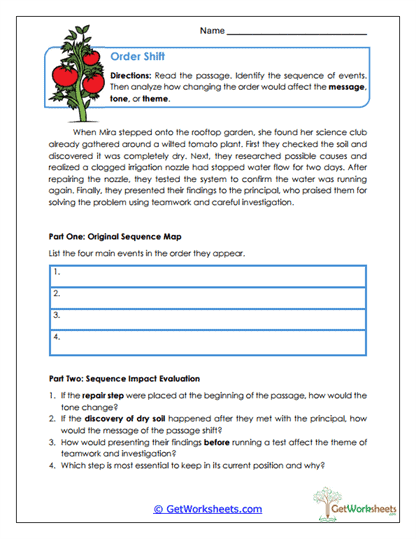
Students identify the major events in a story before considering how changing their order would affect the reader's understanding, the story's tone, and its overall message. By experimenting with alternative sequences, learners gain insight into the author's craft and organizational choices. The activity demonstrates that event order shapes much more than chronology. It encourages deeper comprehension, prediction, and critical thinking.
Bookmark Us Now!
New, high-quality worksheets are added every week! Do not miss out!