Summarizing Reading Passages Worksheets
About This Worksheet Collection
Summarizing is an essential reading comprehension skill that teaches students how to identify the most important ideas in a passage while leaving out unnecessary details. Rather than retelling everything they read, students learn to recognize main ideas, organize supporting information, identify patterns, and express the author's message in their own words. Strong summarizing skills improve comprehension, note-taking, studying, and critical thinking because learners must decide what information matters most and communicate it clearly and concisely.
This collection of summarizing reading passages worksheets introduces students to a variety of proven summary strategies through engaging stories, informational texts, scientific passages, and argumentative reading selections. Learners practice using graphic organizers, identifying main ideas and supporting details, paraphrasing information, condensing passages, writing objective summaries, analyzing claims, and experimenting with creative summary formats. These printable worksheets are excellent resources for classroom instruction, literacy centers, intervention groups, tutoring sessions, homework, and homeschool learning, providing students with multiple approaches to mastering one of the most valuable reading skills.
As students work through the collection, they strengthen reading comprehension, main idea recognition, supporting-detail analysis, paraphrasing, sequencing, concise writing, organizational thinking, evidence evaluation, and critical reasoning. Each activity encourages learners to move beyond simple retelling by selecting only the most meaningful information and presenting it in an organized, purposeful way. By developing effective summarizing habits, students become more confident readers who are better prepared for academic writing, research, note-taking, and understanding increasingly complex texts.
Detailed Descriptions Of These Worksheets
Kite Rescue
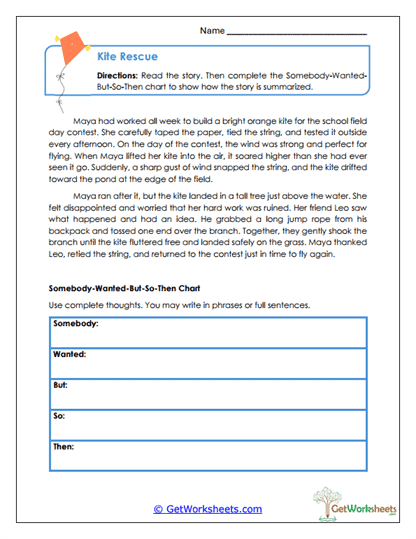
Students use the Somebody-Wanted-But-So-Then strategy to summarize a story about Maya trying to recover her runaway kite. The organizer helps readers identify the central character, the goal, the conflict, the response, and the final outcome in a logical sequence. Breaking the story into these five parts makes summarizing much less overwhelming. This activity builds confidence with narrative structure while reinforcing comprehension and organization.
Garden Discovery
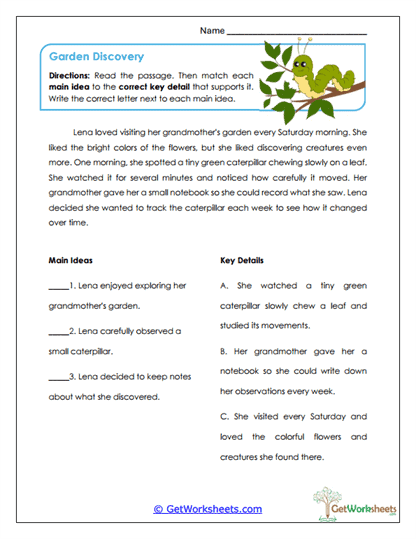
Learners read about Lena's observation of a caterpillar in her grandmother's garden before matching main ideas with the supporting details that belong to each one. The sorting process helps students recognize how several related facts work together to develop a larger concept. Organizing information in this way prepares students to write stronger summaries later. It also strengthens informational reading and logical thinking.
Library Helpers
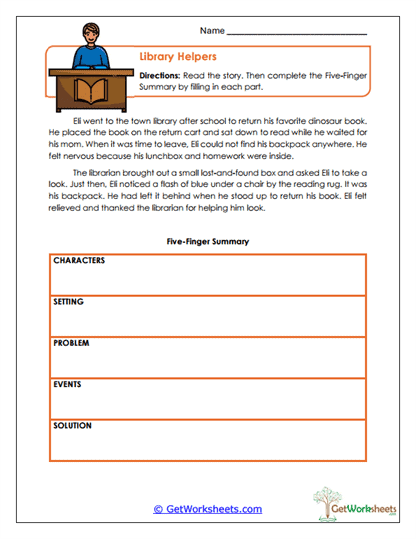
Students organize a story about Eli searching for his missing backpack by completing a Five-Finger Summary organizer. They identify the characters, setting, problem, major events, and solution before using those pieces to build a complete understanding of the story. The structured format encourages learners to focus on essential information rather than every small detail. It also provides a memorable strategy they can apply to future reading.
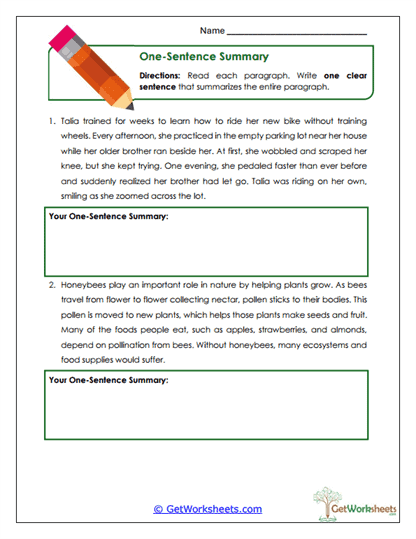
One-Sentence Summary
This worksheet challenges students to condense both a narrative and an informational paragraph into a single, carefully written sentence. They determine the main idea, select only the most important supporting details, and express everything using their own words. The strict sentence limit encourages thoughtful revision and concise writing. It also demonstrates that effective summaries can be brief without losing meaning.
Cultural Crossing
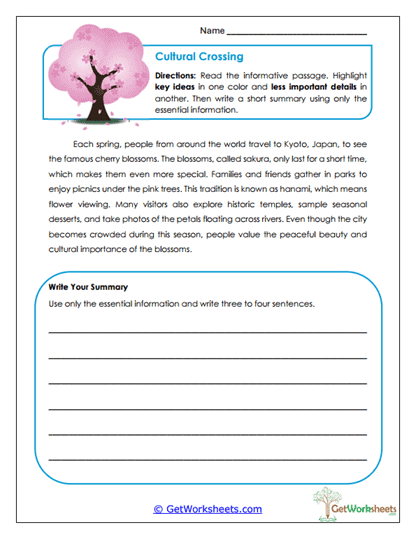
Students read about Kyoto's famous cherry blossom season before separating essential information from interesting but less important details. Using color coding, they organize the passage visually before writing a short summary based only on the key ideas. This process helps learners make thoughtful decisions about what belongs in a summary. The activity also introduces students to an important cultural tradition while strengthening nonfiction comprehension.
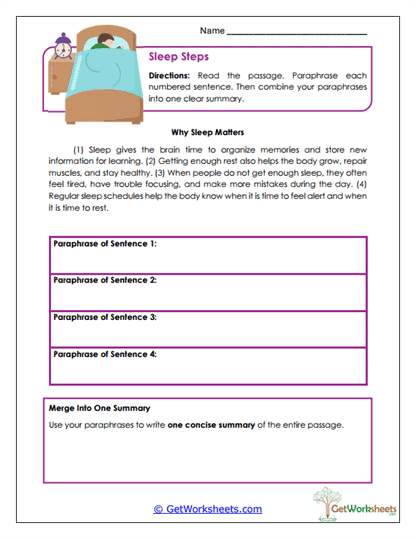
Sleep Steps
Learners paraphrase each sentence of a passage explaining the importance of sleep before combining those ideas into one organized summary. Completing the task one sentence at a time makes summarizing more manageable while discouraging direct copying from the original text. Students practice preserving meaning while changing the wording completely. The worksheet strengthens both reading comprehension and academic writing skills.
Condense Quest
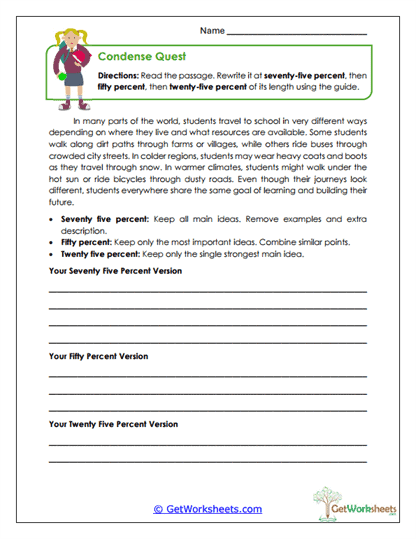
Students explore different ways children travel to school around the world while practicing the art of gradually shortening a passage. They create increasingly concise versions before reducing the entire reading to one carefully crafted sentence. Seeing the passage shrink step by step helps students understand how summaries are refined through revision. This activity develops precision, organization, and critical thinking.
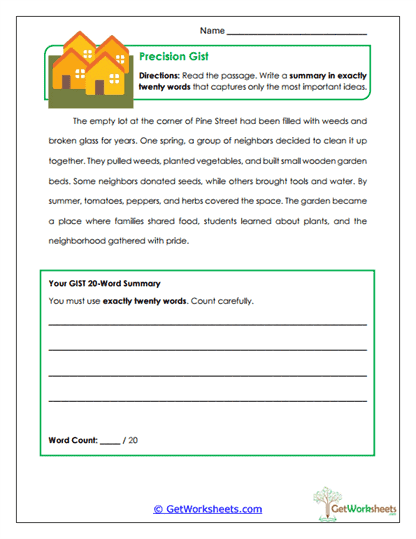
Precision Gist
This activity asks students to summarize a passage about neighbors creating a community garden using exactly twenty words. Every word must contribute meaningful information, encouraging careful revision and thoughtful vocabulary choices. Learners quickly discover that concise writing requires planning as much as creativity. The exercise strengthens summarizing, editing, and language precision.
Objective Summary
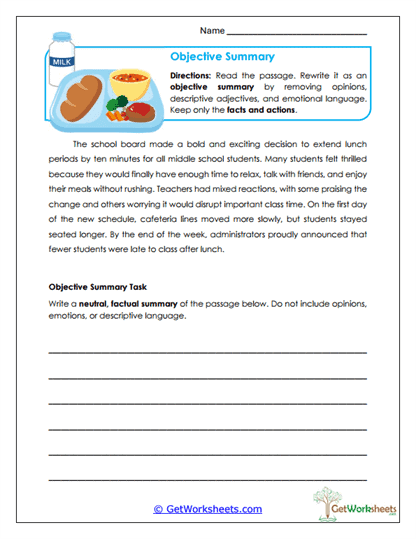
Students transform an opinion-filled passage about a school's lunch schedule into a neutral, fact-based summary. As they remove emotional language and personal opinions, they learn the difference between objective reporting and persuasive writing. The worksheet helps readers focus on factual information while maintaining the author's key ideas. It also builds important skills for research and academic writing.
Claim and Key Points
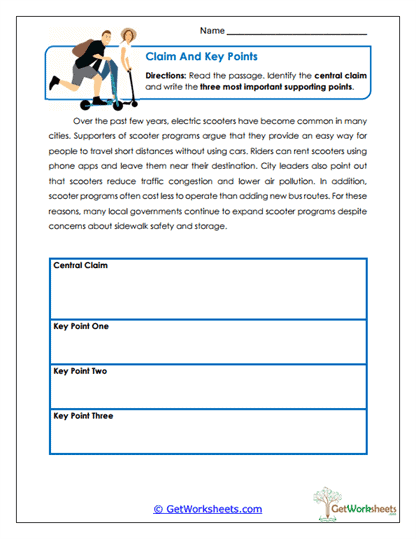
Learners read an argument about electric scooter programs and identify the author's central claim along with the strongest supporting reasons. Organizing the argument into a clear chart helps students separate major ideas from smaller examples. The activity reinforces how persuasive writing is structured while improving summarizing skills. It also prepares students to analyze and write stronger arguments of their own.
Abstract Builder
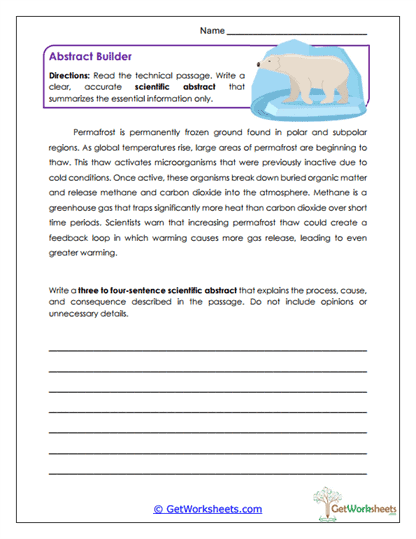
Students read a scientific passage about thawing permafrost before writing a short abstract that explains the process, causes, and consequences. The activity teaches learners how to summarize technical information accurately without unnecessary detail or personal opinion. By organizing complex scientific ideas into a concise explanation, students strengthen both science literacy and informational writing. This worksheet provides valuable preparation for research-based reading and writing.
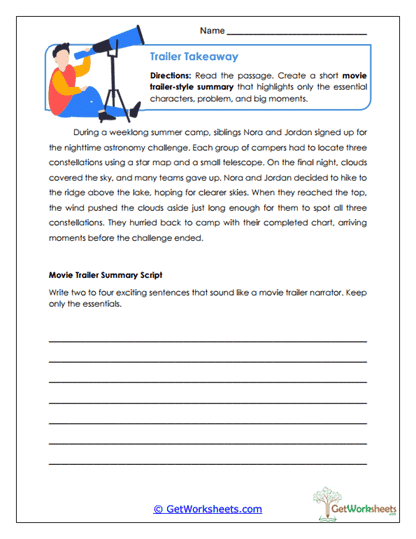
Trailer Takeaway
Students transform a story about two campers completing an astronomy challenge into an exciting movie trailer-style summary. They highlight the main characters, central conflict, and most important events while leaving enough mystery to capture the reader's interest. The creative format encourages concise writing without sacrificing comprehension or accuracy. It demonstrates that summaries can be informative while still being engaging and entertaining.
Bookmark Us Now!
New, high-quality worksheets are added every week! Do not miss out!