Inferential Comprehension Worksheets
About This Worksheet Collection
Inferential reading comprehension is the ability to understand information, ideas, and relationships that an author suggests without stating them directly. Unlike literal comprehension, which focuses on facts explicitly provided in a passage, inferential reading requires students to combine textual evidence with background knowledge and logical reasoning to reach meaningful conclusions. Readers use this process to interpret character emotions, uncover hidden motivations, recognize cause-and-effect relationships, identify underlying themes, and anticipate possible story developments. Paying attention to dialogue, descriptive details, character behavior, and contextual clues helps learners recognize how authors communicate meaning beyond the words on the page. Developing these skills encourages deeper engagement with written material and strengthens the critical thinking abilities needed to understand increasingly complex literary and informational texts.
This collection of Inferential Reading Comprehension Worksheets provides a variety of narrative-based activities that encourage students to read between the lines and support their interpretations with evidence. Learners explore stories involving difficult personal decisions, school competitions, friendships, family interactions, community activities, and unexpected challenges while answering questions about information that is implied rather than directly explained. Activities include predicting story outcomes, interpreting hidden emotions, identifying unstated causes, analyzing character relationships, determining vocabulary meanings through context, and recognizing underlying themes or moral lessons. Other exercises challenge readers to examine author assumptions, compare contrasting viewpoints, interpret suspicious dialogue, and identify subtle conflicts between characters. The combination of multiple-choice questions and open-ended written responses makes these resources useful for guided reading, independent practice, classroom discussions, literacy centers, homeschooling, tutoring, and reading comprehension assessments.
Working through these activities strengthens students' ability to recognize relevant textual clues, connect information across a passage, and develop reasonable interpretations supported by specific details. Learners practice distinguishing between explicitly stated facts, logical inferences, and unsupported assumptions while improving their understanding of character development, narrative structure, emotional subtext, and thematic meaning. Questions that encourage prediction, explanation, and personal reflection help students organize their thinking, justify conclusions, and communicate ideas through clear written responses. Repeated opportunities to analyze dialogue, actions, and descriptive language also promote careful reading habits and greater awareness of how authors construct meaning. By developing evidence-based inferential reasoning, students become more confident and independent readers who can interpret complex narratives, participate in thoughtful literary discussions, and apply analytical comprehension strategies across academic subjects.
Detailed Descriptions Of These Worksheets
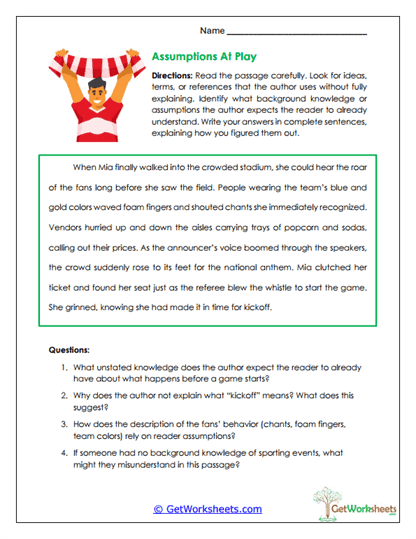
Assumptions At Play
Assumptions At Play explores how authors rely on readers' background knowledge to communicate information without explaining every detail. Through a narrative about Mia attending a crowded sporting event, learners examine familiar references such as team colors, cheering fans, the national anthem, and the beginning of a game. Four open-ended questions encourage students to identify unstated assumptions, interpret sporting terminology, and consider how readers with different experiences might understand the same passage. By examining what an author expects readers to know, students strengthen contextual reasoning, implicit meaning recognition, and their awareness of how prior knowledge contributes to reading comprehension.
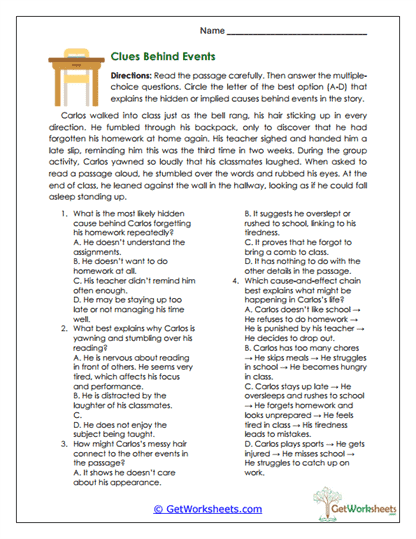
Clues Behind Events
Understanding why events occur is the focus of Clues Behind Events, which features a story about Carlos arriving at school tired, forgetting his homework, and struggling during class. Students answer four multiple-choice questions requiring them to examine behavioral clues and determine the most reasonable explanations for his difficulties. Details involving Carlos's appearance, classroom behavior, and teacher's observations encourage learners to connect information across the narrative rather than consider each event independently. The exercise develops cause-and-effect reasoning, character inference, and the ability to distinguish evidence-supported conclusions from less convincing explanations.
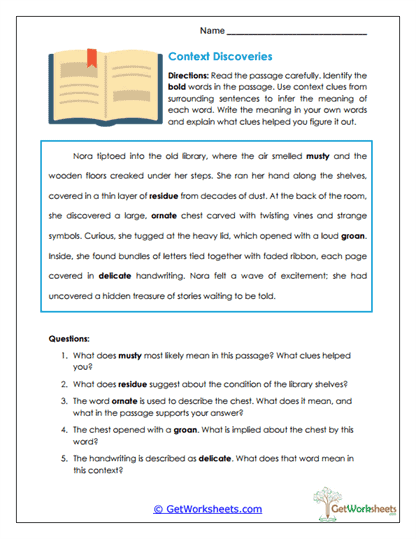
Context Discoveries
Context Discoveries challenges students to determine unfamiliar vocabulary meanings through a mysterious story about Nora exploring an old library and discovering a chest filled with handwritten letters. Five questions focus on interpreting words such as musty, residue, ornate, groan, and delicate using surrounding descriptions and contextual evidence. Learners examine how nearby details reveal information about objects, sounds, textures, and the atmosphere of the setting. The activity builds vocabulary knowledge, contextual inference, and independent reading strategies while demonstrating how descriptive language contributes to a story's meaning.
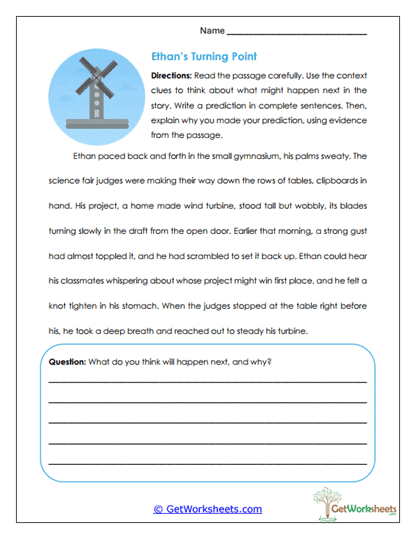
Ethan's Turning Point
A suspenseful science fair experience provides the setting for Ethan's Turning Point, which encourages learners to predict how an unfinished story might continue. Ethan worries about his homemade wind turbine after struggling with its stability, and the approaching judges increase his uncertainty about the presentation. Students use these narrative details to develop a reasonable prediction and explain their reasoning with evidence from the passage. The open-ended activity emphasizes prediction, cause-and-effect relationships, character interpretation, and logical thinking while showing why effective inferences must be supported by textual clues.
Hints And Glances
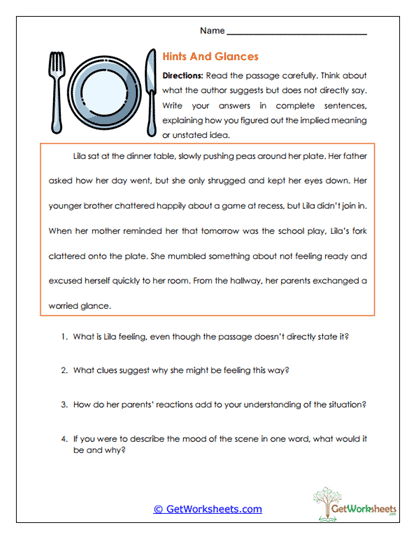
Hints And Glances develops emotional inference through a family dinner scene in which Lila behaves unusually quietly and avoids discussing her upcoming school play. Although the passage does not directly explain her feelings, details involving her silence, lack of appetite, and her parents' concerned glances provide clues about the situation. Four comprehension questions ask students to interpret Lila's possible emotions, identify supporting evidence, examine her parents' reactions, and describe the mood of the scene. By recognizing meaning communicated through gestures, behavior, and atmosphere, learners strengthen character analysis, contextual interpretation, and their understanding of emotional subtext.
Implied Futures
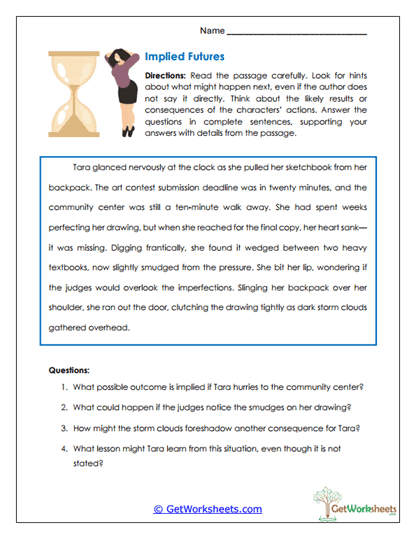
Implied Futures asks readers to anticipate possible consequences as Tara races to submit her artwork before a contest deadline. Her limited time, a smudged drawing, and approaching storm clouds provide clues that something unexpected might happen. Through four open-ended questions, students predict whether Tara will reach the contest, consider how imperfections might affect the judging, and interpret the significance of the changing weather. A final question encourages reflection on lessons Tara might learn from her experience. The activity reinforces foreshadowing recognition, evidence-based prediction, cause-and-effect reasoning, and the ability to infer possible outcomes from developing narrative circumstances.
Lessons from Jonah
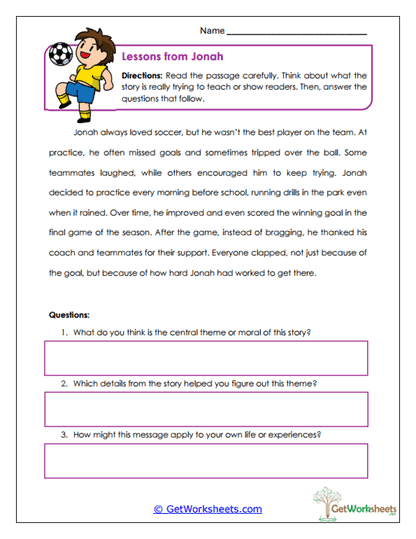
Lessons from Jonah helps students identify an implied theme through a story about a young soccer player who improves through dedication, regular practice, and perseverance. Rather than being told the story's moral directly, learners analyze Jonah's experiences and determine what his actions and personal growth reveal about effort and success. Three written questions guide students to identify the central message, select supporting story details, and explain how the lesson might apply to their own lives. The exercise strengthens thematic inference, character development analysis, textual evidence selection, and meaningful personal reflection.
Maya's Choice
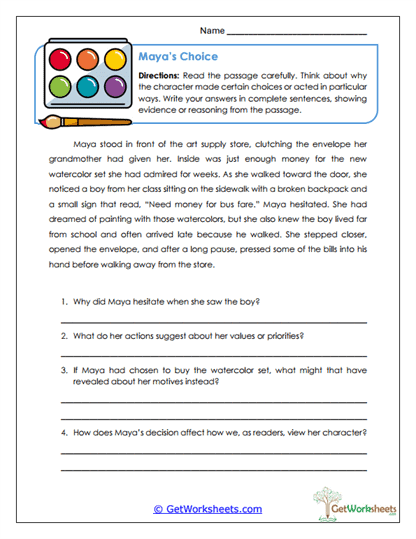
Maya's Choice presents a character with a difficult decision between purchasing a watercolor set she has wanted for months and helping a boy who needs money for bus fare. Four open-ended questions encourage learners to interpret Maya's hesitation, examine the values reflected in her decision, and consider how an alternative choice might change their understanding of her character. The story creates opportunities to explore compassion, personal priorities, and the relationship between actions and underlying motivations. Through evidence-based character analysis, students strengthen their ability to infer beliefs and emotions that are not explicitly explained while developing thoughtful interpretations of narrative decisions.
Reading Relationships
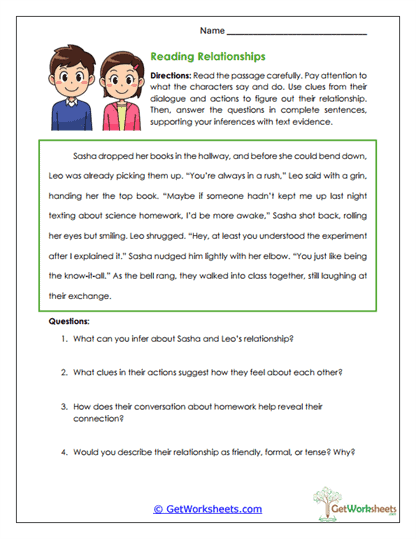
Reading Relationships introduces character inference through a conversation between Sasha and Leo in a school hallway. Their playful teasing, helpful gestures, and references to shared experiences provide subtle clues about the nature of their connection. Students answer four questions requiring them to examine dialogue, interpret nonverbal behavior, and identify evidence suggesting how the characters feel about one another. The activity demonstrates how authors reveal relationships through interactions rather than direct descriptions, building skills in dialogue analysis, emotional inference, and evidence-supported interpretation.
Secrets in Speech
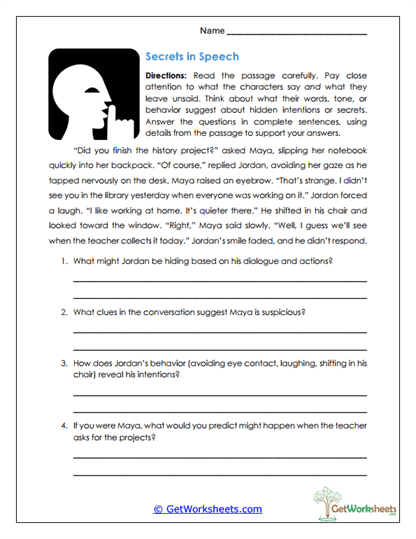
Secrets in Speech examines how dialogue and body language can suggest hidden intentions within a conversation about a school history project. When Maya questions Jordan about his work, his nervous gestures, uncertain answers, and attempts to redirect the discussion create an atmosphere of suspicion. Four inferential questions encourage learners to consider what Jordan might be concealing, identify the clues behind Maya's doubts, and predict what could happen when the teacher collects the projects. Students must distinguish reasonable interpretations from confirmed facts while using specific narrative details to support their conclusions. This activity reinforces nonverbal communication analysis, character motivation inference, critical reading, and the interpretation of meaning beneath spoken words.
Unspoken Rivalry
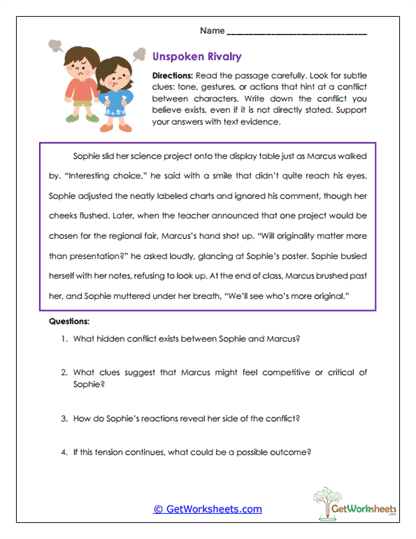
Unspoken Rivalry develops students' ability to recognize conflict that characters do not openly acknowledge. During preparations for a science competition, Sophie and Marcus exchange seemingly polite comments that reveal possible jealousy, competitiveness, and emotional tension. Four questions direct learners to examine their dialogue, facial expressions, and reactions before predicting how the rivalry might develop. The activity strengthens inferential comprehension, character analysis, conflict recognition, and the interpretation of subtle emotional cues. By investigating what characters communicate indirectly, students gain experience analyzing interpersonal relationships and the development of narrative tension.
Values in Contrast
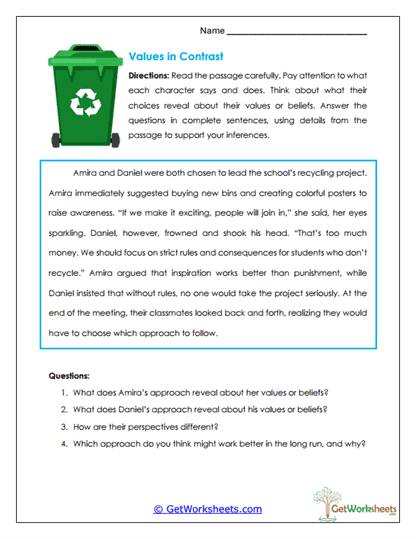
Values in Contrast explores how different beliefs and priorities influence characters working toward a shared goal. In a story about improving a school recycling program, Amira favors colorful posters and encouraging participation, while Daniel emphasizes rules, accountability, and practical concerns. Learners answer four questions that require them to infer each character's values, explain their disagreement, and consider which approach might be more effective over time. Comparing these perspectives develops character motivation analysis, evidence-based interpretation, and an understanding of how dialogue and proposed actions reveal underlying beliefs. The final evaluation also encourages students to consider multiple viewpoints and support their own conclusions with logical reasoning.
Bookmark Us Now!
New, high-quality worksheets are added every week! Do not miss out!