Differentiating Question Types Worksheets
About This Worksheet Collection
Differentiating question types is an essential reading comprehension skill that helps students recognize how different questions require different levels of understanding and reasoning. Literal questions ask readers to identify information directly stated in a passage, while inferential questions require them to examine textual clues, connect details, and draw logical conclusions about ideas that may not be explicitly explained. Evaluative questions extend comprehension further by encouraging readers to form opinions, make judgments, and develop thoughtful interpretations supported by the text or personal connections. Understanding these distinctions helps students become more purposeful readers who can recognize what a question is asking, select appropriate response strategies, and explain their thinking clearly. Learning to distinguish among literal, inferential, and evaluative questions also provides a foundation for deeper literary analysis, evidence-based discussions, and higher-level critical thinking across academic subjects.
This collection of Differentiating Question Types Worksheets provides a variety of reading passages and activities designed to help learners identify, analyze, create, and answer different types of comprehension questions. Students explore narratives about gardening, athletic competitions, community celebrations, historical landmarks, nature, and personal achievements while practicing skills that move beyond basic factual recall. Activities include color-coding questions by category, classifying prompts without answering them, identifying supporting textual evidence, matching sample answers to question types, and transforming literal questions into inferential and evaluative ones. Other exercises invite students to write their own comprehension questions, evaluate characters' decisions, defend personal opinions, and participate in collaborative question-writing stations. These varied approaches make the collection useful for classroom reading lessons, small-group instruction, literacy centers, independent practice, homeschooling, tutoring, and comprehension assessments.
Working through these activities strengthens close reading, textual evidence identification, inferential reasoning, critical interpretation, question formulation, and written communication. Students learn to distinguish between explicitly stated facts and implied meanings while recognizing when a question calls for personal judgment rather than a single factual answer. Creating and classifying questions also develops metacognitive awareness, helping learners understand the thinking processes involved in different reading tasks and become more independent when approaching unfamiliar passages. Opportunities to explain conclusions, support opinions, and discuss alternative interpretations encourage evidence-based reasoning, perspective-taking, and thoughtful academic communication. By practicing literal, inferential, and evaluative comprehension in different contexts, learners build the analytical skills needed for increasingly complex reading assignments, literary discussions, informational text analysis, and meaningful engagement with written material.
Detailed Descriptions Of These Worksheets
Color-Coded Questions
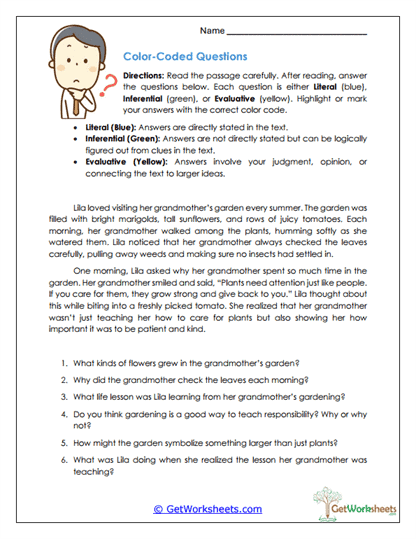
Color-Coded Questions introduces three levels of reading comprehension through a narrative about Lila visiting her grandmother's garden and discovering lessons about patience, kindness, and responsibility. After reading the passage, students answer six questions and identify each as Literal, Inferential, or Evaluative using a designated color-coding system. Blue represents questions answered directly from the text, green identifies questions requiring logical conclusions, and yellow marks prompts involving opinions or personal judgments. The visual approach helps learners recognize different comprehension demands while strengthening close reading, textual interpretation, and thoughtful response development.
Evaluation Debate
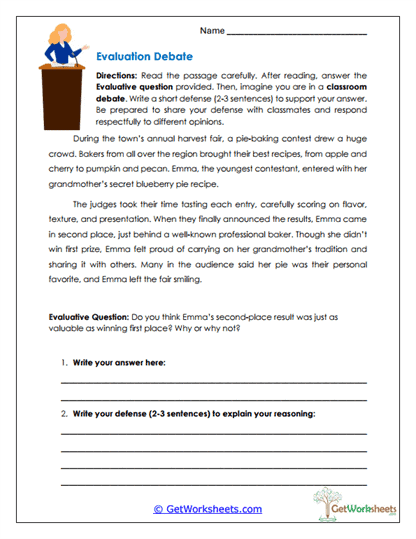
Evaluation Debate encourages students to examine the meaning of achievement through a story about Emma entering her grandmother's blueberry pie recipe in a community baking competition. Although Emma finishes in second place, her experience leads to meaningful connections with family traditions and the people around her. Learners respond to an evaluative question asking whether her second-place result was as valuable as winning first place, then write a short defense explaining their position. The activity also prepares students to participate in a classroom debate where they share opinions and respectfully consider alternative viewpoints. By combining literary interpretation with supported argumentation, the exercise strengthens critical thinking, opinion writing, and evidence-based communication.
Literal or Infer
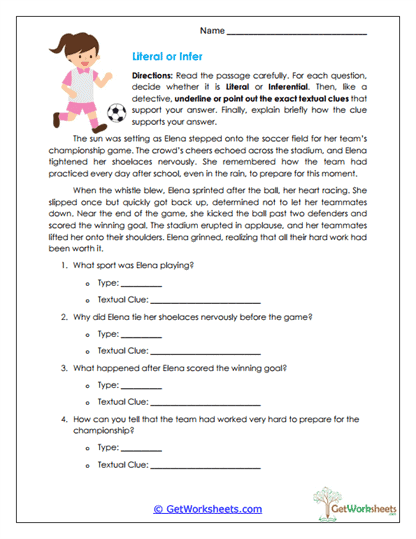
Distinguishing between directly stated facts and reasonable conclusions is the focus of Literal or Infer, which features a story about Elena competing in a soccer championship. Students examine four comprehension questions, determine whether each is Literal or Inferential, and identify textual clues that support their responses. Questions address details about the game alongside ideas involving Elena's nervousness, preparation, and the team's determination. Requiring students to classify each question and locate supporting evidence reinforces careful reading, logical inference, and the importance of grounding interpretations in the passage.
Literal to Evaluative
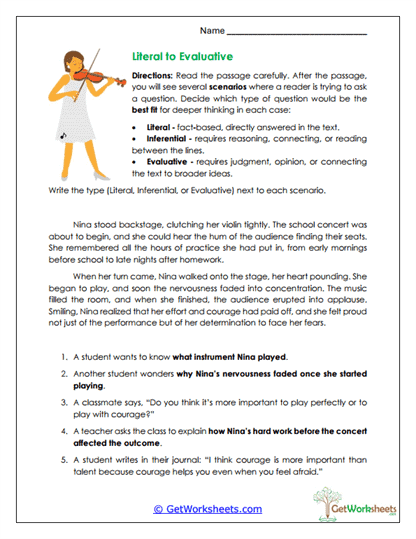
Literal to Evaluative explores how different comprehension questions encourage readers to examine the same story in different ways. After reading about Nina overcoming nervousness during a school violin concert, learners classify five scenarios as Literal, Inferential, or Evaluative based on whether they require factual information, interpretation, or personal judgment. The activity strengthens question analysis, textual reasoning, and critical thinking while helping students recognize the differences between identifying events, explaining emotions, and expressing supported opinions.
Make It, Solve It
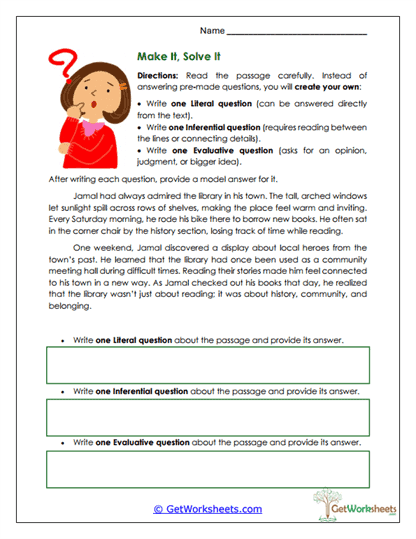
Make It, Solve It places students in the role of question creators as they explore a narrative about Jamal discovering the historical significance of his town's library. Rather than answering a prepared set of comprehension questions, learners develop one Literal, one Inferential, and one Evaluative question about the passage. They then provide an appropriate answer for each question, demonstrating their understanding of the different levels of reasoning involved. The story's themes of community, history, and belonging provide meaningful opportunities for factual questioning, interpretation, and personal reflection. This question-writing approach promotes active reading, analytical thinking, and greater independence in understanding how comprehension questions are constructed.
Match The Question
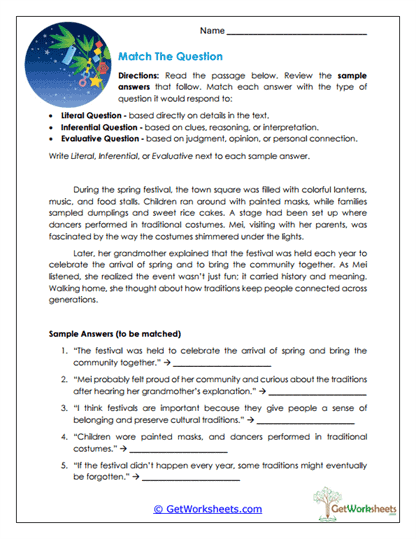
Match The Question approaches reading comprehension from the perspective of the answer rather than the question. Following a passage about a spring festival filled with cultural traditions, family activities, and community celebrations, learners examine five sample answers and determine whether each corresponds to a Literal, Inferential, or Evaluative question. The examples include directly stated events, conclusions about characters' feelings, opinions concerning traditions, and possible future outcomes. By analyzing the reasoning reflected in each response, students develop a stronger understanding of factual evidence, implied meaning, and personal evaluation within reading comprehension.
Question Classifier
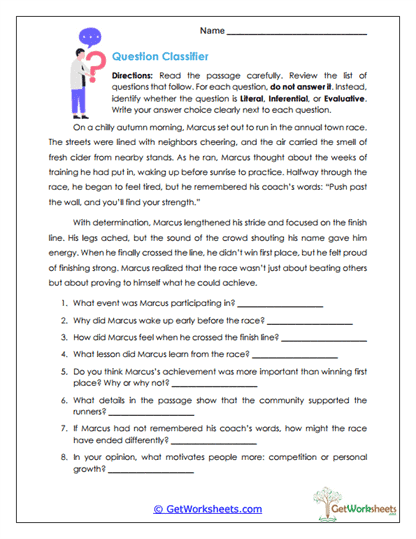
Question Classifier challenges learners to identify different comprehension levels without actually answering the questions presented. Using a narrative about Marcus participating in a community running race, students review eight prompts and classify each as Literal, Inferential, or Evaluative according to the thinking it requires. This focused activity develops question analysis, recognition of textual evidence, inferential reasoning, and evaluative judgment while helping readers understand how question wording signals different expectations.
Question Levels
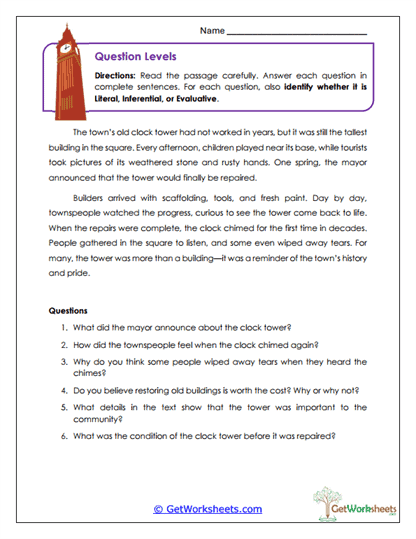
Question Levels combines question classification with written comprehension through a passage about a town restoring its historic clock tower. The story describes the building's deteriorating condition, the community's restoration efforts, and the emotional response when its chimes ring again. Students answer six questions in complete sentences while identifying whether each is Literal, Inferential, or Evaluative. Some prompts require straightforward facts about the restoration, while others ask readers to interpret community reactions or express opinions about preserving historic landmarks. The combined format reinforces accurate information retrieval, deeper textual interpretation, and supported personal judgment while encouraging thoughtful responses to questions at different comprehension levels.
Question Slips
Question Slips invites students to create their own comprehension questions after reading a narrative about Carlos observing the night sky and becoming fascinated with astronomy. His experience with a telescope, a meteor, and scientific reading provides the context for developing one Literal, one Inferential, and one Evaluative question. Learners write an original question for each category and provide an answer that demonstrates factual understanding, logical interpretation, or personal judgment. The student-directed format strengthens question construction, close reading, evidence-based reasoning, and written communication while encouraging curiosity and thoughtful engagement with the passage.
Question Stations
Question Stations transforms reading comprehension into a collaborative activity centered on a narrative about Leila training for and completing a city marathon. After reading about her perseverance and personal achievement, students work in groups and rotate among three stations dedicated to Literal, Inferential, and Evaluative question writing. Each group develops questions based on the passage and later responds to questions created by classmates. The station structure encourages learners to apply different reasoning strategies while discussing textual details, implied meanings, and broader judgments about the story. Through cooperative question creation and response, students strengthen analytical reading, communication, teamwork, and their understanding of the different levels of comprehension.
Rewrite & Rethink
Rewrite & Rethink teaches students how to transform a straightforward factual question into prompts that require deeper reading and interpretation. Using a story about Maya's summer experiences on her uncle's farm, learners begin with a provided Literal question, rewrite it as an Inferential question and an Evaluative question, and then answer all three. The activity develops question formulation, textual analysis, inferential thinking, and supported personal reflection while demonstrating how changing a question can encourage readers to explore different meanings within the same passage.
Thinking Tiers
Thinking Tiers organizes reading comprehension into three levels through two passages featuring a thunderstorm experience and a community beach cleanup. Each passage is followed by one Literal, one Inferential, and one Evaluative question, allowing students to practice retrieving factual information, interpreting clues, and developing thoughtful personal responses. Questions explore topics such as an animal's reaction to stormy weather, the effects of environmental cleanup efforts, and opinions about community responsibility. The consistent three-tier structure helps learners recognize how different questions approach the same text while strengthening reading analysis, logical reasoning, and written comprehension.
Bookmark Us Now!
New, high-quality worksheets are added every week! Do not miss out!