Library Choices
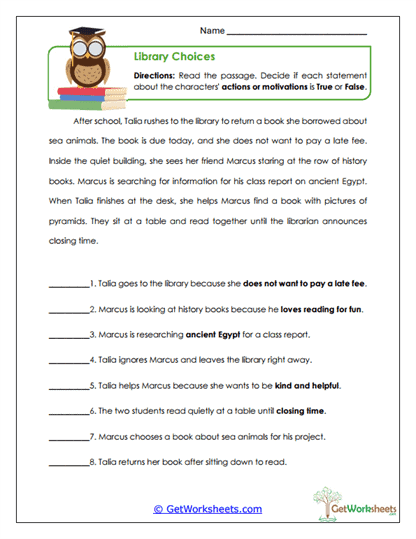
Library Choices develops students’ ability to evaluate character actions and motivations through a reading comprehension passage about two friends spending time at their local library. After reading about Talia returning an overdue-risk book and helping Marcus research ancient Egypt for a class report, learners examine eight statements and determine whether each is True or False. The activity reinforces literal comprehension, character motivation analysis, factual verification, textual evidence identification, inferential reasoning, and close reading while encouraging students to distinguish between actions directly described in the story and motivations suggested by those actions. By examining the characters’ decisions, interactions, and reasons for visiting the library, students develop a stronger understanding of how narrative details reveal both what characters do and why they may choose to do it.
Learning Goals
- Character Action Recognition: Identify what Talia and Marcus actually do throughout the story, including returning a book, researching a topic, and reading together.
- Motivation Analysis: Interpret the reasons behind character decisions using information directly stated in the passage or reasonably implied by their behavior.
- True or False Classification: Evaluate eight statements and determine whether each accurately reflects the characters’ actions, experiences, or motivations.
- Textual Evidence Verification: Compare statements with narrative details to distinguish supported interpretations from incorrect or unsupported claims.
Teaching Advantages
- Eight Character-Focused Statements: Questions encourage learners to examine both observable actions and the reasons behind character behavior.
- Familiar Library Setting: The narrative provides a relatable context involving borrowed books, school research, friendship, and cooperation.
- Combination of Literal and Inferential Thinking: Students practice recognizing directly stated information while interpreting reasonable motivations.
- Simple Response Format: Clearly numbered True or False statements support focused comprehension practice.
- Flexible Instructional Applications: Suitable for guided reading, independent assignments, small-group discussions, and literacy assessments.
Library Choices strengthens students’ ability to evaluate written statements by examining character behavior and the evidence supporting different interpretations. Through close reading, factual comparison, motivation inference, textual evidence recognition, and statement verification, learners develop a more complete understanding of narrative comprehension. Teachers can use the activity to demonstrate how some character motivations are directly explained, while others must be inferred from actions and circumstances. The story also creates opportunities to discuss cooperation, helpfulness, and the importance of understanding why characters make particular decisions. These skills prepare learners for more advanced reading comprehension tasks involving character development, inferential reasoning, and evidence-based literary analysis.
Bookmark Us Now!
New, high-quality worksheets are added every week! Do not miss out!