Trail Of Reason
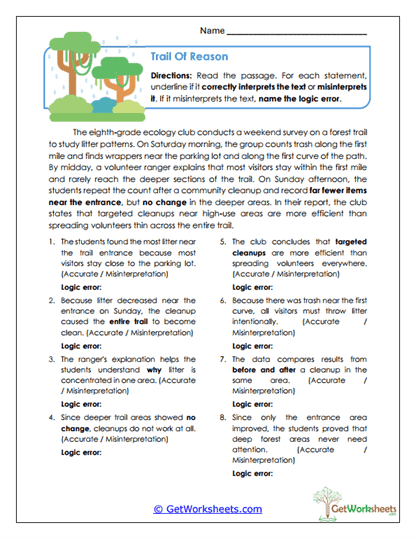
Trail Of Reason challenges students to evaluate the accuracy of interpretations drawn from an informational passage about an eighth-grade ecology club investigating litter patterns along a forest trail. After reading about the students’ observations, a ranger’s explanation of visitor activity, and the results of a community cleanup, learners examine eight statements and determine whether each accurately interprets the text or misrepresents its findings. The exercise strengthens critical reading, logical reasoning, textual evidence evaluation, cause-and-effect analysis, inference verification, and error identification while requiring students to name the reasoning mistake when a statement is misleading. By comparing the ecology club’s actual findings with conclusions that may exaggerate or distort the evidence, students develop a stronger understanding of how to evaluate claims and avoid unsupported assumptions.
Instructional Objectives
- Accurate Interpretation Recognition: Identify statements that correctly represent the ecology club’s observations, the ranger’s explanation, and the conclusions drawn from the cleanup.
- Logical Error Identification: Recognize misleading interpretations involving overgeneralization, unsupported assumptions, or conclusions extending beyond the available evidence.
- Evidence-Based Reasoning: Compare each statement with details about litter distribution, visitor activity, and changes observed after the cleanup.
- Cause-and-Effect Evaluation: Distinguish reasonable connections supported by the passage from claims that incorrectly assign causes or exaggerate the significance of individual observations.
Instructional Benefits
- Eight Analytical Statements: Each exercise requires students to evaluate whether an interpretation accurately reflects the passage’s information.
- Logical Error Explanation: Learners identify the reasoning problem in statements that misinterpret the text, extending the activity beyond simple answer selection.
- Environmental Research Context: The forest trail investigation provides a meaningful setting involving ecology, community responsibility, and data collection.
- Higher-Order Reading Practice: Students examine how conclusions are supported, limited, or contradicted by observations.
- Flexible Classroom Applications: Useful for critical reading lessons, small-group discussions, independent practice, and assessments of analytical reasoning.
Trail Of Reason encourages students to evaluate not only whether information appears in a passage but also whether conclusions drawn from that information are logically justified. Through textual interpretation, evidence evaluation, cause-and-effect reasoning, inference analysis, and logical error recognition, learners develop a more sophisticated approach to reading comprehension. Teachers can use the activity to demonstrate why improvement in one section of a trail does not automatically prove that the entire trail has become clean or that other areas will never require attention. The requirement to name reasoning errors also helps students explain why certain conclusions are misleading rather than simply identifying them as inaccurate. These analytical skills support more advanced critical reading, argumentative writing, informational text evaluation, and the ability to recognize flawed reasoning in academic and everyday communication.
Bookmark Us Now!
New, high-quality worksheets are added every week! Do not miss out!