Lighthouse Proof
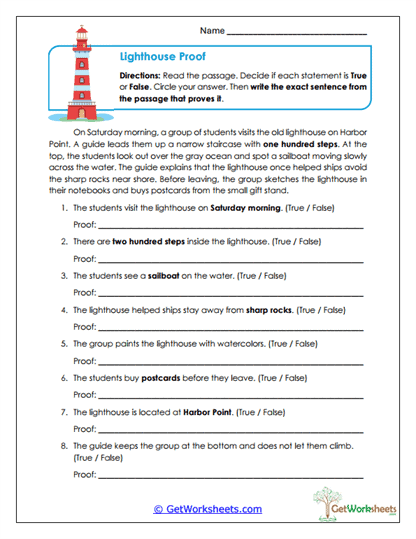
Lighthouse Proof develops students’ ability to evaluate factual statements and justify their decisions using exact sentences from a reading passage. Through a narrative about a group of students visiting a historic lighthouse at Harbor Point, learners examine eight statements, determine whether each is True or False, and copy the sentence from the passage that supports their conclusion. The activity reinforces literal comprehension, textual evidence identification, factual comparison, close reading, quotation accuracy, and evidence-based reasoning while encouraging students to connect their answers with information explicitly provided in the story. By examining details about the lighthouse’s staircase, the surrounding harbor, its historical purpose, and the group’s visit, students practice locating reliable evidence and explaining the accuracy of written claims.
Key Learning Objectives
- True or False Evaluation: Determine whether each of the eight statements accurately reflects the information presented in the lighthouse passage.
- Exact Textual Evidence: Locate and reproduce sentences from the reading that support a factual claim or provide information contradicting an incorrect statement.
- Reading Detail Recognition: Identify specific facts involving the lighthouse’s location, staircase, nearby rocks, visiting students, and activities during the tour.
- Evidence-Based Justification: Strengthen the relationship between a comprehension answer and the supporting information found in its source text.
Educational Value
- Eight Evidence-Based Questions: Each statement requires students to make a comprehension decision and provide supporting proof.
- Historic Landmark Setting: The lighthouse visit introduces an engaging context involving navigation, maritime safety, and local history.
- Dedicated Proof Lines: Separate writing spaces encourage learners to identify relevant sentences and record them accurately.
- Close Reading Reinforcement: Claims involving numbers, locations, activities, and descriptive details require careful examination of the passage.
- Classroom Assessment Opportunities: Teachers can evaluate both the accuracy of students’ True or False selections and their ability to locate supporting evidence.
Lighthouse Proof moves beyond basic statement classification by requiring students to demonstrate how their answers connect to the reading. Through textual evidence selection, factual verification, sentence identification, information retrieval, and close reading, learners develop stronger habits of supporting conclusions with specific source material. Teachers can use the activity to discuss why an answer should be grounded in the passage rather than based on what a reader assumes might have happened. The exact-sentence requirement also reinforces careful copying, attention to wording, and the importance of distinguishing supported information from unsupported claims. These skills prepare students for more advanced comprehension activities involving written justification, textual citations, evidence-based explanations, and the critical evaluation of information.
Bookmark Us Now!
New, high-quality worksheets are added every week! Do not miss out!