Garden Watch
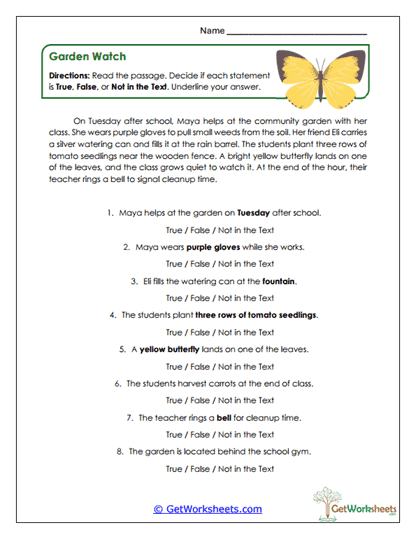
Garden Watch develops students’ ability to distinguish between information that is true, false, or not mentioned in a reading passage through a short narrative about a school gardening activity. After reading about Maya and her classmates planting tomato seedlings, watering the garden, and observing a butterfly, learners evaluate eight statements and classify each as True, False, or Not in the Text. The exercise strengthens literal comprehension, factual verification, textual evidence recognition, close reading, information comparison, and critical reasoning while encouraging students to recognize the difference between incorrect information and details that are simply unstated. By examining specific events, character actions, and descriptive details, learners develop a more precise understanding of how to evaluate statements using information found in a text.
Learning Goals
- True Statement Identification: Recognize claims that accurately reflect information explicitly stated in the passage, including the students’ gardening activities and observations.
- False Statement Recognition: Identify statements that contradict details in the story, such as incorrect descriptions of how gardening tasks were completed.
- Unstated Information Classification: Distinguish statements that introduce details the passage neither confirms nor contradicts, reinforcing the difference between unsupported and inaccurate claims.
- Textual Evidence Verification: Return to the passage to determine whether each statement is supported, contradicted, or not addressed by the available information.
Teaching Advantages
- Three-Choice Classification Format: True, False, and Not in the Text options introduce a more advanced comprehension challenge than traditional two-choice activities.
- Eight Reading Statements: A variety of claims encourages students to examine actions, objects, descriptive details, and events carefully.
- Engaging Garden Narrative: The school gardening activity provides a familiar context involving plants, classroom cooperation, and nature observations.
- Evidence-Based Reading Practice: Learners must avoid assuming that an unstated detail is automatically false.
- Flexible Instructional Applications: Suitable for guided reading, independent assignments, literacy centers, homework, and reading comprehension assessments.
Garden Watch strengthens reading comprehension by requiring learners to evaluate what a passage states, what it contradicts, and what it leaves unexplained. Through factual identification, textual comparison, evidence recognition, information classification, and critical reading, students develop greater accuracy when interpreting written statements. Teachers can use the exercise to demonstrate why a claim about an unmentioned location or activity should be treated differently from a statement directly contradicted by the story. The three-category format also encourages students to rely on textual evidence rather than personal assumptions or outside knowledge. These skills provide a foundation for more advanced reading comprehension tasks involving source evaluation, factual reasoning, and the careful interpretation of informational and narrative texts.
Bookmark Us Now!
New, high-quality worksheets are added every week! Do not miss out!