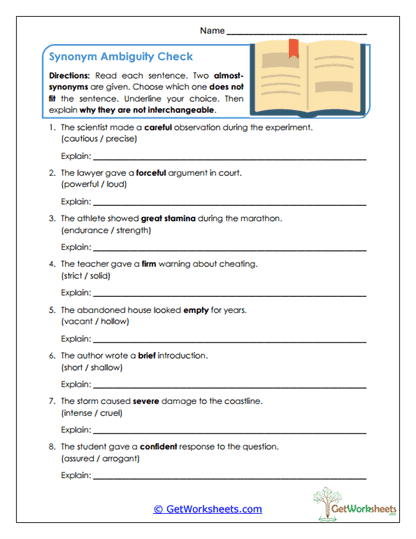
Synonym Ambiguity Check
Some vocabulary words seem almost identical at first glance, but careful readers know that small meaning differences can completely change how a sentence sounds. This worksheet asks students to examine pairs of near-synonyms, decide which word fits the sentence best, and explain why the other option does not work as well in that context. Learners must think deeply about connotation, precision, tone, and subtle meaning differences instead of relying on simple dictionary definitions. Ideal for grades 5-7, this activity strengthens analytical vocabulary skills, comprehension, reasoning, and advanced language understanding in a highly thoughtful format.
Key Learning Objectives
- Near-Synonym Analysis – Students compare words with similar meanings but different usage or tone.
- Contextual Reasoning – Learners determine which vocabulary word best fits the sentence situation.
- Connotation Awareness – Children explore how emotional tone affects word choice.
- Critical Language Thinking – Students explain why certain words are not fully interchangeable.
Classroom & Home Use
- Supports Higher-Level Vocabulary Growth – Encourages deeper understanding of nuanced language.
- Excellent for Literary Discussion – Helps students analyze author word choice more thoughtfully.
- Strengthens Writing Precision – Students become more intentional about vocabulary usage.
- Useful for Advanced Readers and Writers – Great enrichment activity for upper elementary learners.
- Encourages Evidence-Based Thinking – Students justify answers using reasoning and context clues.
This worksheet helps students move beyond memorizing synonyms and into truly understanding how language works. As learners compare near-synonyms, they strengthen analytical thinking, vocabulary precision, comprehension, and inferencing skills while recognizing that even similar words can create very different meanings or impressions. The explanation component is especially valuable because it forces students to think carefully about why one word fits better than another. Teachers often appreciate this type of activity because it prepares students for deeper literary analysis and more sophisticated writing. It is an outstanding resource for helping learners become more careful, accurate, and intentional language users.
Bookmark Us Now!
New, high-quality worksheets are added every week! Do not miss out!