Identifying Fractions on a Number Line Worksheets
-
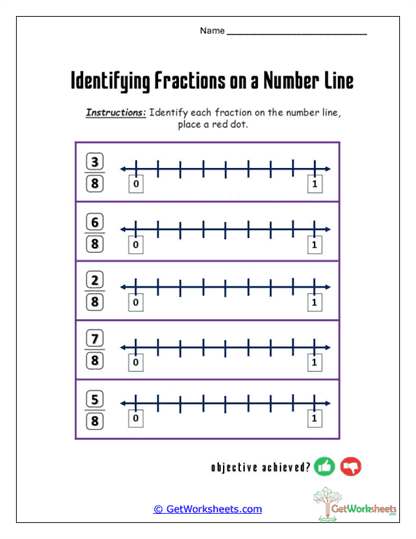
Eighths on the Number Line
-
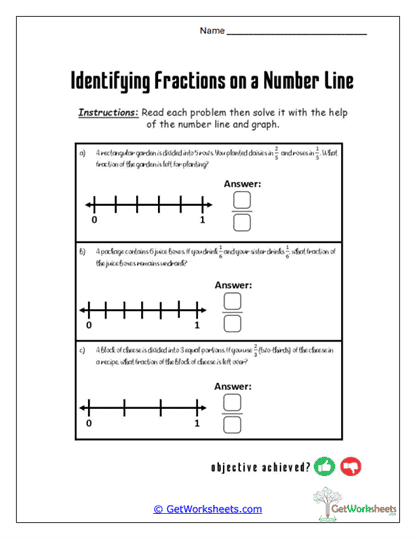
Everyday Fraction Lines
-
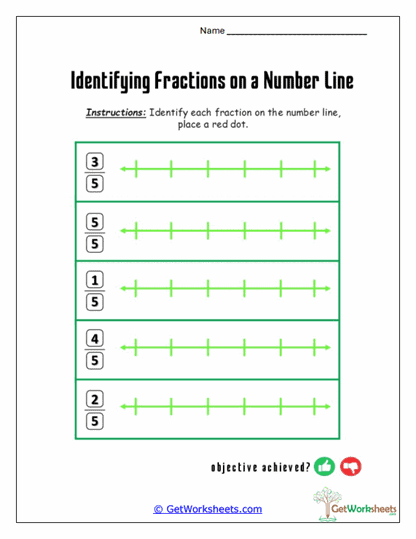
Fifths Number Line Practice
-
-
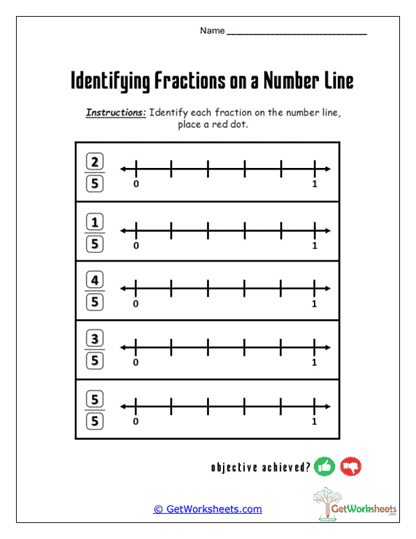
Fifths on the Number Line
-
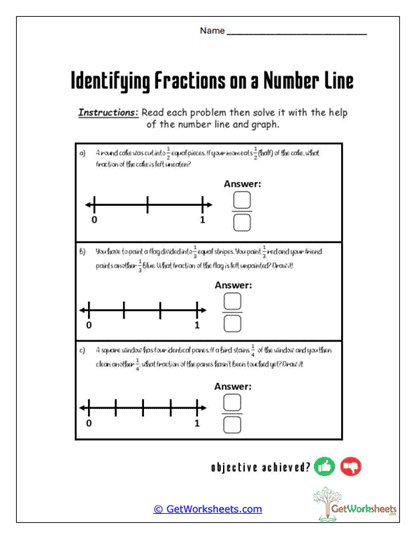
Flag Fraction Lines
-
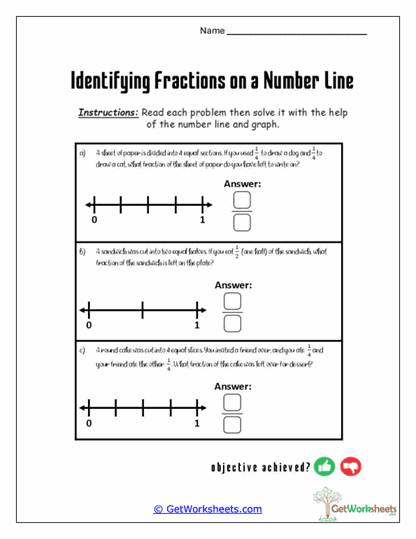
Fraction Leftovers
-
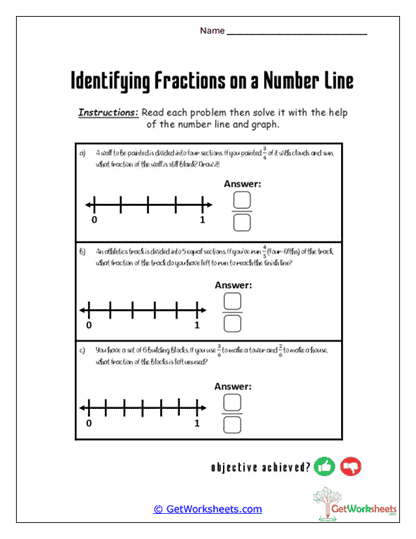
Fraction Situations
-
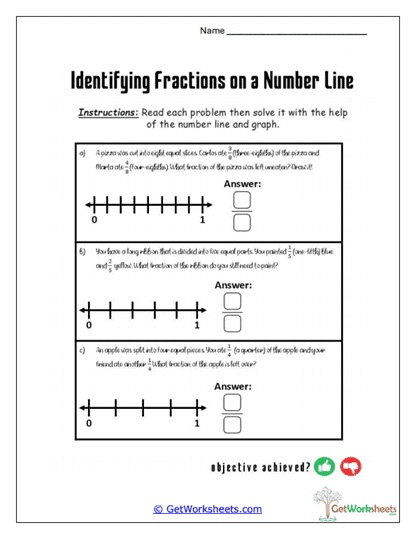
Fraction Story Lines
-
Geometric Fraction Lines
-
Mixed Fraction Shapes
-
Ninths on the Number Line
-
Shape Fraction Path
-
Sixths on the Number Line
-
Swirl Fraction Lines
-
Watermelon Fractions
About This Worksheet Collection
Identifying fractions on a number line helps students understand that fractions are numbers with exact positions between whole-number values. To locate a fraction correctly, learners must divide the distance from zero to one into equal intervals based on the denominator and then count the number of intervals named by the numerator. This process strengthens fraction magnitude and helps children connect visual models, written notation, and numerical location.
This collection gives students varied practice through shaded shapes, geometric models, familiar pictures, word problems, fraction families, and number lines divided into fifths, sixths, eighths, and ninths. Some worksheets ask learners to translate a picture into a fraction before plotting it, while others focus on locating fractions directly or determining used and remaining portions in real-world situations. The pages can be used during whole-class lessons, guided math, centers, intervention, tutoring, homework, independent review, or homeschool instruction.
As students work through the collection, they develop stronger numerator and denominator understanding, equal-part reasoning, number-line fluency, visual discrimination, fraction comparison, and word-problem comprehension. They also practice identifying complements, counting intervals accurately, recognizing one whole, and explaining how fraction size relates to position. These skills prepare learners for ordering fractions, comparing values, working with equivalent fractions, measuring with fractional units, and solving more advanced fraction problems.
Detailed Descriptions Of These Worksheets
Eighths on the Number Line
Number lines divided into eight equal intervals give learners focused practice locating fractions with smaller parts. Children count from zero to plot values such as two-eighths, five-eighths, and seven-eighths at their exact positions. Because every denominator is the same, students can concentrate on how the numerator affects the distance traveled along the line. The activity also supports future work with rulers, recipes, and measurements that commonly use eighths.
Everyday Fraction Lines
Real-world situations involving a garden, juice, and a recipe ask students to determine how much of a whole was used or remains. Learners translate each story into fraction notation and then represent the answer on a number line. Careful reading is important because some questions require the stated amount, while others ask for its complement. This multi-step format connects practical reasoning with visual fraction placement.
Fifths Number Line Practice
The full sequence from one-fifth through five-fifths appears across clearly partitioned number lines. Students count equal jumps from zero and place each fraction at its proper location. Seeing the complete family of fifths helps learners recognize how each additional part moves the value closer to one whole. The page is especially useful for building comparison and ordering skills with like denominators.
Fifths on the Number Line
Five separate number lines reinforce how fractions with a denominator of five are located. Learners divide the space from zero to one into equal fifths and use the numerator to determine the number of jumps. Including five-fifths helps children recognize that a fraction can equal one complete whole. Repeated plotting develops accuracy and reduces the common mistake of counting tick marks instead of intervals.
Flag Fraction Lines
Short stories involving a flag, a log, and window panes challenge students to identify the fraction being described. Children decide whether the problem asks for a completed portion or the amount still remaining, then plot the answer between zero and one. The number line offers a visual check on whether the fraction's size makes sense. This activity brings reading comprehension and mathematical modeling together in an accessible format.
Fraction Leftovers
Problems about paper, sandwiches, and cereal focus on finding the portion that remains after some of the whole has been used. Students identify the given fraction, determine its complement, and mark the remaining amount on a number line. The familiar settings make the meaning of the fractions easier to visualize. This page is particularly helpful for teaching that used and unused parts must combine to make one whole.
Fraction Situations
A painted wall, a partly completed book, and fabric used for a project provide the settings for these fraction problems. Learners must determine whether to use the fraction stated in the story or subtract it from one whole. After writing the correct value, they place it on the matching number line. The worksheet encourages careful reading and reinforces complementary fraction relationships.
Fraction Story Lines
Three story problems ask children to represent fractions involving pizza, ribbon, and apples. Students identify the complete whole, determine the amount used or left, and then show the result visually. Plotting the answer helps learners connect written situations with precise numerical positions. The activity supports both fraction subtraction and mathematical explanation.
Geometric Fraction Lines
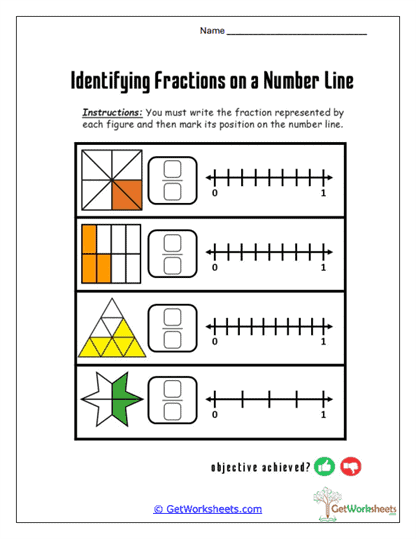
Squares, grids, a triangle, and a star provide varied models for identifying shaded fractions. Children count the total number of equal parts, determine how many are shaded, and write the corresponding fraction before plotting it. The different shapes demonstrate that fraction meaning does not depend on one familiar model. This helps students become more confident interpreting fractions in unfamiliar geometric designs.
Mixed Fraction Shapes
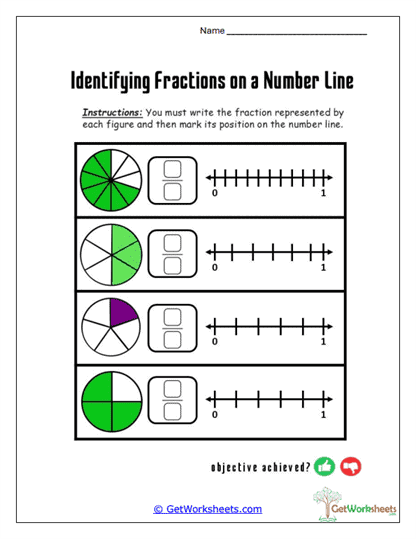
Circular models divided into different numbers of sections require learners to adjust their thinking for each denominator. Students write the shaded fraction and partition the accompanying number line into the correct number of equal intervals. The changing models prevent children from relying on a repeated visual pattern. This practice strengthens flexibility, accuracy, and fraction magnitude.
Ninths on the Number Line
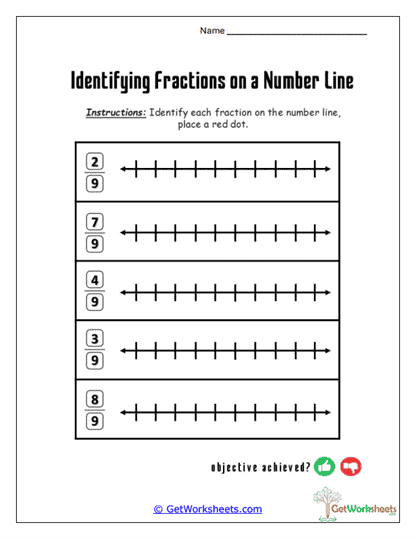
Fractions with a denominator of nine are plotted on number lines containing nine equal spaces. The narrow intervals require children to count carefully and place each point with precision. Since the denominator remains constant, learners can compare values by focusing on the numerators. The page also builds visual tracking skills needed for graphs, rulers, and other finely divided scales.
Shape Fraction Path
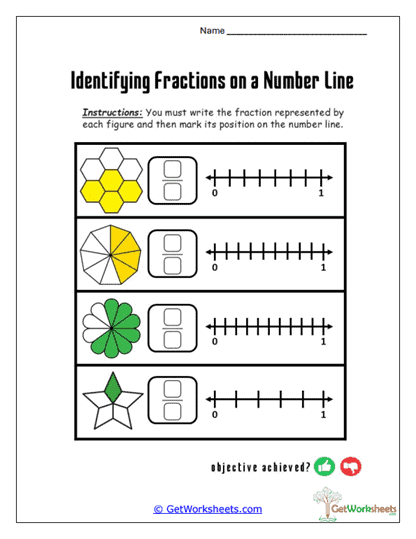
A collection of hexagons, a circle, a flower-like figure, and a star broadens students' understanding of fraction models. Learners identify the whole, count equal parts, write the shaded fraction, and transfer that value to a number line. The variety encourages close observation rather than dependence on circles or rectangles. It also strengthens the ability to move between pictures, symbols, and numerical positions.
Sixths on the Number Line
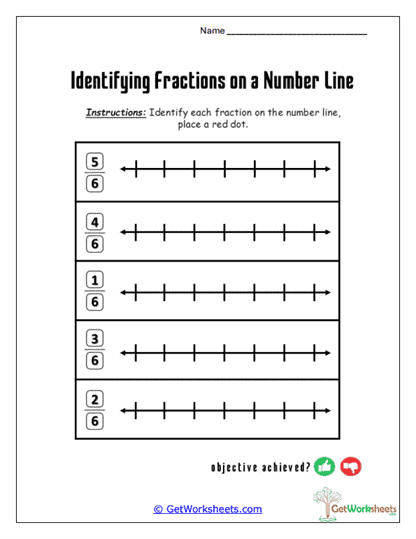
Each number line is divided into six equal spaces so students can plot one-sixth through five-sixths. Children begin at zero and use the numerator to count the necessary jumps. The repeated structure makes it easy to see that fractions with larger numerators lie farther to the right. This focused practice develops reliable habits for reading and using number lines.
Swirl Fraction Lines
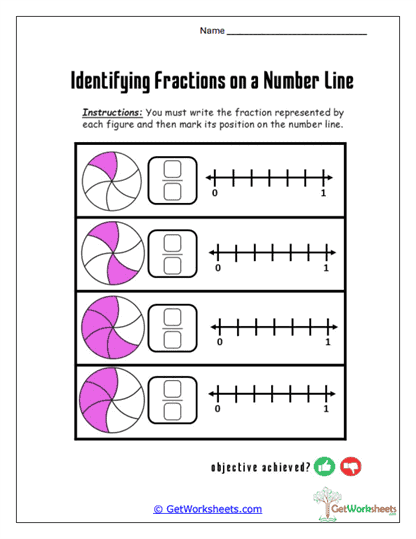
Curved, swirl-shaped models show that equal fractional parts do not always resemble standard slices or blocks. Students determine the numerator and denominator, write the fraction, and place it on a number line from zero to one. The unusual designs encourage learners to think about equal area rather than simple shape appearance. This activity strengthens visual reasoning while reinforcing fraction magnitude.
Watermelon Fractions
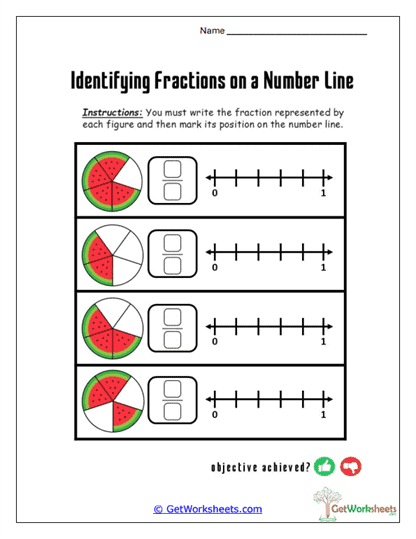
Shaded watermelon slices provide a familiar and engaging introduction to fraction placement. Children count all equal slices, identify the shaded amount, write the fraction, and mark its location on a number line. Connecting the picture with the plotted point helps learners understand that both representations show the same value. The page offers a strong transition from concrete models to more abstract number-line work.
Bookmark Us Now!
New, high-quality worksheets are added every week! Do not miss out!