Everyday Fraction Lines
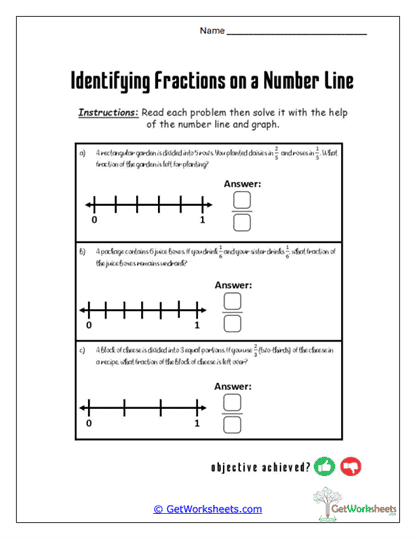
Students solve three real-world fraction problems involving a garden, a box of juice, and a cheese recipe. They identify how much of each whole was used or remains, write the fraction, and represent the answer on a number line. This elementary worksheet strengthens fraction word-problem comprehension, part-whole reasoning, number-line plotting, subtraction from one whole, equal partitioning, and mathematical explanation. It is especially appropriate for grades 3-4 because learners must move between story language, fraction notation, and a visual model.
Key Learning Objectives
- Recognize the Complete Whole: Students identify the full garden, juice box, or cheese block in each problem.
- Interpret Fraction Language: Learners understand phrases such as one-half, three-fifths, and two-thirds.
- Find a Remaining Fraction: Children determine what is left when part of the whole has already been used.
- Show the Fraction Visually: Students plot the result on a number line divided into equal intervals.
Teaching Advantages
- Uses Familiar Situations: Gardens, drinks, and recipes make fraction language easier to picture.
- Builds Multi-Step Thinking: Students read, calculate, write, and plot each answer.
- Helpful for Parent Guidance: Adults can ask, “Are we finding the part used or the part left?”
- Supports Visual Checking: The plotted point helps students see whether the result is closer to zero, one-half, or one.
- Low-Prep Practice: The page fits math groups, independent work, tutoring, homework, or homeschool instruction.
Some students focus on the numbers in a word problem but overlook what the question is actually asking. This worksheet teaches them to identify whether they need the given fraction or its remaining complement. Students practice fraction notation, reading comprehension, number-line intervals, subtraction from one whole, equal parts, and mathematical reasoning through three practical examples. Parents can help by having the child underline the fraction given and circle the words “used,” “left,” or “remaining.” In classroom and homeschool settings, this activity builds confidence and prepares learners to solve more complex fraction problems involving portions, remainders, and real-world quantities.
Bookmark Us Now!
New, high-quality worksheets are added every week! Do not miss out!