Mixed Fraction Shapes
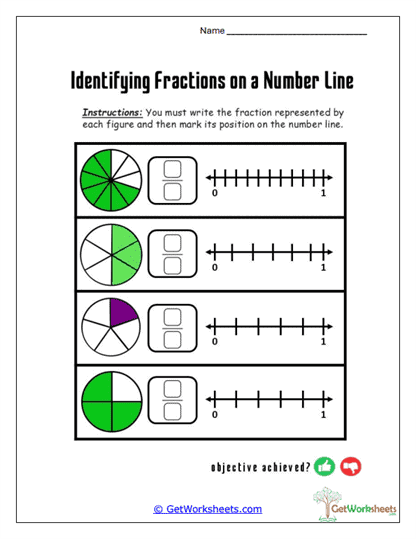
Students examine four circular fraction models divided into different numbers of equal sections, write the fraction represented by each shaded amount, and place that value on a number line from zero to one. The models include several denominators, requiring learners to adjust how they count and how they divide each number line. This elementary worksheet strengthens visual fraction recognition, numerator and denominator understanding, number-line partitioning, fraction magnitude, counting accuracy, and mathematical representation. It is well suited for grades 2-3 because students practice the same core skill across models with different-sized parts.
Key Learning Objectives
- Count Equal Sections: Students determine the total number of parts in each complete circle.
- Count Shaded Parts: Learners identify how many sections are included in the represented fraction.
- Write Correct Notation: Children place the shaded amount over the total number of equal sections.
- Partition the Number Line: Students use the denominator to understand how many equal intervals belong between zero and one.
- Plot the Fraction: Learners mark the location named by the numerator.
Teaching Advantages
- Builds Flexible Fraction Thinking: Students work with more than one denominator instead of repeating identical models.
- Shows Why Intervals Matter: The number line must be divided according to the fraction’s denominator.
- Helpful for Parent Support: Adults can ask the child to match each shaded section with one equal jump on the line.
- Encourages Careful Counting: The different circle designs prevent students from using the same answer pattern repeatedly.
- Low-Prep Practice: The worksheet fits whole-class modeling, independent work, math centers, tutoring, or homeschool instruction.
Some students assume that every fraction number line should be divided the same way. This worksheet teaches them that the denominator controls the number of equal intervals from zero to one. Learners strengthen fraction sense, visual models, number-line placement, magnitude, counting, notation, and spatial reasoning while studying four varied shapes. Parents can help by asking the child to label each interval before placing the final point. In classroom and homeschool settings, this activity builds confidence and prepares students to identify and compare fractions even when the pictures and denominators change.
Bookmark Us Now!
New, high-quality worksheets are added every week! Do not miss out!