Subtracting Fractions (Unlike Denominators) Worksheets
About This Worksheet Collection
Subtracting fractions with unlike denominators requires students to rename the fractions so they are divided into equal-sized parts before finding the difference. Learners identify a common denominator, create equivalent fractions, subtract the new numerators, and simplify the result when necessary. Understanding this process helps children see why fractions with differently sized parts cannot be subtracted directly.
This collection develops that skill through equivalent-fraction practice, common-denominator selection, structured solution tables, direct computation, matching tasks, missing-step exercises, error analysis, puzzles, written explanations, and real-world word problems. Some worksheets isolate one important part of the procedure, while others guide students through the complete subtraction process or ask them to explain why each step is needed. The pages can be used during direct instruction, guided math, centers, intervention, tutoring, homework, assessment, independent review, or homeschool lessons.
As students complete the collection, they strengthen least-common-denominator reasoning, multiplication fluency, equivalent-fraction understanding, numerator accuracy, simplification, mathematical organization, and problem-solving confidence. They also practice identifying errors, completing missing work, connecting multiple representations, explaining their reasoning, and applying fraction subtraction to practical situations. These skills prepare learners for subtracting mixed numbers, solving multi-step fraction problems, and working with more advanced rational-number operations.
Detailed Descriptions Of These Worksheets
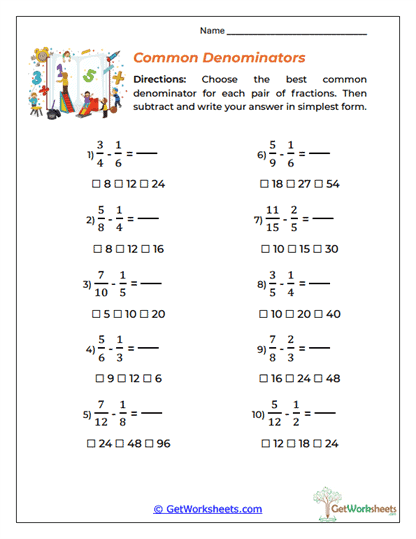
Common Denominators
Students choose an appropriate common denominator from several possibilities before completing each subtraction problem. They rename both fractions, subtract the new numerators, and reduce the difference when possible. The answer choices provide support while still requiring learners to compare multiples and select an efficient denominator. This activity strengthens the full subtraction process without leaving students to find every step completely on their own.
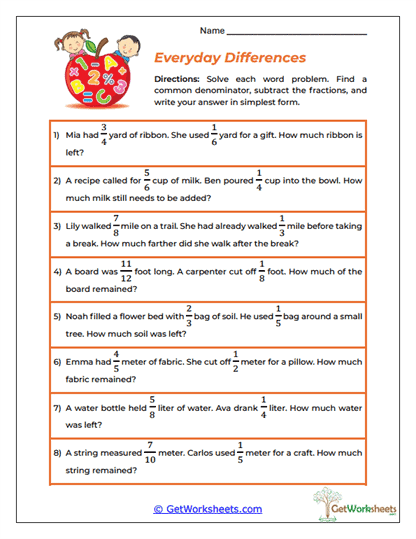
Everyday Differences
Real-life situations involving measurements, materials, liquids, and distances ask learners to determine how much remains after part of an amount is used. Students identify the starting quantity, rename the unlike fractions, subtract, and label the simplified result with the correct unit. Careful reading is necessary because the numerical work must match the meaning of the story. The page connects common-denominator reasoning with practical problem solving.
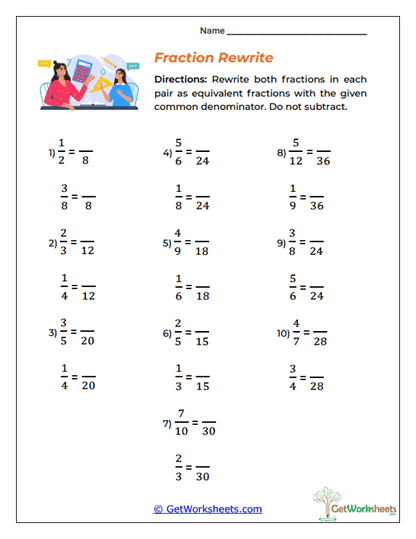
Fraction Rewrite
This worksheet focuses entirely on creating equivalent fractions with a denominator that has already been supplied. Learners identify the scale factor and apply it equally to the numerator and denominator. Removing the subtraction step allows students to concentrate on preserving fraction value during the rewrite. The repeated practice directly addresses the common mistake of changing only the denominator.
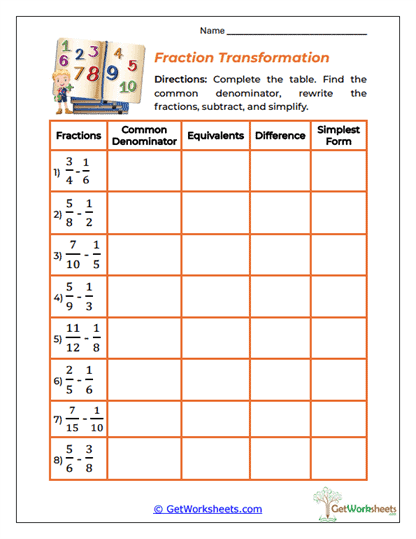
Fraction Transformation
A structured table organizes the major stages of unlike-denominator subtraction. Students record the common denominator, equivalent forms, numerical difference, and final simplified answer in separate columns. This layout makes skipped steps and calculation errors easier to identify. It is particularly helpful for learners who understand the method but need support keeping multi-step work clear and orderly.
Hidden Step
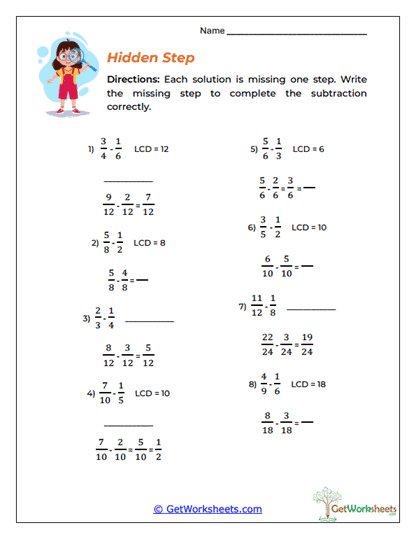
Partially completed solutions contain one missing stage that students must recognize and supply. The absent work may involve finding the least common denominator, rewriting a fraction, subtracting the numerators, or simplifying the result. Learners study what has already been completed before deciding what logically comes next. This format strengthens procedural understanding and helps children see how every part of the solution is connected.
Reason It Out
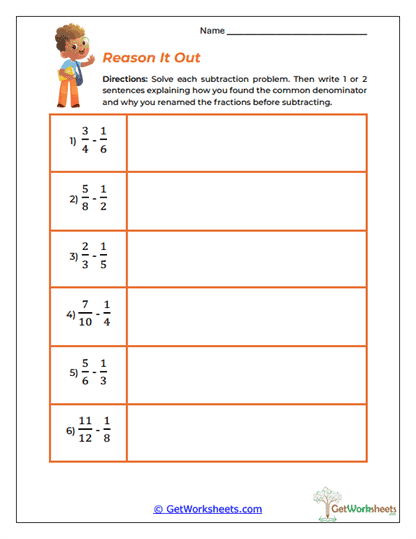
Students solve subtraction problems and then describe their reasoning in one or two complete sentences. Their explanations address how the common denominator was found and why the original fractions had to be renamed. Writing about the process reveals whether learners understand the mathematical purpose behind the steps. The activity combines computation, vocabulary, logical explanation, and fraction concepts.
Rename Match
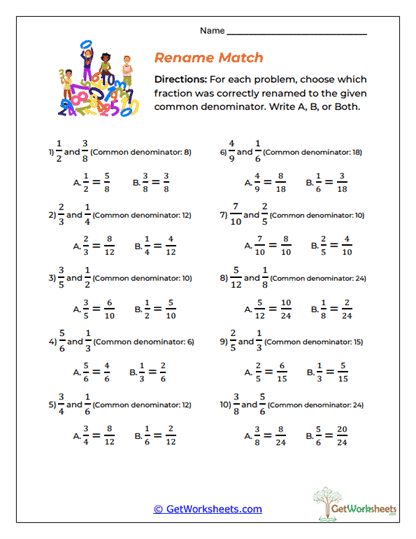
Two possible equivalent-fraction rewrites are presented for each original value. Students determine whether choice A, choice B, or both correctly preserve the fraction's value. Checking the scale factor for both the numerator and denominator encourages careful proportional reasoning. The page is useful for identifying students who can find a common denominator but make mistakes when calculating the new numerator.
Simple Solutions
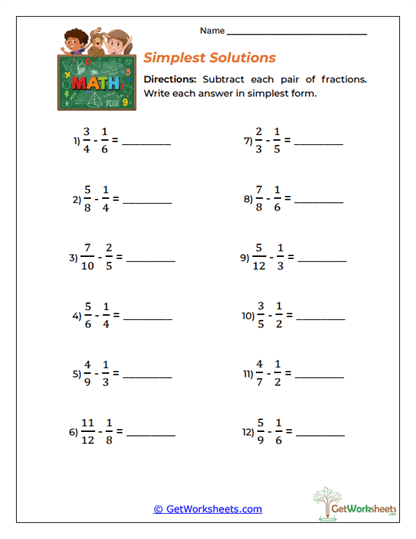
A focused set of subtraction problems gives learners repeated practice completing the entire procedure independently. Students find a shared denominator, create equivalent fractions, subtract, and simplify each difference. The consistent format helps the correct sequence become more familiar and efficient. This page works well for review, homework, fluency building, or a quick skill assessment.
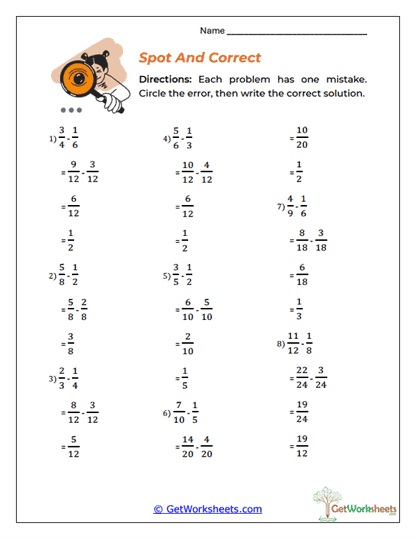
Spot and Correct
Completed subtraction solutions contain one error that students must locate and repair. Mistakes may appear in the common denominator, equivalent-fraction rewrite, numerator calculation, or final simplification. Learners circle the incorrect step and then complete the whole problem accurately. This approach develops stronger checking habits and turns common misconceptions into useful teaching examples.
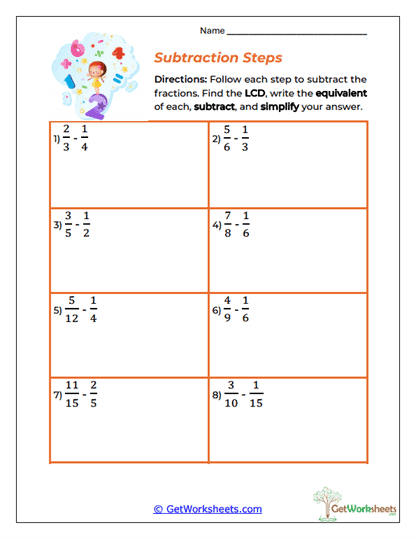
Subtraction Steps
Large workspaces guide students through each stage of solving unlike-denominator differences. Learners find the least common denominator, rewrite the fractions, subtract the numerators, and reduce the final result. Showing every step makes it easier to determine exactly where confusion begins. The page provides a dependable structure before students are expected to complete the process more mentally or compactly.
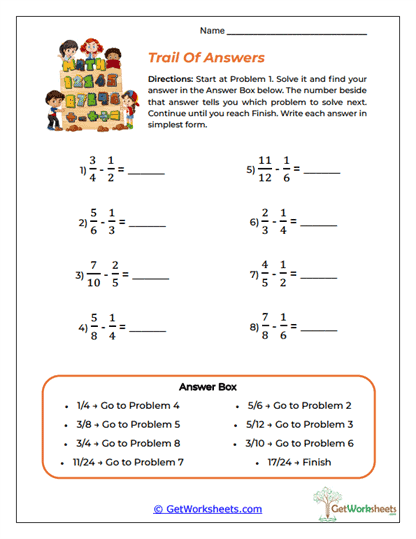
Trail of Answers
A follow-the-path puzzle turns repeated fraction subtraction into a game-like activity. Each simplified difference directs students to the next problem, so an incorrect calculation or unfinished reduction can lead them off the correct trail. This built-in feedback encourages learners to revisit their common denominators, equivalent fractions, and arithmetic. The format strengthens persistence and self-correction while providing substantial practice.
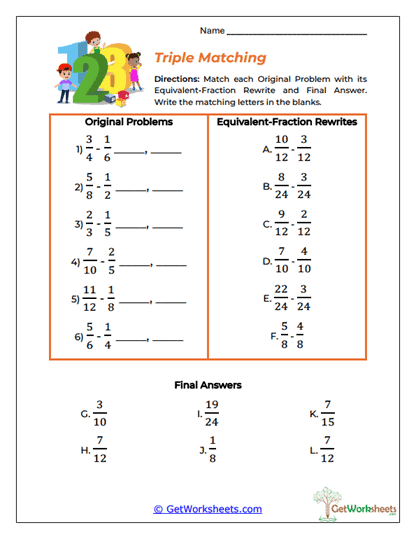
Triple Matching
Students connect the original subtraction equation, its correctly renamed equivalent form, and the final simplified difference. Finding all three matching pieces shows the entire process from unlike fractions to a completed answer. Similar-looking choices require careful attention to denominators, scale factors, subtraction, and reduction. The activity provides a comprehensive review of how each stage contributes to one connected solution.
Bookmark Us Now!
New, high-quality worksheets are added every week! Do not miss out!