Adding Fractions (Like Denominators) Worksheets
About This Worksheet Collection
Adding fractions with like denominators means combining fractional parts that are already the same size. Because the denominators match, students add the numerators to find the total number of parts while keeping the denominator unchanged. Understanding why this rule works helps learners avoid the common mistake of adding both the numerator and denominator.
This collection develops fraction addition through visual bars, block models, number lines, drawing activities, direct computation, missing-addend equations, estimation, matching tasks, error analysis, word problems, and mixed review. Some worksheets provide strong visual support, while others ask students to calculate, simplify, explain mistakes, or apply the skill in unfamiliar formats. The pages can be used during direct instruction, guided math, centers, intervention, tutoring, homework, assessment, independent practice, or homeschool lessons.
As students complete the collection, they strengthen numerator and denominator understanding, fraction magnitude, computational fluency, equivalent-fraction recognition, simplification, estimation, equation sense, and mathematical reasoning. They also practice identifying missing values, evaluating completed work, solving real-world problems, and checking whether answers are reasonable. These skills prepare learners for improper fractions, mixed numbers, unlike denominators, fraction subtraction, and more advanced operations.
Detailed Descriptions Of These Worksheets
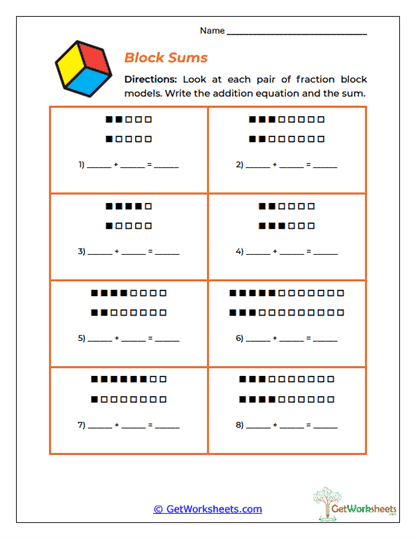
Block Sums
Rows of shaded fraction blocks help learners connect visual models with written addition equations. Students identify each addend, count the combined shaded pieces, and record the final sum while keeping the shared denominator. The clear block structure reinforces that every piece has the same value. This activity is especially useful for children who need concrete support before moving to number-only problems.
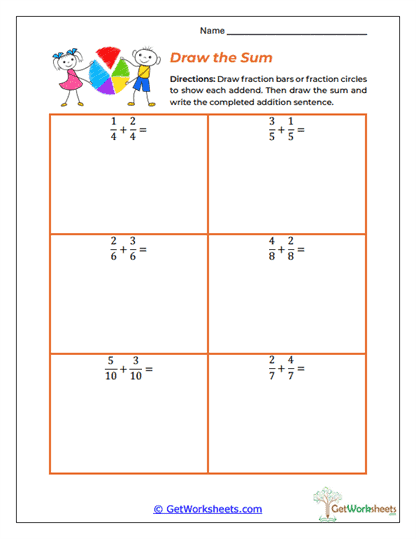
Draw the Sum
Students create their own fraction bars or circles to model each addition problem. They divide the whole into equal sections, shade both addends, and count the total number of shaded parts. Building the model themselves requires more planning than simply reading a completed picture. The activity strengthens equal partitioning, visual reasoning, and accurate equation writing.
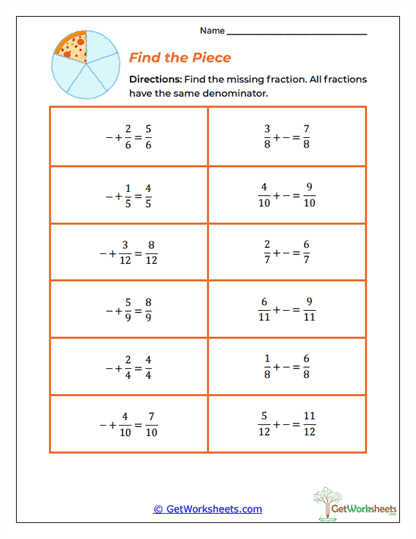
Find the Piece
Missing-addend equations ask learners to work backward from a known fraction and total. Students subtract the known numerator from the sum's numerator while keeping the common denominator unchanged. Adding the missing value back into the equation gives them a simple way to check their reasoning. This format connects fraction addition with subtraction, fact families, and inverse operations.
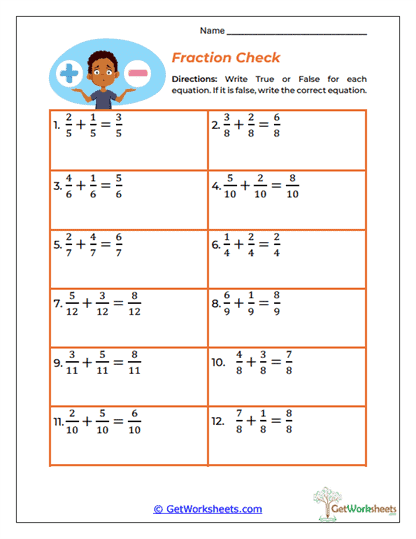
Fraction Check
Completed addition equations must be evaluated as true or false. Learners solve each problem independently, compare their result with the stated answer, and decide whether the equation is accurate. The activity draws attention to common errors such as adding denominators or miscalculating the numerator. It also helps students build the habit of verifying work instead of accepting an answer automatically.
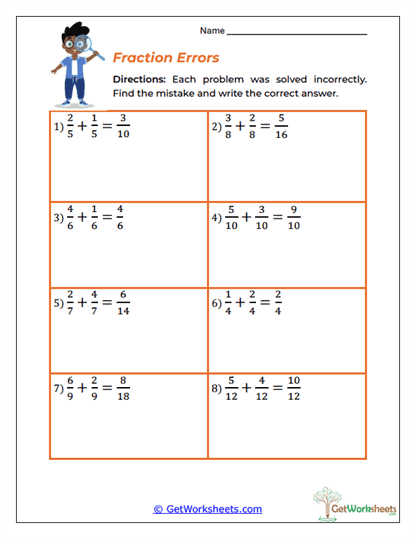
Fraction Errors
Every problem contains an incorrect fraction sum that students must examine and repair. Learners identify what went wrong, apply the like-denominator rule correctly, and write the accurate answer. Explaining the mistake encourages deeper understanding of why the denominator remains unchanged. The worksheet is particularly useful for intervention, corrections, or reviewing repeated misconceptions.
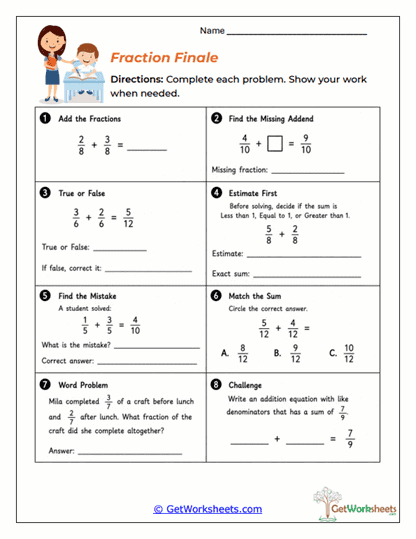
Fraction Finale
This cumulative review combines direct addition, missing addends, true-or-false statements, estimation, error correction, matching, word problems, and equation creation. Because the format changes throughout the page, students must choose an appropriate strategy instead of repeating one routine. The variety provides a broad picture of each learner's understanding. It works well as an end-of-unit review, assessment, or preparation for more advanced fraction work.
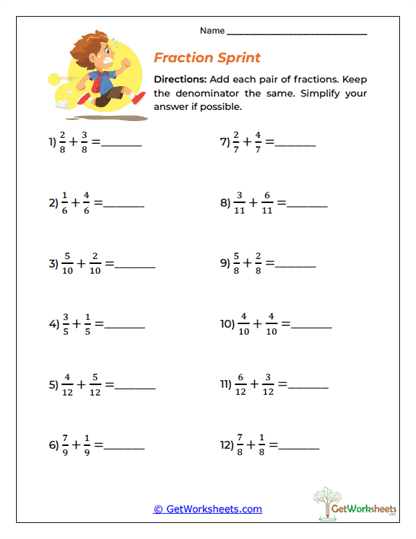
Fraction Sprint
A straightforward set of like-denominator problems helps students build speed and accuracy. Learners add the numerators, retain the common denominator, and simplify answers when needed. The consistent layout keeps attention on computation and fraction structure. This page is well suited for morning work, independent review, homework, or a quick skill check.
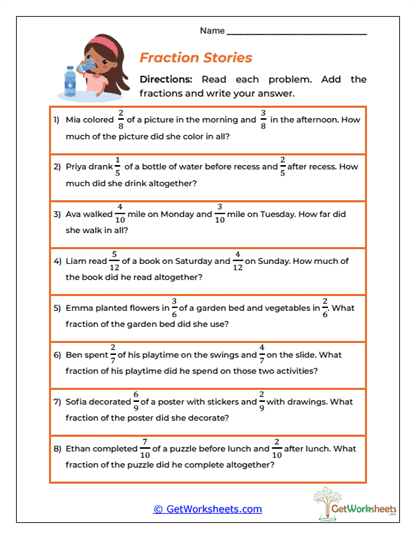
Fraction Stories
Short real-world situations ask students to identify and combine two fractional amounts. Learners determine which information matters, select addition as the correct operation, and write a response that fits the context. The activity connects fraction computation with reading comprehension and practical reasoning. It also teaches children to think about what the numbers represent rather than treating the equation as an isolated task.
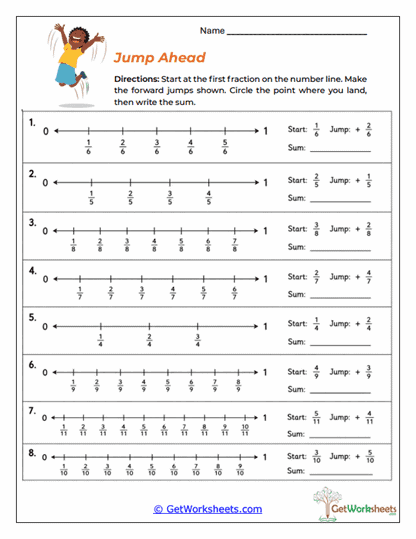
Jump Ahead
Number lines show fraction addition as forward movement across equal intervals. Students begin at the first fraction, make the correct fractional jump, and identify the landing point as the sum. This visual method makes the operation feel like distance traveled rather than an abstract rule. It strengthens fraction magnitude, spatial reasoning, and number-line fluency.
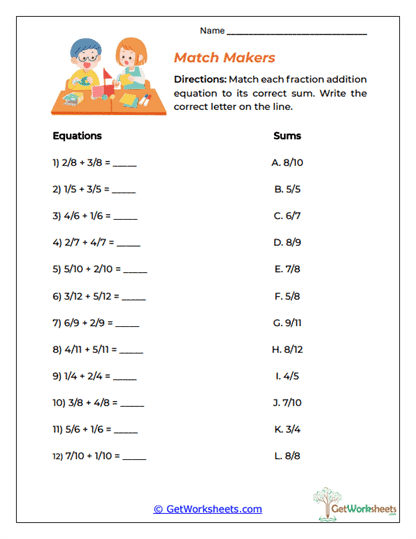
Match Makers
Students solve fraction equations and connect each result with a matching answer choice. Some sums must be simplified before the equivalent value becomes clear. The two-column format creates a built-in opportunity for self-checking when an expected answer does not appear. This engaging structure reinforces computation, equivalence, simplification, and careful matching.
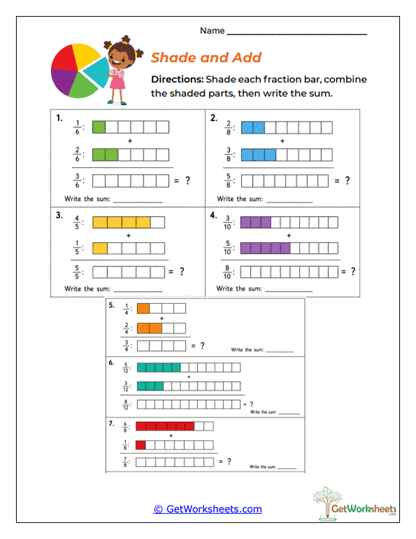
Shade and Add
Fraction bars allow learners to see exactly how two like-denominator fractions combine. Students shade each amount, count all shaded sections, and write the corresponding addition sentence. The models clearly demonstrate why only the numerators are added. This page provides strong support for students who are just beginning to move from pictures to symbolic fraction equations.
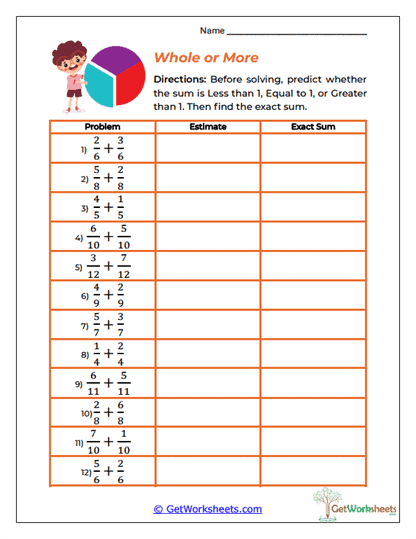
Whole or More
Before solving, students predict whether each sum will be less than one, equal to one, or greater than one. They compare the combined numerator with the denominator and then calculate the exact result to test their estimate. This process develops benchmark reasoning and helps children catch unreasonable answers. It also introduces important connections among proper fractions, one whole, and improper fractions.
Bookmark Us Now!
New, high-quality worksheets are added every week! Do not miss out!