Flag Fraction Lines
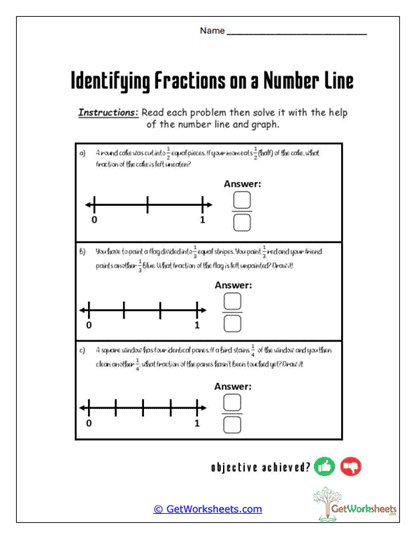
Students read three short word problems involving a painted flag, a sectioned log, and cleaned window panes. They determine the fraction represented in each situation, write the answer, and use the number line to show where that fraction belongs between zero and one. This elementary worksheet strengthens reading comprehension, fraction identification, number-line placement, equal-part reasoning, subtraction from one whole, and mathematical modeling. It is especially useful for grades 3-4 because students must understand the story context before deciding which fraction to plot.
Learning Goals
- Identify the Whole: Students determine what complete flag, log, or set of panes represents one whole.
- Find the Given Fraction: Learners identify the portion that was painted, used, or completed.
- Determine What Remains: Children subtract from one whole when the question asks for the unpainted or unfinished part.
- Plot the Answer: Students place the fraction at the correct point on the number line.
How This Helps
- Connects Words to Visual Math: Students turn a written situation into a fraction and then into a position on a number line.
- Supports Developing Readers: The number line gives children a concrete way to check whether their answer makes sense.
- Easy for Parents to Explain: Adults can ask, “How many equal parts make the whole, and how many of those parts are being described?”
- Builds Real-Life Fraction Sense: The situations show how fractions can describe everyday objects and tasks.
- Ready for Immediate Use: The worksheet works well for guided math, intervention, tutoring, homework, or homeschool lessons.
Many children can identify a fraction in a picture but struggle when the same idea is written as a short story. This worksheet helps them slow down, find the whole, identify the number of equal parts, and decide whether the question asks for the used or remaining amount. Students strengthen fraction vocabulary, number-line reasoning, word-problem comprehension, equal partitioning, subtraction from one whole, and mathematical accuracy. Parents can encourage children to sketch the sections before plotting the answer. In classroom and homeschool settings, this activity builds confidence and helps students connect everyday fraction situations with precise locations between zero and one.
Bookmark Us Now!
New, high-quality worksheets are added every week! Do not miss out!