Improper Fractions Worksheets
About This Worksheet Collection
Improper fractions represent values that are equal to or greater than one because the numerator is at least as large as the denominator. Students learn to interpret these fractions by thinking about how many equal parts create one whole and how many parts are present altogether. Connecting improper fractions with mixed numbers helps learners understand that both forms can describe the same quantity in different ways.
This collection develops that understanding through fraction bars, shaded models, conversion practice, matching activities, charts, number lines, comparison tasks, ordering exercises, error analysis, and real-world word problems. Some worksheets begin with visual representations, while others ask students to apply division, multiplication, addition, and remainder reasoning more independently. The pages can be used during direct instruction, guided math, centers, intervention, homework, tutoring, assessment, review, or homeschool lessons.
As students complete the collection, they strengthen fraction equivalence, mixed-number reasoning, division with remainders, multiplication, addition, number-line placement, comparison, ordering, and mathematical modeling. They also learn to check conversions, diagnose common mistakes, preserve denominators correctly, and explain why two different fraction forms have equal value. These skills prepare learners for adding, subtracting, multiplying, and dividing fractions and mixed numbers in later mathematics.
Detailed Descriptions Of These Worksheets
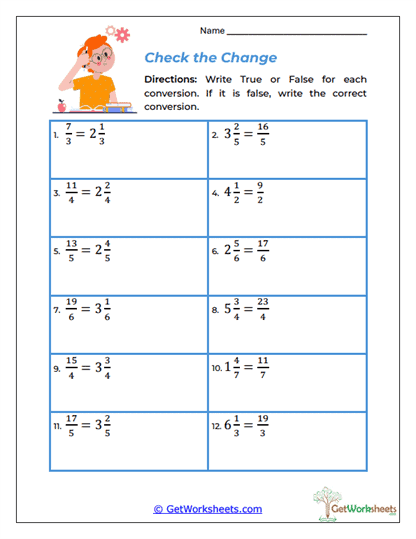
Check the Change
Completed conversions between improper fractions and mixed numbers must be evaluated as true or false. Learners independently convert each value, compare it with the answer shown, and correct any statement that is not equivalent. The activity draws attention to common errors involving quotients, remainders, numerators, and unchanged denominators. Converting the corrected answer back to its original form gives students a dependable way to verify their work.
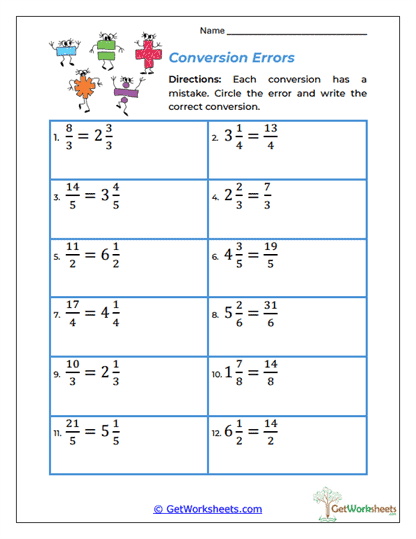
Conversion Errors
Twelve incorrect conversions invite students to locate, explain, and repair mathematical mistakes. Children determine whether the error occurred in multiplication, addition, division, the remainder, or the fraction notation itself. Rather than practicing one routine repeatedly, they must diagnose several different misconceptions. This makes the page useful for reteaching, assessment, and developing stronger self-checking habits.
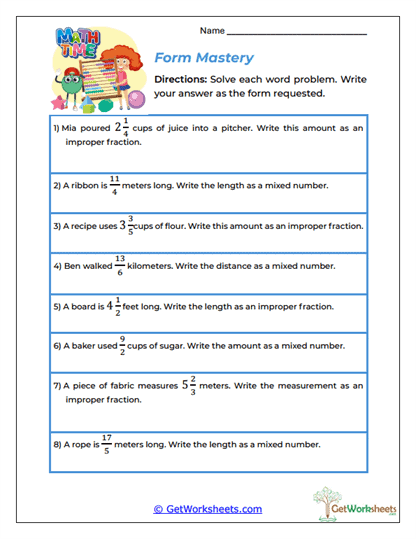
Form Mastery
Real-world situations involving measurements, materials, food, and distance require learners to convert quantities into the requested form. Some problems begin with mixed numbers, while others provide improper fractions, so students must first decide which conversion process is needed. Including the correct unit helps connect the numerical result with the meaning of the story. The activity combines careful reading, mathematical modeling, and fraction equivalence.
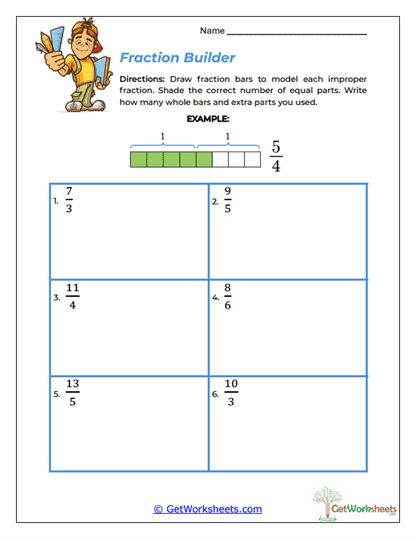
Fraction Builder
Students draw and shade fraction bars to build improper fractions greater than one. Each model shows how many complete wholes can be formed and how many fractional pieces remain. Creating the amount visually helps children understand why a numerator may be larger than its denominator. The completed bars also provide a natural introduction to rewriting the value as a mixed number.
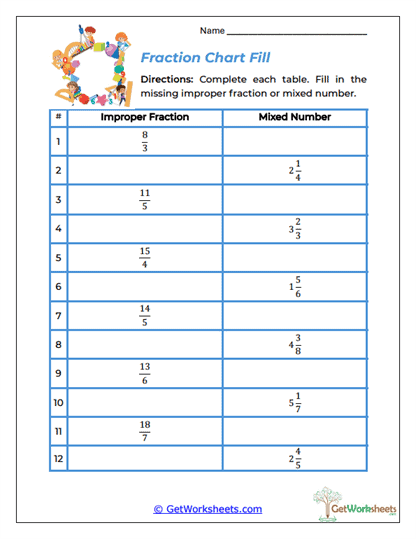
Fraction Chart Fill
A two-column chart asks learners to supply either a missing improper fraction or its equivalent mixed number. Because the starting form changes from row to row, students must choose between division with a remainder and multiplication followed by addition. The organized layout makes it easy to compare the two representations side by side. Checking each row in reverse encourages flexible and accurate conversion skills.
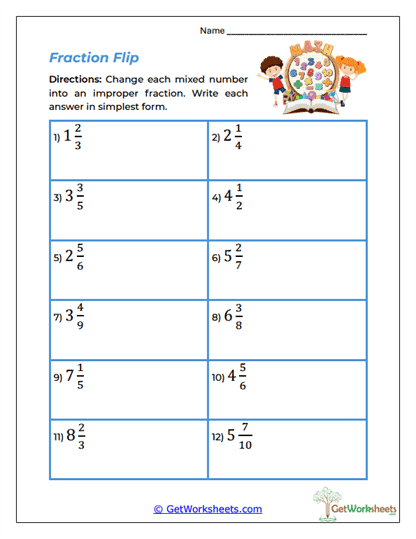
Fraction Flip
Mixed numbers are rewritten as improper fractions through a consistent three-step process. Learners multiply the whole number by the denominator, add the original numerator, and place the total over the unchanged denominator. Repeated practice helps prevent common mistakes such as forgetting the extra numerator or altering the denominator. Drawing one visual model can further demonstrate why the converted fraction has the same value.
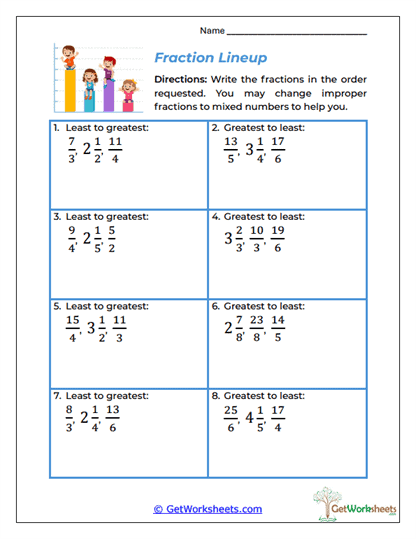
Fraction Lineup
Groups of improper fractions and mixed numbers must be arranged in ascending or descending order. Students may rewrite every value in the same form so the whole-number portions and fractional remainders are easier to compare. Alternating directions require careful reading instead of automatic sequencing. The task brings together conversion, magnitude, equivalence, and multi-step organization.
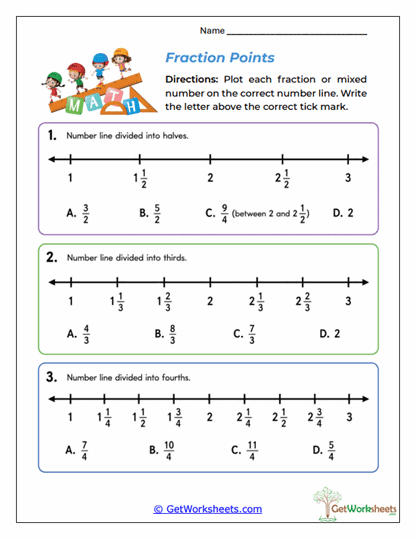
Fraction Points
Number lines divided into halves, thirds, and fourths show where improper fractions and mixed numbers belong beyond one whole. Learners use the interval size and whole-number markers to place each labeled value accurately. Converting an improper fraction into a mixed number may make its position easier to recognize. This visual practice reinforces that fractions greater than one are ordinary numbers with exact locations.
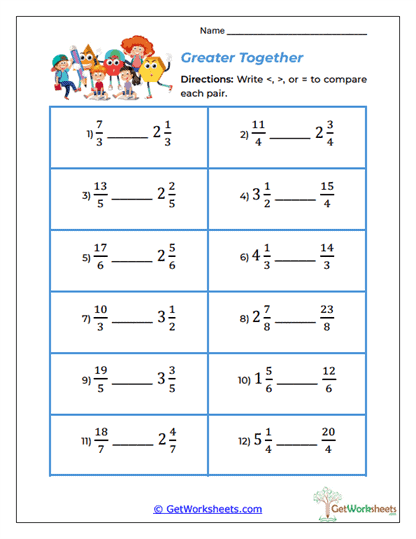
Greater Together
Pairs of improper fractions and mixed numbers are compared using less than, greater than, or equal symbols. Children can convert the values into matching forms before examining the whole-number portions and any remaining fractional parts. Some pairs look different but represent the same amount, so appearance alone is not enough. The page strengthens fraction magnitude and encourages students to explain the reasoning behind each comparison.
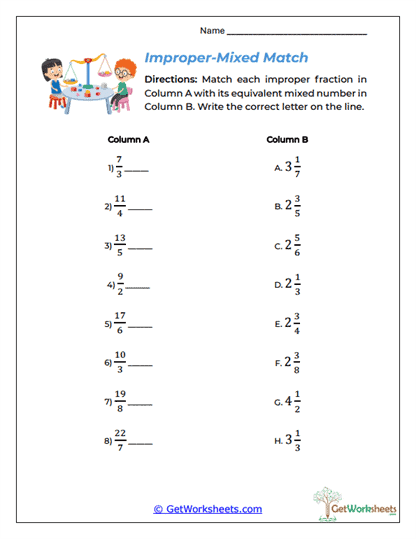
Improper-Mixed Match
Improper fractions in one column must be connected with equivalent mixed numbers in another. Learners divide each numerator by its denominator, use the quotient as the whole number, and turn the remainder into the fractional part. Matching the results gives students an added opportunity to check whether both forms truly describe the same quantity. The format works well for centers, partner practice, or independent review.
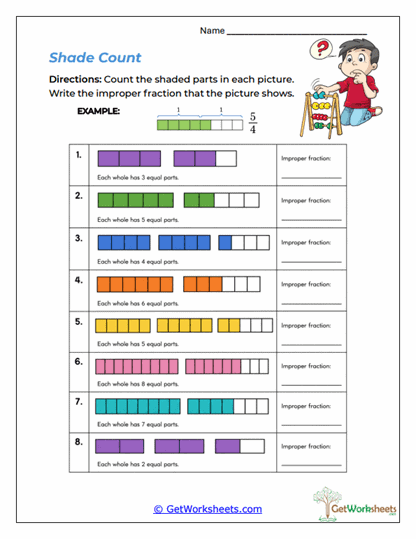
Shade Count
Groups of shaded fraction bars are used to generate improper fractions. Students count every shaded piece across complete bars and leftover sections, then write that total over the number of equal parts in one whole. This helps correct the misconception that the numerator should show only the number of completed bars. The visual-to-symbolic transition gives developing learners a concrete way to understand values greater than one.
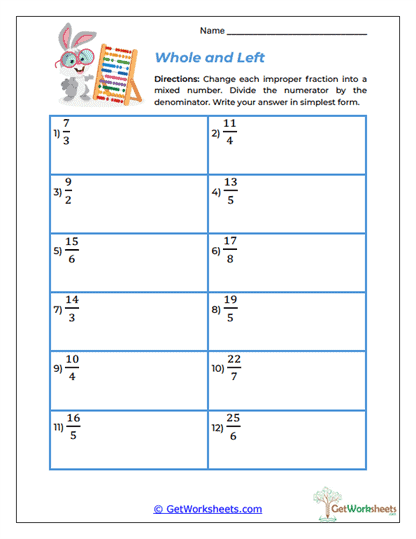
Whole and Left
Twelve improper fractions are converted into mixed numbers and simplified when necessary. Learners divide the numerator by the denominator, record the quotient as the whole number, and use the remainder for the new numerator. The original denominator stays in place because the size of the fractional pieces does not change. Converting the result back into an improper fraction provides a useful accuracy check.
Bookmark Us Now!
New, high-quality worksheets are added every week! Do not miss out!