Shape Fraction Path
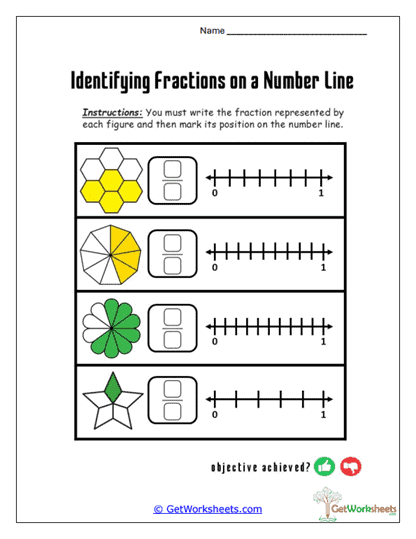
Students study four different fraction designs, including connected hexagons, a divided circle, a flower-like model, and a star. They count the equal parts, write the fraction shown by the shaded sections, and then mark each value on a number line between zero and one. This elementary worksheet strengthens fraction-model interpretation, numerator and denominator recognition, equal-part reasoning, number-line placement, visual discrimination, and fraction magnitude. It is especially appropriate for grades 2-3 because students learn that fractions can be represented by many shapes, not only circles and rectangles.
Academic Focus
- Recognize the Whole: Students identify which complete group or shape represents one full unit.
- Count Equal Parts: Learners determine the denominator by counting all sections in the whole.
- Identify the Shaded Amount: Children use the colored pieces to determine the numerator.
- Transfer Between Models: Students connect the picture fraction with its correct location on a number line.
- Understand Fraction Size: Learners see how more shaded parts move the value farther to the right.
Instructional Benefits
- Prevents Shape Dependence: Students learn that fraction meaning stays the same even when the model looks unfamiliar.
- Supports Careful Observation: Irregular arrangements require children to identify the whole before counting.
- Easy for Families to Discuss: Parents can ask, “What counts as the complete shape, and are all parts equal?”
- Builds Representation Skills: Students practice moving between pictures, symbols, and number lines.
- Useful Across Settings: The page works well for guided instruction, review, intervention, tutoring, or homeschool practice.
Children sometimes believe fractions only apply to pizzas or simple bars. This worksheet broadens their understanding by showing fractional parts inside several different visual designs. Students strengthen numerator and denominator knowledge, part-whole relationships, equal partitioning, number-line reasoning, visual analysis, notation, and mathematical language through four varied examples. Parents should remind children that the pieces must be equal in value, even when they do not all look exactly alike. In classroom and homeschool settings, this activity builds confidence and helps learners recognize fractions across many kinds of diagrams, patterns, and geometric models.
Bookmark Us Now!
New, high-quality worksheets are added every week! Do not miss out!