Fraction Situations
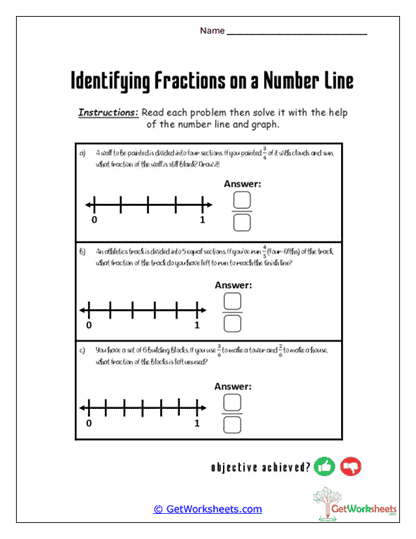
Students read three fraction situations involving a painted wall, a completed book, and fabric used for a project. They determine the fraction that is used, completed, or left over, then write and plot each answer on a number line from zero to one. This elementary worksheet strengthens fraction interpretation, complement reasoning, number-line placement, word-problem analysis, equal partitioning, and mathematical communication. It is well suited for grades 3-4 because students must decide whether to use the stated fraction directly or subtract it from one whole.
Academic Focus
- Identify the Fraction Given: Students locate the amount that was painted, read, or used.
- Understand the Question: Learners decide whether the problem asks for the completed portion or the remaining portion.
- Find the Complement: Children calculate the fraction needed to make one whole when necessary.
- Represent the Result: Students write the fraction and place it correctly on the number line.
Instructional Benefits
- Builds Careful Reading: Students learn that the same numbers can lead to different answers depending on what the question asks.
- Supports Fraction Complements: The activity reinforces relationships such as one-fourth and three-fourths making one whole.
- Easy for Families to Discuss: Parents can ask, “How much more is needed to reach the whole?”
- Connects Models and Symbols: Learners move from words to notation to number-line placement.
- Useful Across Settings: The worksheet works well for direct instruction, small groups, tutoring, intervention, or homeschool practice.
Children often copy the fraction they see in a problem even when the question asks for the part that remains. This worksheet helps them understand that the used and unused parts must combine to equal one whole. Students strengthen fraction complements, number-line reasoning, story-problem comprehension, subtraction, mathematical vocabulary, and answer checking through three focused situations. Parents can encourage children to write an equation such as one whole minus the used fraction before plotting. In classroom and homeschool settings, this activity builds confidence and gives students a dependable method for solving fraction problems about parts finished, parts used, and parts left.
Bookmark Us Now!
New, high-quality worksheets are added every week! Do not miss out!