Adding Fractions (Unlike Denominators) Worksheets
About This Worksheet Collection
Adding fractions with unlike denominators requires students to rename the fractions so they are divided into equal-sized parts before combining them. Learners find a common denominator, create equivalent fractions, add the new numerators, and simplify the result when needed. Understanding this process helps students see that fractions can only be added directly when the pieces represent the same-sized portions of a whole.
This collection develops that skill through least-common-denominator practice, equivalent-fraction exercises, visual fraction bars, number lines, direct computation, matching tasks, missing-addend problems, error analysis, true-or-false statements, real-world word problems, and mixed review. Some worksheets isolate one important step, while others ask learners to complete the entire addition process independently. The pages can be used during direct instruction, guided math, centers, intervention, tutoring, homework, assessment, review, or homeschool lessons.
As students complete the collection, they strengthen multiplication facts, denominator reasoning, equivalent-fraction fluency, numerator accuracy, simplification, fraction magnitude, inverse operations, and mathematical problem solving. They also practice selecting efficient strategies, checking completed work, explaining mistakes, and applying fraction addition in meaningful situations. These skills prepare learners for subtracting unlike fractions, working with mixed numbers, solving multi-step word problems, and studying more advanced rational-number concepts.
Detailed Descriptions Of These Worksheets
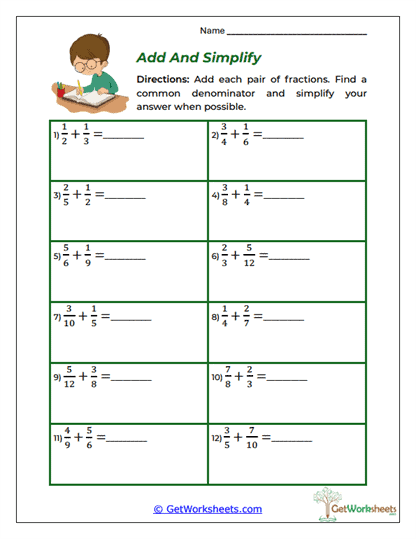
Add and Simplify
Students complete the full process for adding fractions with different denominators. They find a shared denominator, rewrite both addends as equivalent fractions, combine the new numerators, and reduce the final answer when possible. The repeated format helps learners remember the correct sequence without relying on a provided denominator. This page is well suited for independent practice after the individual steps have been introduced.
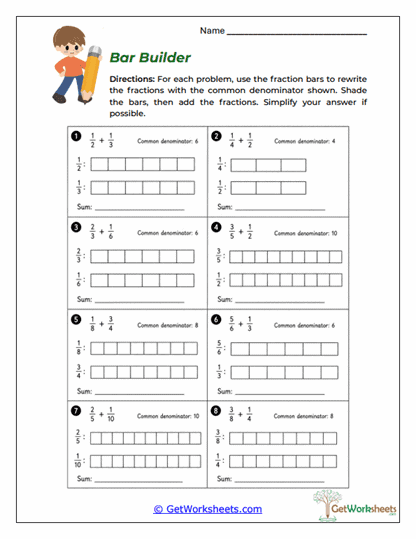
Bar Builder
Fraction bars make the renaming and addition process visible. Learners rewrite each fraction using the supplied common denominator, shade the matching amounts, and combine the equal-sized sections. The pictures help confirm that the original and rewritten fractions represent the same quantities. Students then simplify the sum or express it in another appropriate form when needed.
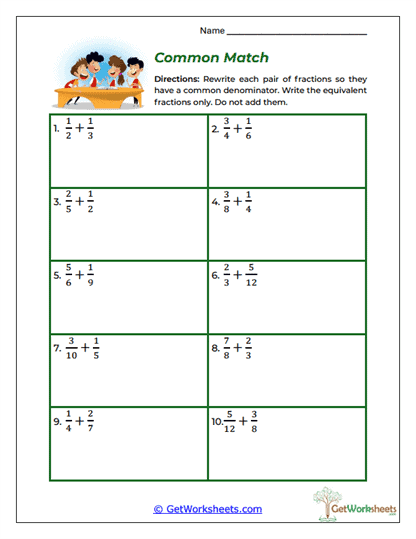
Common Match
This worksheet concentrates on the preparation required before unlike fractions can be added. Students choose a common denominator and rewrite each pair as equivalent fractions without calculating a sum. Focusing on renaming alone allows learners to build confidence with scaling numerators and denominators correctly. It is especially helpful for students who need more practice before managing several fraction steps at once.
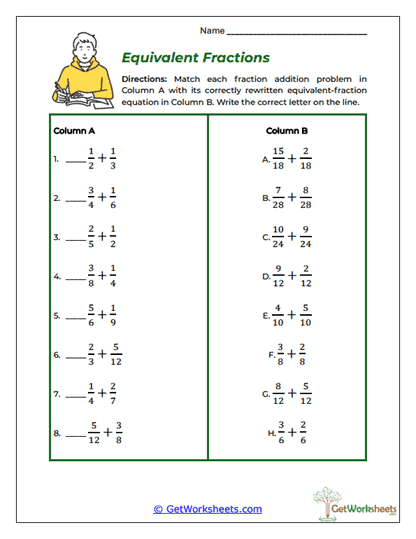
Equivalent Fractions
Addition equations written in different forms must be matched according to their equivalent values. Students examine how each numerator and denominator was scaled and connect equations that represent the same total. The activity reinforces that a fraction's appearance can change while its value remains constant. Its matching format also gives learners a useful way to review and check their reasoning.
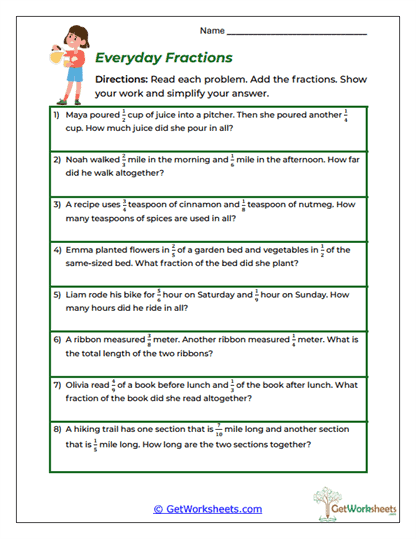
Everyday Fractions
Real-life situations involving recipes, distances, time, gardening, reading, and other familiar experiences require students to add unlike fractions. Learners identify the two quantities, select addition, create equivalent fractions, and simplify the final result. Writing the answer with the correct unit keeps the calculation connected to the story. This page strengthens both reading comprehension and practical mathematical reasoning.
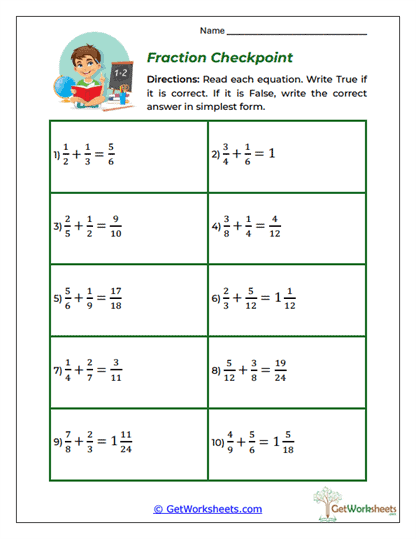
Fraction Checkpoint
Completed unlike-denominator equations are evaluated as true or false. Students verify the common denominators, equivalent forms, numerator sums, simplification, and any mixed-number answers shown. Incorrect statements must be rewritten accurately. The activity encourages learners to examine every stage of the process rather than checking only the final numerator.
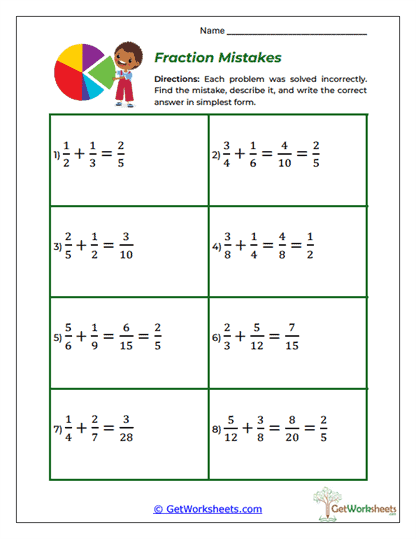
Fraction Mistakes
Incorrectly solved addition problems give students an opportunity to diagnose common misconceptions. They may encounter fractions added without matching denominators, incorrectly scaled numerators, or unsimplified final answers. Learners identify the error, rebuild the calculation correctly, and explain why the original method failed. This turns mistakes into useful examples of how fraction addition should work.
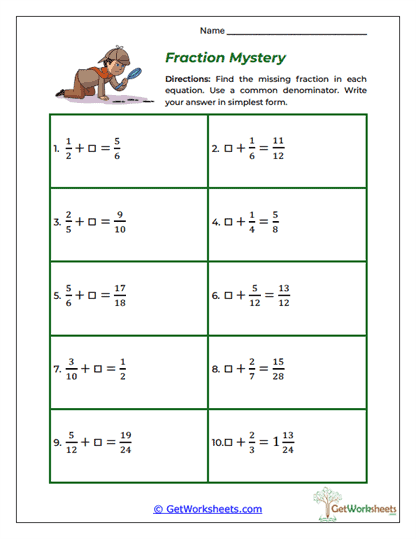
Fraction Mystery
An unknown addend appears in each fraction equation. Students rename the known quantities with a common denominator and use subtraction to determine what amount is missing. The answer is then reduced to its simplest equivalent form. Working backward connects fraction addition with inverse operations and early algebraic reasoning.
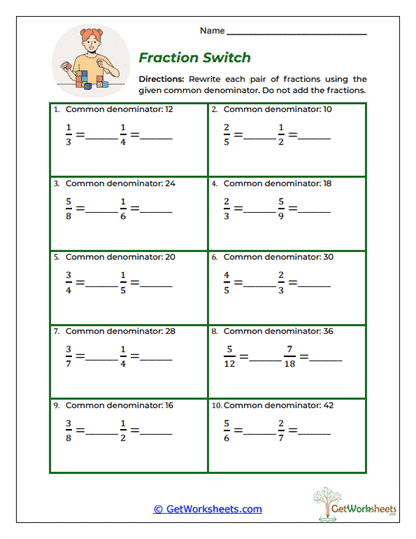
Fraction Switch
A new denominator is already supplied, allowing learners to focus entirely on creating an equivalent fraction. Students determine the scale factor used on the denominator and apply that same multiplication to the numerator. The structure directly addresses the mistake of changing only the bottom number. Repeated practice builds stronger proportional reasoning and prepares students for full addition problems.
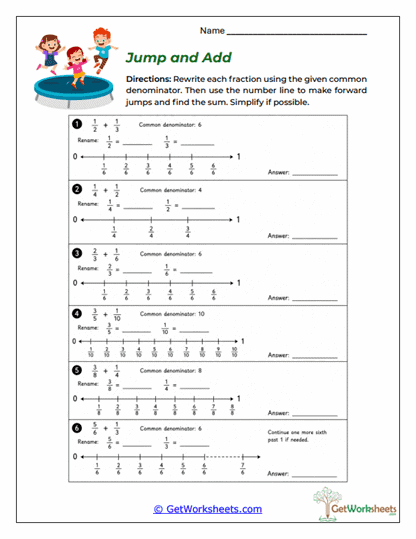
Jump and Add
Number lines represent addition as forward movement across equal fractional intervals. Learners first rename the unlike fractions so both use the provided denominator, then begin at the first addend and jump forward by the second. The landing point shows the total and may extend beyond one whole. This visual approach strengthens magnitude, improper-fraction understanding, and number-line fluency.
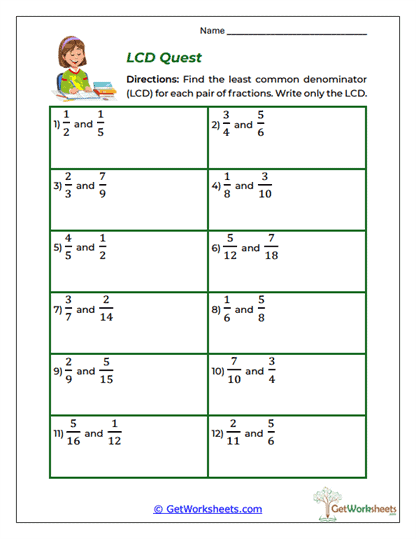
LCD Quest
Pairs of denominators are used to practice finding the least common denominator. Students list or compare multiples until they identify the smallest number shared by both. Isolating this skill helps learners avoid becoming overwhelmed by the rest of the fraction-addition process. It also reinforces multiplication facts, divisibility, and least-common-multiple reasoning.
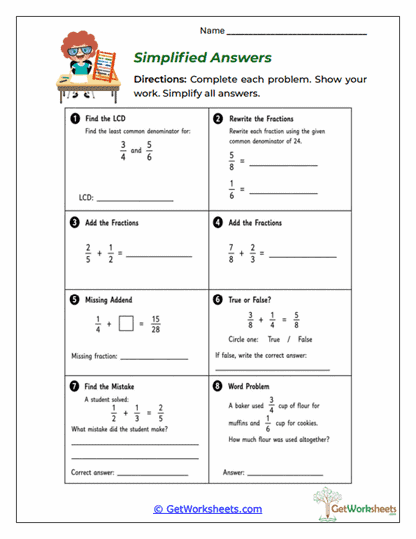
Simplified Answers
This comprehensive review combines several skills from the collection on one page. Learners find least common denominators, rename fractions, add and simplify, solve a missing-addend equation, evaluate a statement, correct an error, and complete a word problem. The changing formats require students to decide which strategy each question needs. It works well as a final checkpoint, cumulative review, or assessment-preparation activity.
Bookmark Us Now!
New, high-quality worksheets are added every week! Do not miss out!