Subtracting Fractions (Like Denominators) Worksheets
About This Worksheet Collection
Subtracting fractions with like denominators means removing equal-sized fractional parts from a starting amount. Because the denominators already match, students subtract the numerators while keeping the denominator unchanged. Understanding this relationship helps learners see that only the number of pieces changes during subtraction, not the size of those pieces.
This collection develops fraction subtraction through direct computation, student-created models, number lines, missing-number equations, matching activities, sorting tasks, comparisons, error checking, and practical word problems. Some worksheets provide visual support, while others focus on simplification, inverse reasoning, answer classification, or evaluating completed equations. The pages can be used during direct instruction, guided math, centers, intervention, tutoring, homework, assessment, independent practice, or homeschool lessons.
As students complete the collection, they strengthen numerator and denominator understanding, subtraction fluency, fraction magnitude, equivalent-fraction recognition, simplification, equation sense, and mathematical reasoning. They also practice finding missing values, comparing differences, interpreting models, checking completed work, and applying subtraction in real-world situations. These skills prepare learners for subtracting unlike fractions, working with mixed numbers, solving multi-step problems, and completing more advanced fraction operations.
Detailed Descriptions Of These Worksheets
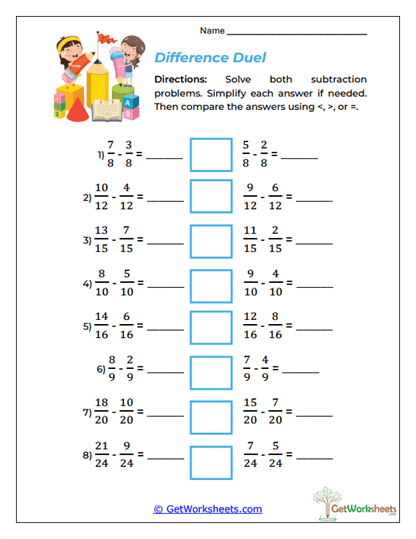
Difference Duel
Two fraction subtraction problems appear in each row, and learners solve both before comparing the results. Students simplify each difference and then choose the correct greater than, less than, or equal symbol. The activity combines subtraction, equivalence, magnitude, and comparison in one multi-step task. It helps children move beyond calculation and think carefully about the relative size of each answer.
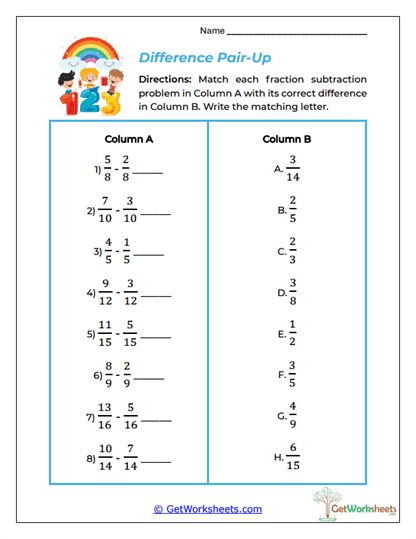
Difference Pair-Up
Students solve fraction subtraction problems and match each simplified difference with an answer choice. The matching format encourages learners to review their work when a result does not appear in the answer bank. Some differences must be reduced before the equivalent value becomes recognizable. This activity provides repeated subtraction practice while reinforcing simplification and self-checking.
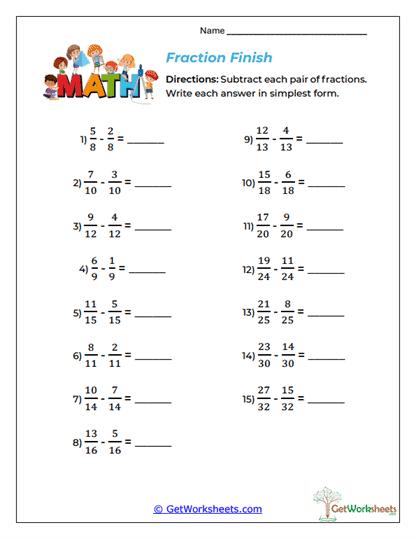
Fraction Finish
A focused set of like-denominator problems helps students build speed and accuracy with fraction subtraction. Learners subtract the numerators, keep the shared denominator, and reduce each answer when possible. The consistent structure allows them to concentrate on calculation and proper final form. This page works well for independent review, homework, intervention, or a quick skill check.
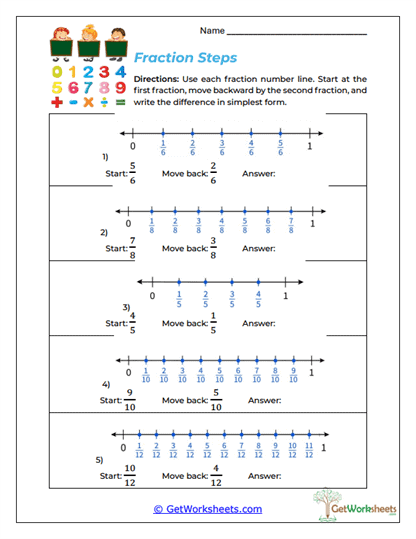
Fraction Steps
Number lines show fraction subtraction as backward movement across equal intervals. Students locate the starting fraction, move left by the amount being removed, and identify the landing point as the difference. This visual strategy makes the subtraction process easier to understand than a rule alone. Simplifying the final value also connects number-line reasoning with equivalent fractions.
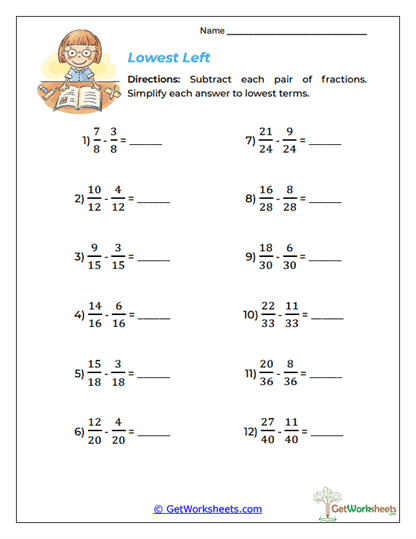
Lowest Left
Every problem requires students to subtract and then reduce the result to lowest terms. Learners follow a dependable routine by subtracting the numerators, keeping the denominator, and checking for shared factors. The page emphasizes that a mathematically correct difference may still be incomplete if it has not been simplified. Repeated practice strengthens factor recognition and careful finishing habits.
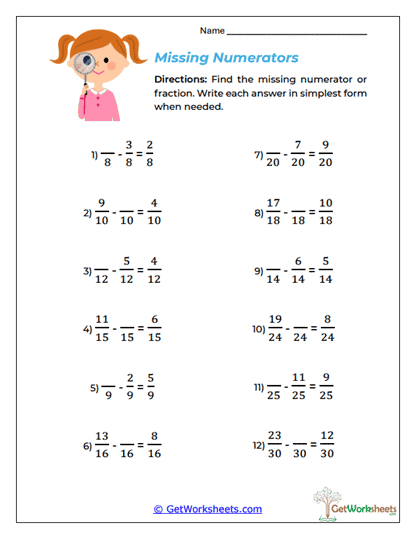
Missing Numerators
Unknown numerators or missing fractions must be found within subtraction equations. Students use inverse reasoning and familiar fact-family relationships to determine which value completes each equation. Since the denominators remain the same, learners can focus on the relationship among the numerators. Substituting the answer back into the equation provides a natural way to check the solution.
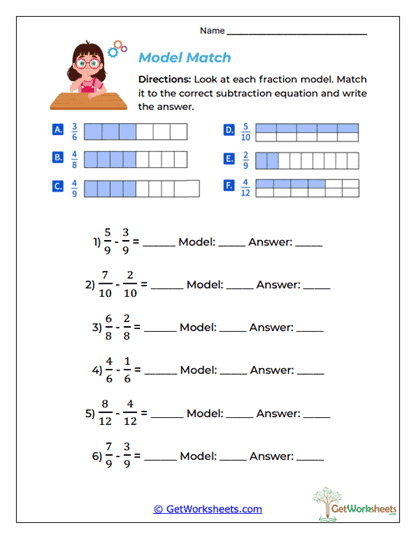
Model Match
Written subtraction equations are connected with visual fraction models showing the correct remaining amount. Learners solve each problem, identify the matching shaded representation, and simplify the final difference. The models help confirm that the denominator continues to describe the same-sized pieces after subtraction. This page is especially useful for students who benefit from seeing equations and pictures together.
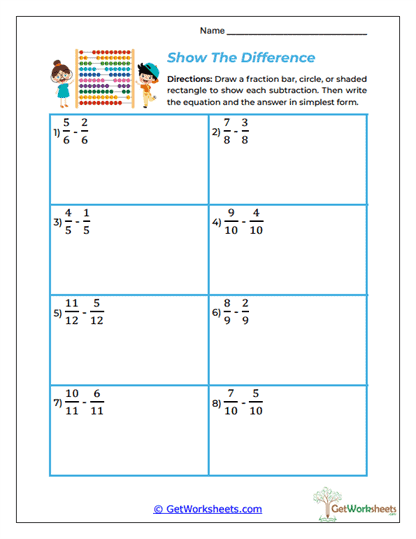
Show the Difference
Students draw fraction bars, circles, or rectangles to represent each subtraction problem. They shade the starting amount, cross out the portion being removed, and count the parts that remain. Creating the model themselves helps learners understand why the numerators change while the denominator stays constant. The activity builds visual reasoning, equal partitioning, and accurate equation writing.
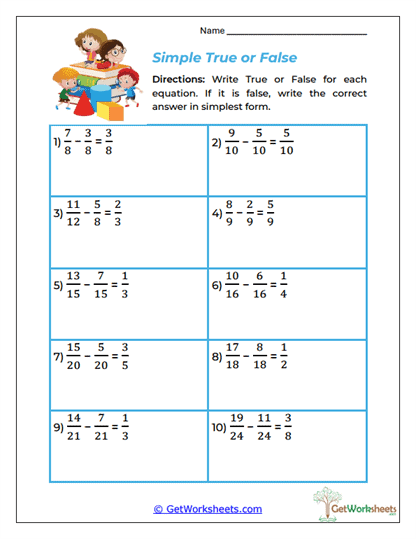
Simple True or False
Completed subtraction equations must be checked and labeled as true or false. Learners verify the numerator calculation, confirm that the denominator stayed unchanged, and decide whether the answer is fully simplified. False statements are corrected with accurate differences. This format strengthens error detection and encourages students to prove that a solution is correct.
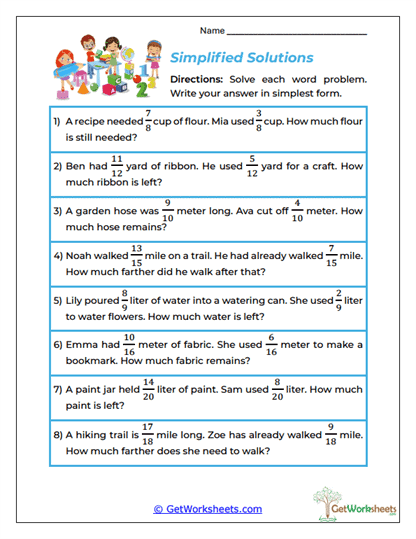
Simplified Solutions
Short word problems ask students to subtract fractional amounts in practical situations involving distance, materials, liquids, and measurements. Learners identify the starting quantity, determine what was removed, and calculate what remains. Each answer must be simplified and labeled with the appropriate unit. The activity connects reading comprehension with meaningful fraction subtraction.
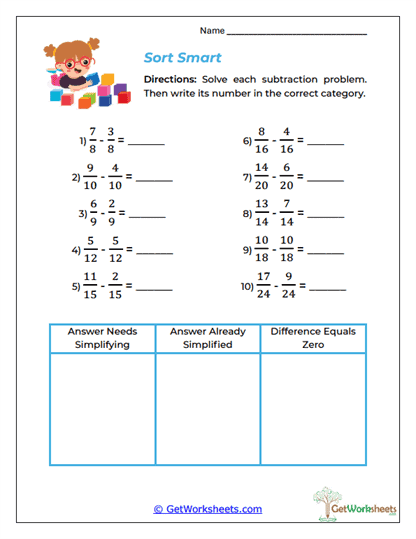
Sort Smart
After solving each subtraction problem, students classify the result as needing simplification, already in simplest form, or equal to zero. This requires learners to inspect the mathematical form of the answer instead of stopping after the numerator subtraction. The sorting task reinforces factor recognition, fraction vocabulary, and zero differences. It also helps children explain why an answer belongs in a particular category.
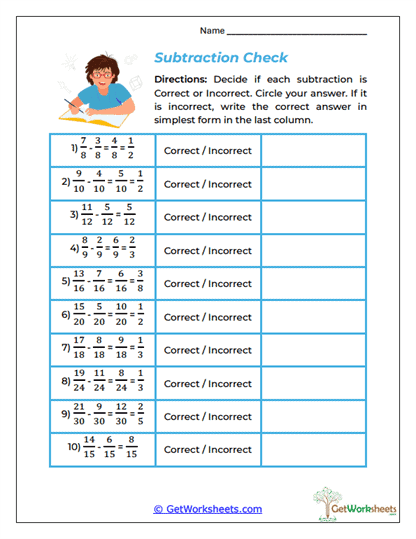
Subtraction Check
Students inspect completed fraction differences and decide whether the work is correct. They recalculate each problem, examine the denominator and simplification, and replace inaccurate answers. The worksheet highlights common mistakes such as faulty numerator subtraction or unfinished reductions. It develops strong checking habits and helps learners become more independent when reviewing their own work.
Bookmark Us Now!
New, high-quality worksheets are added every week! Do not miss out!