Fractions Worksheets
-
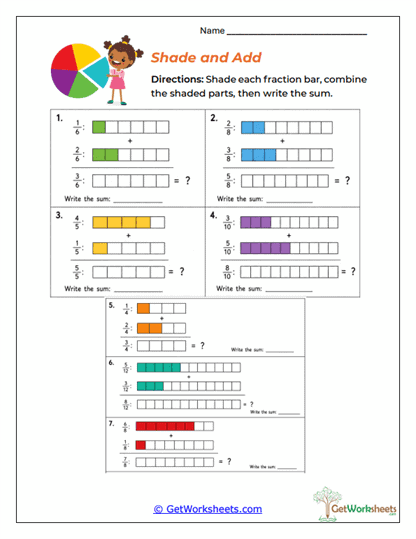
Adding Fractions (Like Denominators)
-
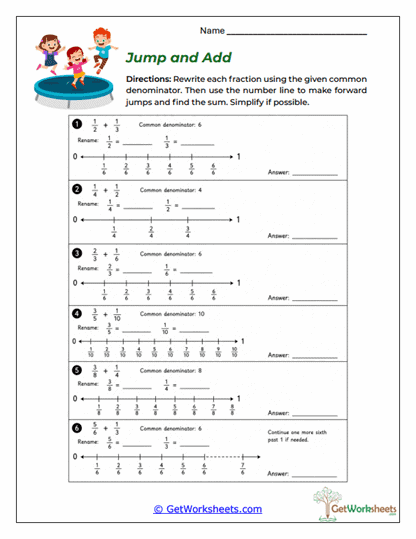
Adding Fractions (Unlike Denominators)
-
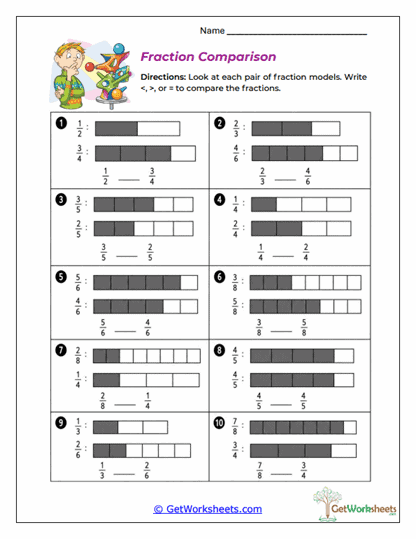
Comparing Fractions
-
-
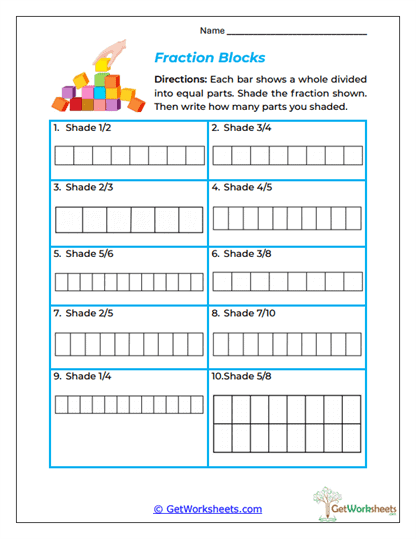
Fraction of a Number
-
Fraction Word Problems
-
Identifying Fractions on a Number Line
-
Improper Fractions
-
Simplifying Fractions
-
Subtracting Fractions (Like Denominators)
-
Subtracting Fractions (Unlike Denominators)
About This Worksheet Collection
Fractions describe equal parts of a whole, a group, or a measured quantity. Understanding them requires students to recognize how the numerator and denominator work together, compare fractional values, locate them on number lines, and move between different but equivalent forms. This broad collection gives learners a structured way to build those connected skills while developing a deeper understanding of fraction size and meaning.
The collection includes worksheets focused on comparing fractions, finding fractional parts of numbers, identifying fractions on number lines, working with improper fractions, and simplifying fractions to lowest terms. Activities range from visual models and equal-group exercises to numerical calculations, number-line work, conversions, comparisons, and factor-based reasoning. These resources can support whole-class lessons, guided math, centers, intervention, tutoring, independent practice, homework, assessment, or homeschool instruction.
By working through these topics, students strengthen number sense, multiplication and division fluency, part-whole reasoning, fraction magnitude, equivalence, factor recognition, and mathematical accuracy. They also learn to select appropriate strategies, explain how fractions are related, and check whether their answers are reasonable. Together, these skills prepare learners for fraction operations, mixed numbers, ratios, proportions, decimals, percentages, measurement, and more advanced mathematical problem solving.
Detailed Descriptions Of These Worksheets
Adding Fractions (Like Denominators)
This collection introduces students to combining fractional parts that share the same unit size. Because the denominators match, learners focus on adding the numerators while keeping the denominator constant to represent the total number of equal parts. Visual models, area diagrams, and number lines reinforce why only the top numbers are combined, helping students avoid common additive errors. These activities build foundational operational fluency, prepare children for simplifying sums or converting to mixed numbers, and strengthen confidence with basic fraction math.
Adding Fractions (Unlike Denominators)
Learners build on basic fraction addition by working with parts of different sizes. Students practice using factor reasoning and multi-step strategies to find common denominators, renaming fractions into equivalent forms before combining them. Visual representations help children see why equal-sized units are necessary before addition can take place. This collection strengthens multiplication and factor fluency, deepens understanding of equivalence, and builds the strategic flexibility needed for advanced rational number operations.
Comparing Fractions
This collection helps learners decide whether one fraction is greater than, less than, or equal to another. Students consider the size and number of equal parts while examining how numerators and denominators affect each value. Visual models, benchmarks, equivalent fractions, and common denominators can all be used to support accurate comparisons. These activities build flexible number sense and help children avoid treating fractions as unrelated whole numbers.
Fraction of a Number
Learners practice finding a fractional amount within a whole number or group of objects. The denominator tells them how many equal groups to create, while the numerator shows how many of those groups are needed. Through models and calculations, students connect fraction concepts with multiplication, division, and equal grouping. This skill is especially valuable when working with quantities, measurements, money, and real-world word problems.
Fractions Word Problems
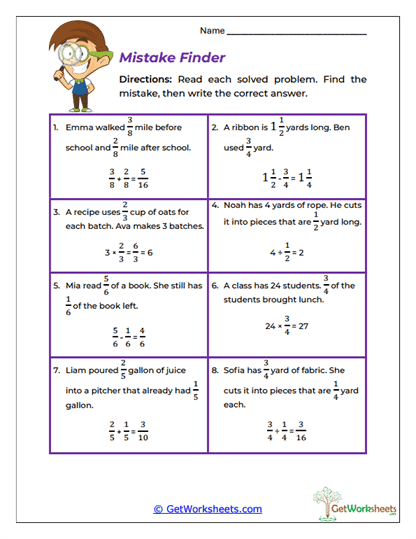
These worksheets bridge abstract fraction concepts with real-world scenarios, practical applications, and multi-step challenges. Students read scenarios involving measurements, recipes, shared quantities, and data sets to determine which fraction concept or operation to apply. Exercises require learners to interpret mathematical language carefully, set up accurate calculations, and evaluate whether their final answers make sense in context. This collection develops critical thinking, reading comprehension in math, and practical problem-solving skills for everyday life.
Identifying Fractions on a Number Line
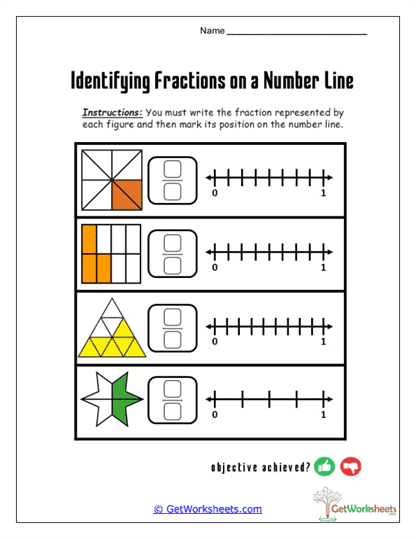
These worksheets show students that fractions have exact numerical positions rather than existing only as shaded pieces of a shape. Learners divide the space between whole numbers into equal intervals and count the jumps indicated by the numerator. Plotting values helps children compare fraction sizes and understand their distance from zero, one-half, and one whole. The collection also strengthens the connection among pictures, fraction notation, and numerical magnitude.
Improper Fractions
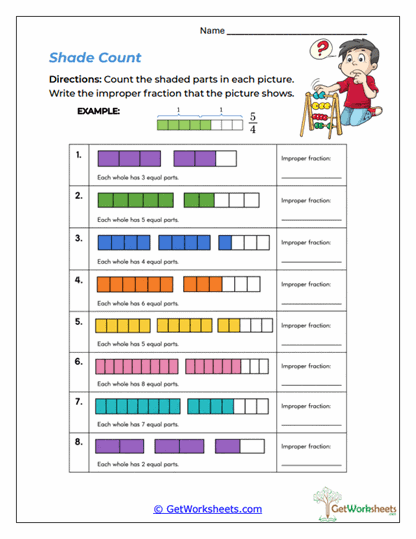
Students explore fractions whose numerators are equal to or greater than their denominators. Models and number lines help them see how these values include one or more complete wholes along with possible leftover parts. Learners also practice connecting improper fractions with equivalent mixed numbers and moving between the two forms. This understanding prepares them to compare, order, and calculate with fractions greater than one.
Simplifying Fractions
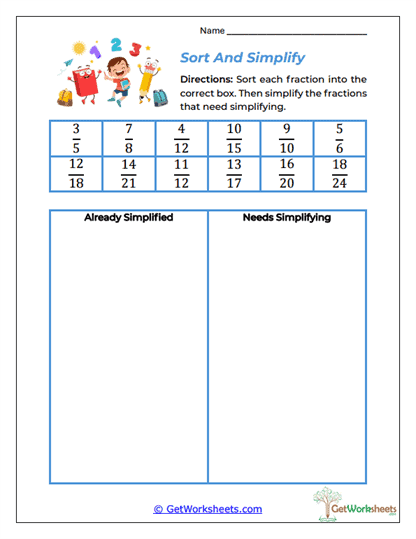
This collection teaches students to rename fractions in lowest terms without changing their value. Learners identify factors shared by the numerator and denominator, divide both numbers equally, and check whether any additional reduction is possible. Visual models and equivalent-fraction reasoning help explain why the fraction's appearance changes while the represented amount remains the same. Simplification supports clearer answers and is an essential skill for later fraction operations.
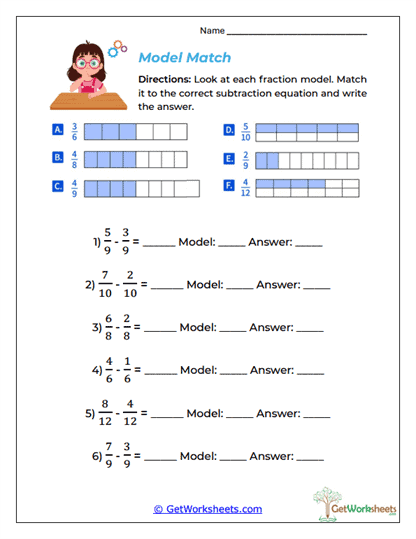
Subtracting Fractions (Like Denominators)
This collection guides students through taking away fractional amounts that have equal-sized parts. Learners focus on subtracting the numerators while maintaining the shared denominator, reinforcing the concept of removing parts from a defined whole. Visual models and number lines support conceptual understanding, especially when problems require borrowing, regrouping, or simplifying the final difference. Working through these exercises develops procedural accuracy, improves basic subtraction fluency, and cements core fraction rules.
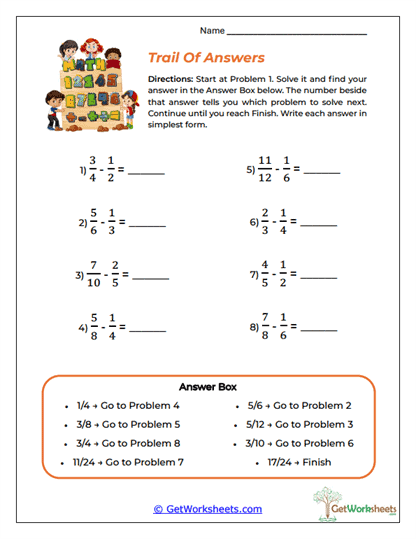
Subtracting Fractions (Unlike Denominators)
Students tackle subtracting fractions that represent different unit sizes. To solve these problems, learners identify common multiples, convert the fractions into equivalent forms with shared denominators, and find the remaining difference. Activities encourage students to verify their work using visual models, benchmarks, or reverse addition to ensure accuracy. This collection refines factor recognition, enhances multi-step problem solving, and prepares learners for working with algebraic expressions and complex equations.
Bookmark Us Now!
New, high-quality worksheets are added every week! Do not miss out!