Fifths on the Number Line
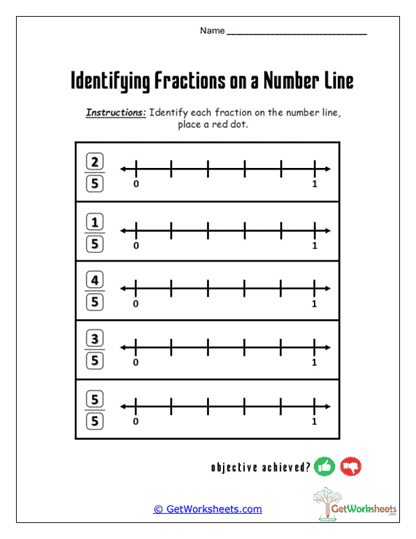
Students identify and plot five fractions with a denominator of five on separate number lines. The fractions include one-fifth through five-fifths, allowing learners to see how each additional fifth moves one equal interval farther from zero and closer to one. This elementary worksheet strengthens number-line partitioning, fraction magnitude, numerator understanding, denominator understanding, equal intervals, and spatial reasoning. It is especially useful for grades 2-3 because all of the problems use the same denominator, letting students focus on how the numerator determines the point’s position.
Key Learning Objectives
- Divide the Line Into Fifths: Students recognize that the distance from zero to one must contain five equal intervals.
- Interpret the Numerator: Learners count the number of fifth-size jumps named by the top number.
- Plot Each Fraction: Children place a red dot at the correct tick mark for every value.
- Recognize One Whole: Students understand that five-fifths lands at one because all five equal parts are included.
Teaching Advantages
- Focuses on One Denominator: Repeated fifths help children build a clear and consistent number-line pattern.
- Makes Fraction Size Visible: Students can see one-fifth, two-fifths, and larger fractions increasing from left to right.
- Helpful for Parent Guidance: Adults can ask the child to begin at zero and count one jump for each fifth.
- Supports Future Comparison: Plotting all five values helps students understand which fractions are greater or less.
- Low-Prep Practice: The page fits math centers, guided lessons, homework, intervention, or homeschool instruction.
Some students count tick marks rather than spaces and place fractions one position too far along the line. This worksheet gives them repeated practice recognizing that the denominator names the number of equal intervals between zero and one. Students strengthen fraction magnitude, number-line fluency, equal partitioning, numerator and denominator vocabulary, counting, and mathematical precision. Parents can remind children that zero is the starting point and does not count as the first fifth. In classroom and homeschool settings, this activity builds confidence and prepares learners to compare, order, and identify fractions on more complicated number lines.
Bookmark Us Now!
New, high-quality worksheets are added every week! Do not miss out!