Fraction Word Problems Worksheets
About This Worksheet Collection
Fraction word problems ask students to apply fraction skills within meaningful situations involving quantities, measurements, groups, and changes. To solve them successfully, learners must first understand what is happening in the story, identify the important numbers, and decide whether the situation requires addition, subtraction, multiplication, or division. This process helps students connect fraction procedures with real mathematical relationships rather than treating each operation as an isolated rule.
This collection develops fraction problem-solving through operation-identification activities, equation matching, visual models, estimation, one-step and multi-step problems, error analysis, solution checking, and creative writing tasks. Some worksheets remove the calculation step so students can focus on comprehension, while others ask them to write equations, draw representations, solve complete problems, or explain mistakes. The pages can be used during direct instruction, guided math, centers, intervention, tutoring, homework, assessment, enrichment, or homeschool lessons.
As students complete the collection, they strengthen reading comprehension, operation sense, mathematical modeling, fraction fluency, estimation, equation writing, mixed-number reasoning, and problem-solving persistence. They also practice checking whether answers are reasonable, explaining their thinking, using appropriate units, and connecting equations with real-world meaning. These skills prepare learners for more advanced fraction operations, ratios, proportions, algebraic reasoning, measurement, and multi-step mathematical applications.
Detailed Descriptions Of These Worksheets
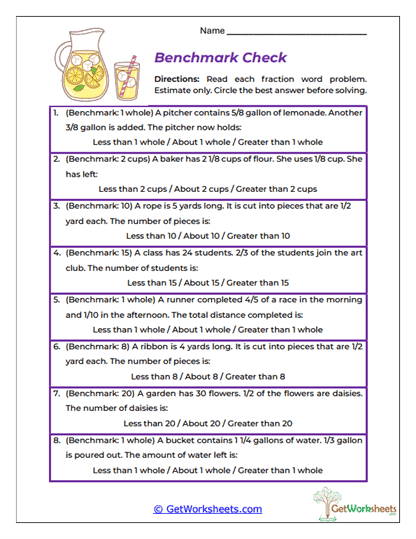
Benchmark Check
Students estimate the likely size of each answer by comparing it with a familiar benchmark. They decide whether the result should be below, near, or above a stated whole number or measurement before completing any exact calculation. This encourages learners to think about fraction magnitude and the meaning of the situation rather than relying only on procedures. Estimation also provides a useful way to recognize answers that are much too large or too small.
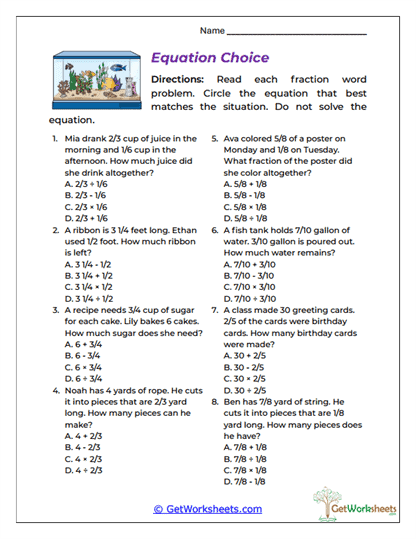
Equation Choice
Several possible equations are provided for each fraction story, and students must select the one that best represents the situation. Learners pay attention to the required operation, the order of the quantities, and language such as "left," "altogether," "of," or "cut into pieces." Comparing similar-looking choices helps reveal whether a misunderstanding involves the operation or the placement of the numbers. The structured format offers helpful support before students begin writing equations independently.
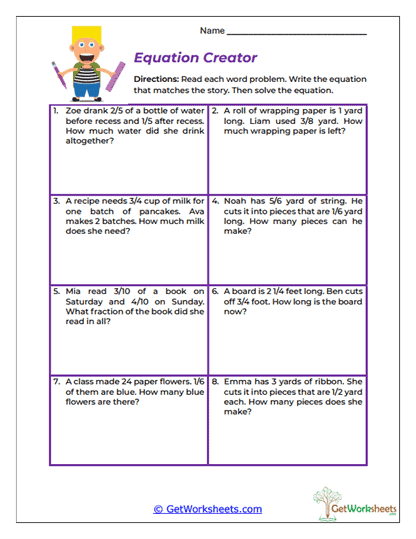
Equation Creator
Word problems are translated into mathematical equations before students solve them. Learners identify the action taking place, organize the relevant quantities, and select the operation that accurately represents the story. Writing the equation creates a useful planning step between reading and calculating. It also allows teachers and parents to see whether an error began with comprehension or computation.
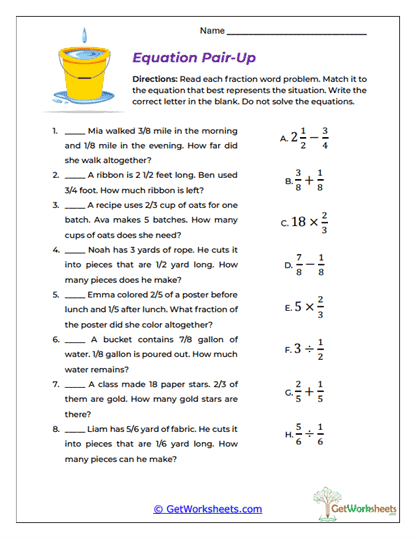
Equation Pair-Up
Fraction stories in one section must be matched with equations that correctly model them. Students determine what each quantity represents and whether the situation describes combining, removing, grouping, or finding part of an amount. Since several equations may contain the same numbers, careful attention to operation and order is necessary. This activity strengthens equation recognition without adding the extra demand of completing every calculation.
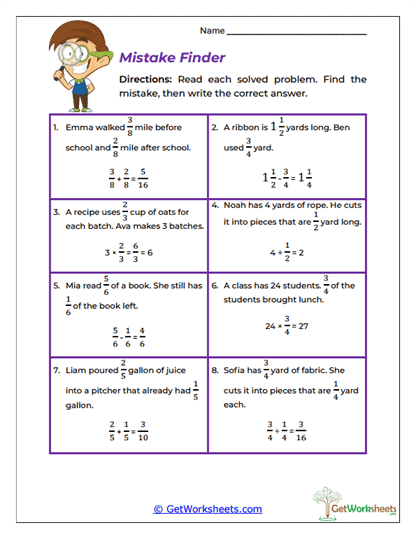
Mistake Finder
Completed fraction problems containing errors invite learners to examine and repair the work. Students decide whether the equation matches the story, identify the incorrect step, and calculate a valid solution. Mistakes may involve operation choice, mixed numbers, reciprocals, simplification, or one of the four fraction operations. The activity turns incorrect answers into opportunities for deeper reasoning and clearer mathematical explanation.
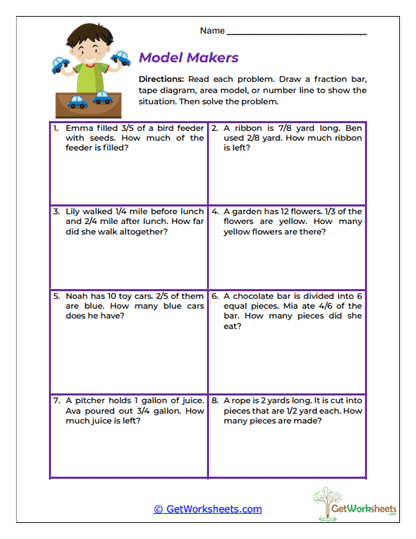
Model Makers
Students draw a fraction bar, tape diagram, area model, or number line to represent each situation. Building a visual model helps them identify the whole, the fractional parts, the change taking place, and the unknown quantity. The completed picture then guides the operation and supports the numerical solution. This approach is especially helpful for learners who understand problems more easily when the relationships are made visible.
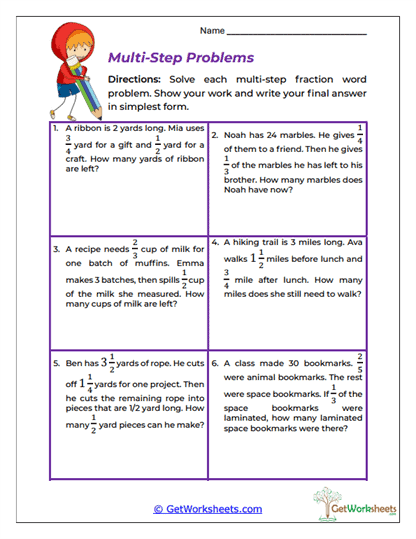
Multi-Step Problems
Longer situations require students to use more than one operation to reach the final answer. Learners break each story into smaller parts, determine what must be found first, and organize intermediate calculations carefully. Problems may include fractions, mixed numbers, measurements, and combinations of addition, subtraction, multiplication, or division. The page develops planning, stamina, and accuracy while preparing students for more advanced mathematical applications.
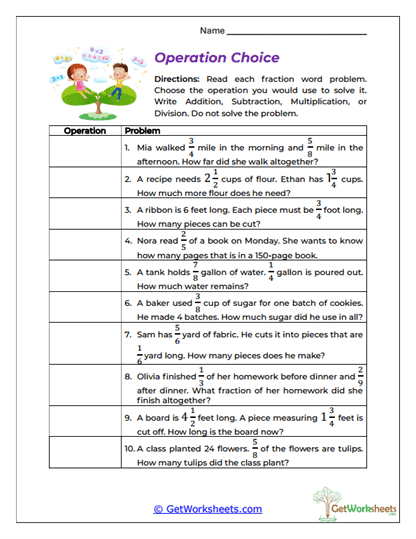
Operation Choice
This worksheet asks students to identify the needed operation without solving the problem. Learners decide whether each story involves combining amounts, finding a difference, taking a fraction of a quantity, or dividing something into equal groups. Removing the computation allows them to focus fully on the language and structure of the situation. The activity is useful for identifying students who know fraction procedures but struggle to choose when each one applies.
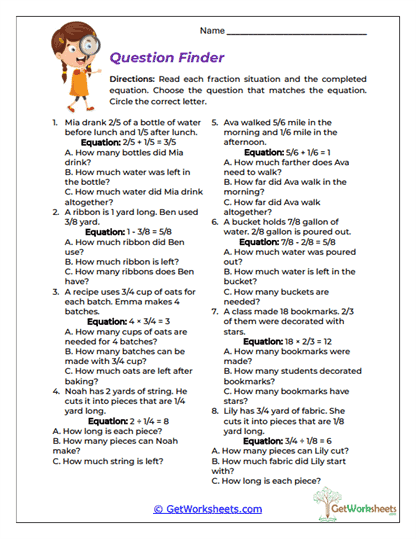
Question Finder
Students study a completed fraction equation and determine which question it correctly answers. They work backward from the operation and result to identify whether the solution represents a total, remainder, difference, product, or number of groups. Similar answer choices require careful reading and attention to what each quantity means. This reverse-reasoning format strengthens the connection between a numerical answer and its real-world interpretation.
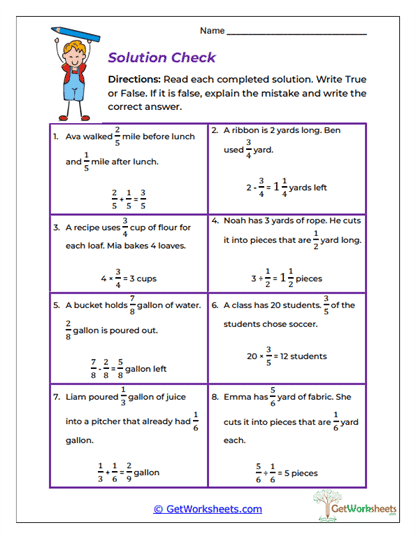
Solution Check
Each completed solution must be evaluated as true or false. Learners verify the operation, recompute the fraction work, examine the final form, and explain any error they find. The task emphasizes that checking includes both the arithmetic and whether the answer makes sense in the original context. It helps students become more independent and thoughtful when reviewing their own work.
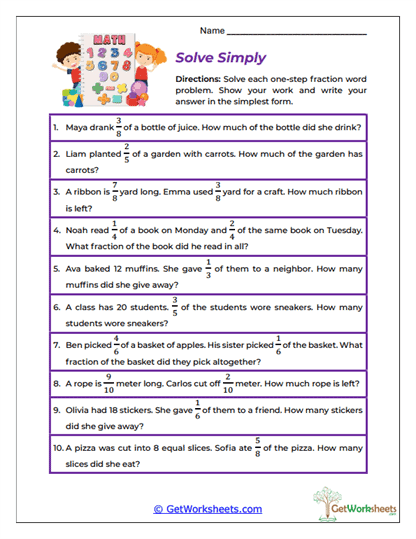
Solve Simply
Familiar one-step situations give learners manageable practice applying all four fraction operations. Students identify the action in each story, select an appropriate method, show their calculations, and simplify the result. Contexts involving food, school, measurements, collections, and sharing make the quantities easier to imagine. This page provides a clear bridge between learning fraction rules and applying them independently.
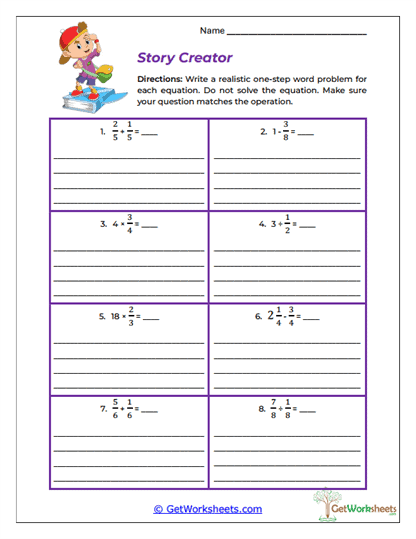
Story Creator
Provided fraction equations become the basis for original word problems written by the student. Learners choose realistic objects, quantities, and units while making sure the story matches the operation and asks for the correct unknown. Creating a problem requires a deeper understanding of what the equation means than calculation alone. The open-ended format combines mathematical reasoning, vocabulary, and written communication.
Bookmark Us Now!
New, high-quality worksheets are added every week! Do not miss out!