Fraction of a Number Worksheets
-
Divided Parts
-
Equation Writing
-
Estimate and Solve
-
-
Expression Matching
-
Fact Check
-
Finding Fractions
-
Fraction Blocks
-
Fraction Chart
-
Fraction Mistakes
-
Fraction Models
-
Fraction Picks
-
Fraction Rankings
-
Fraction Sets
-
Fraction Value Match
-
Mystery Whole
-
Odd Fraction
-
Pattern Paths
-
Pixel Patch
-
Quantity Match
-
Real Life Fractions
-
Set Count
-
Target Match
-
Value Comparison
-
Whole Hunt
About This Worksheet Collection
Finding a fraction of a number requires students to determine how much of a whole quantity is represented by a given numerator and denominator. Learners typically divide the whole number by the denominator to find the value of one equal part, then multiply that amount by the numerator. Understanding this process helps children connect fractions with multiplication, division, equal groups, and real quantities rather than viewing fractions only as shaded pieces of a shape.
This collection approaches the skill through object sets, fraction bars, number lines, tables, equations, matching activities, color-coded puzzles, number patterns, error analysis, comparisons, missing-number problems, and practical word problems. Some pages offer visual models for developing learners, while others ask students to calculate independently, work backward, evaluate statements, or create their own expressions. The worksheets can support whole-class instruction, guided math, centers, intervention, independent practice, homework, tutoring, assessment, or homeschool lessons.
Across the collection, students strengthen fraction sense, fact fluency, equal-group reasoning, equation writing, estimation, pattern recognition, mathematical modeling, and problem-solving accuracy. They also learn to compare results, recognize equivalent expressions, correct mistakes, interpret real-world situations, and explain how their calculations work. These skills establish a strong foundation for fraction operations, ratios, percentages, algebraic reasoning, measurement, and other upper-elementary math concepts.
Detailed Descriptions Of These Worksheets
Divided Parts
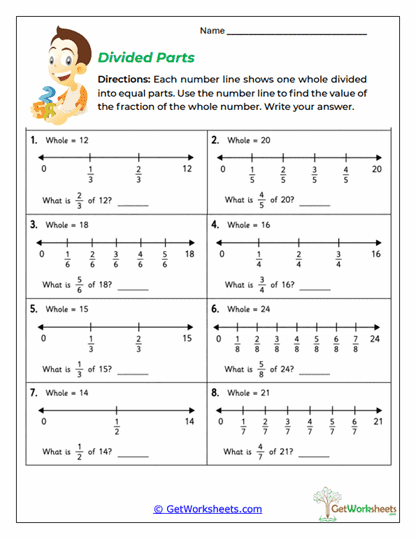
Number lines show learners how a whole quantity can be separated into equal fractional intervals. Children determine the value of each jump and count the number of sections represented by the numerator. This visual structure makes the division step easier to understand before students complete the multiplication. It offers a helpful bridge between concrete fraction models and symbolic equations.
Equation Writing
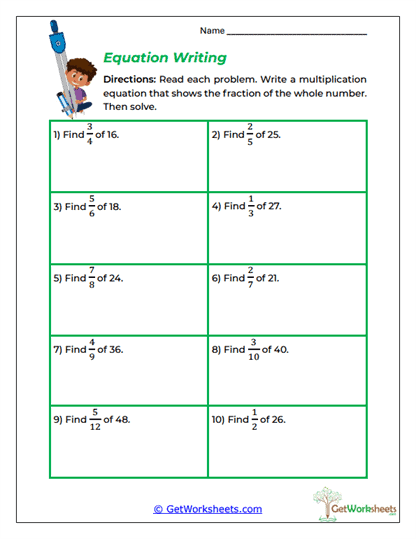
Fraction phrases are transformed into multiplication equations before each value is calculated. Learners identify the whole number, use the denominator to find one equal part, and apply the numerator to complete the expression. Recording the equation encourages organized work and gives teachers or parents a clear view of the child's reasoning. The activity also introduces symbolic habits that support later algebra work.
Estimate and Solve
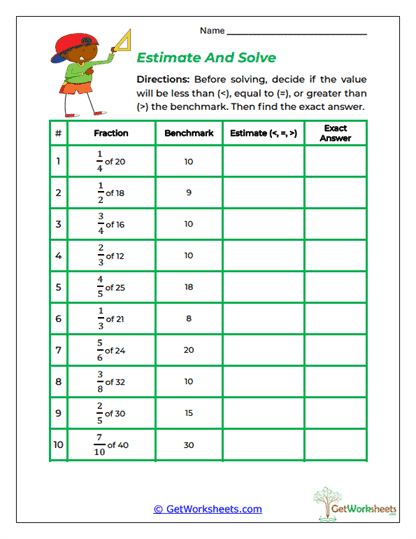
Before calculating an exact result, children compare each fraction expression with a given benchmark. They predict whether the value will be smaller than, equal to, or larger than that reference point and then solve to check their thinking. This two-step format encourages learners to consider whether an answer is reasonable instead of relying only on a memorized process. Estimation becomes a useful tool for catching multiplication or division mistakes.
Expression Matching
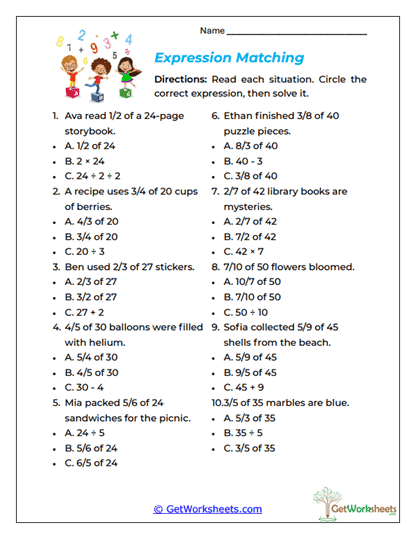
Short situations require students to choose the mathematical expression that correctly represents the fraction being described. Once they identify the appropriate equation, they solve it and connect the answer back to the context. Incorrect choices help reveal confusion about operations and the meaning of the word "of." The page strengthens both reading comprehension and mathematical modeling.
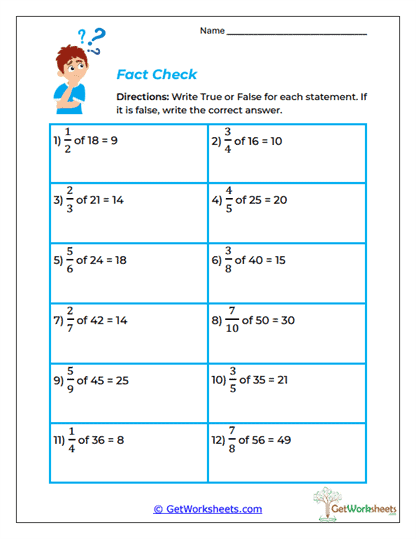
Fact Check
Completed fraction statements must be examined and labeled as true or false. When an answer is incorrect, learners calculate the proper value and rewrite the statement accurately. Checking someone else's work encourages students to pay attention to each step rather than accepting a finished answer without question. It also develops habits they can use when reviewing their own calculations.
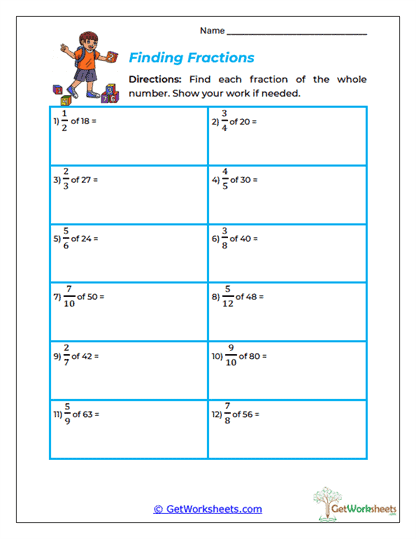
Finding Fractions
A mixed set of problems gives learners broad practice finding fractional parts of whole numbers. The denominators vary throughout the page, requiring children to apply the same divide-then-multiply reasoning in several different situations. Open workspace allows them to use equations, drawings, equal groups, or mental math. This makes the activity useful for independent review or assessing whether students can select an efficient strategy.
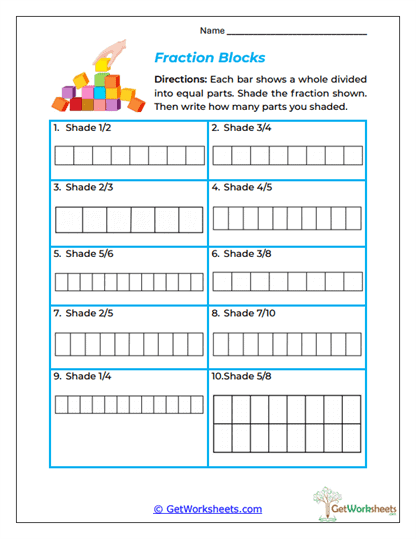
Fraction Blocks
Rectangular bars divided into equal sections provide clear visual support for each problem. Students shade the requested fraction and then determine exactly how many individual blocks their shaded portion contains. The activity reinforces that a numerator represents groups of equal parts rather than always indicating a fixed number of boxes. It is especially helpful for children who need to see the relationship between a fraction and the size of the complete set.
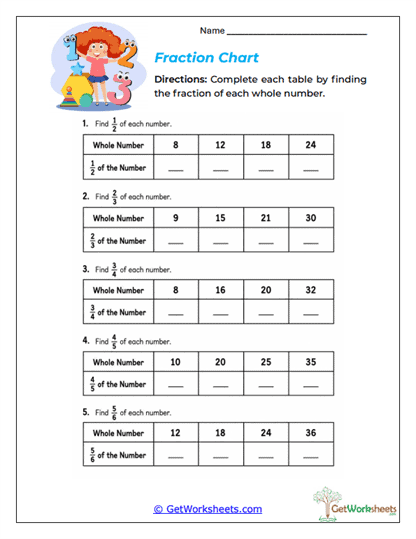
Fraction Chart
Learners complete organized tables by finding the same fraction of several different whole numbers. Working across each row helps them observe how the answers change as the original quantities increase. The consistent table layout supports careful placement and makes numerical patterns easier to notice. Repeated practice also builds greater speed with common multiplication and division facts.
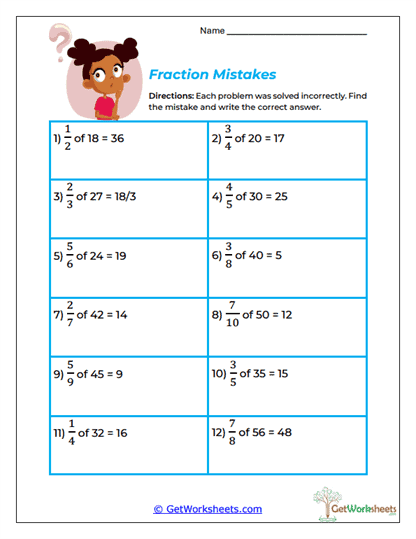
Fraction Mistakes
Every problem includes an incorrect solution that students must investigate and repair. Children solve the expression themselves, compare their result with the answer shown, and determine where the reasoning went wrong. The errors may involve dividing by the wrong number, multiplying incorrectly, or stopping before the process is complete. This approach turns common misconceptions into useful opportunities for discussion and correction.
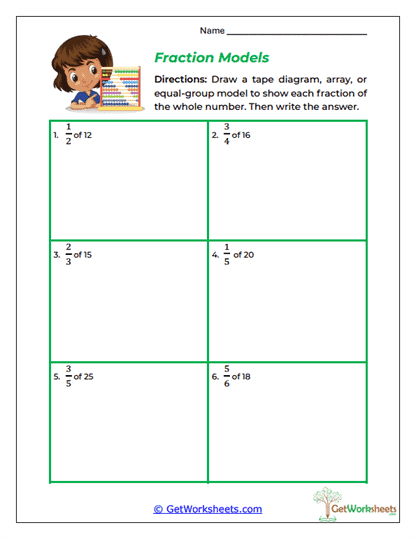
Fraction Models
Students draw tape diagrams, arrays, or equal-group representations to show how each fraction value is formed. The denominator guides how the whole is partitioned, while the numerator determines how many of those groups are selected. Building the picture before calculating helps children understand why the standard procedure works. The page also gives learners flexibility to choose a model that makes sense to them.
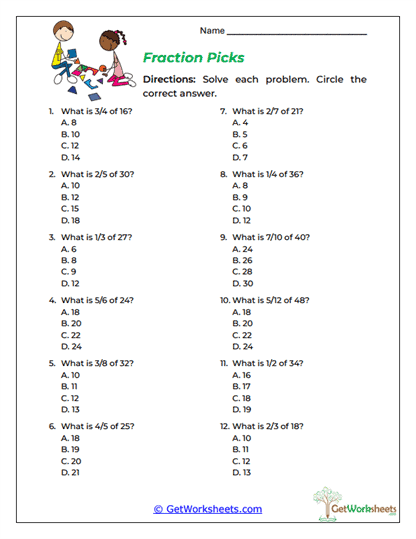
Fraction Picks
Multiple-choice problems provide focused practice with common fractions of whole numbers. Learners calculate each value and then locate the matching answer among four options. Solving before looking closely at the choices discourages guessing and strengthens test-taking habits. The format works well as a quick review, homework page, or informal skill assessment.
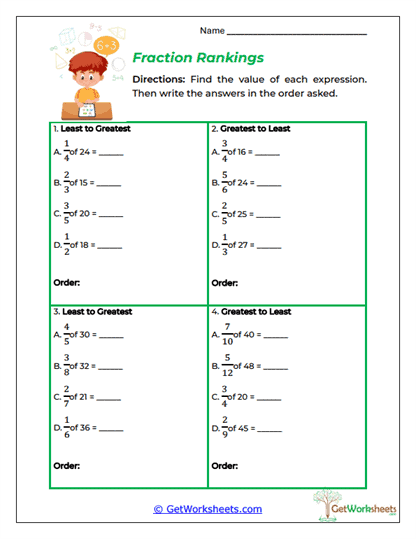
Fraction Rankings
Groups of fraction expressions must first be solved and then arranged in the requested order. Students compare the whole-number results and organize them from least to greatest or greatest to least. Because the activity combines two skills, careful labeling and workspace organization are important. It helps children strengthen calculation accuracy while also practicing numerical comparison.
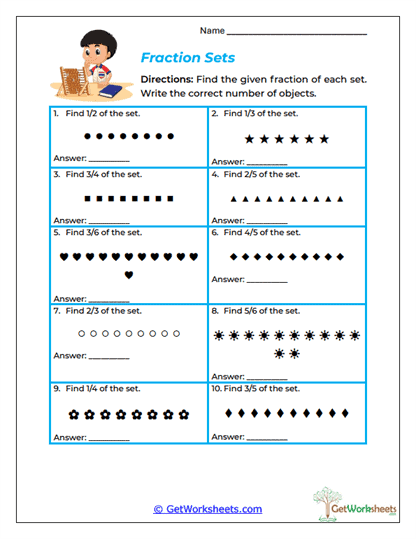
Fraction Sets
Pictures of object groups make fraction-of-a-set problems easier to visualize. Learners count the complete collection, separate it into the number of equal groups indicated by the denominator, and then select the amount described by the numerator. Children may circle or mark objects as they work, which supports developing fraction understanding. The activity shows that fractions can describe collections just as easily as pizzas, bars, or other single shapes.
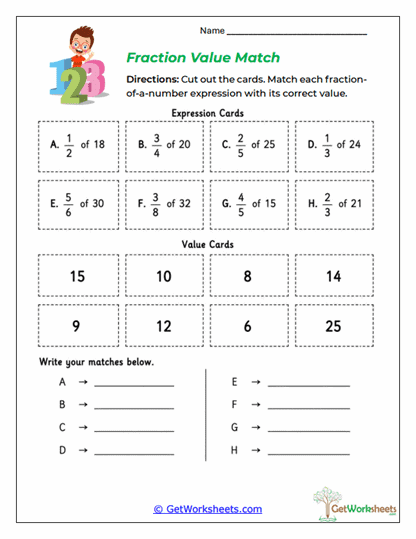
Fraction Value Match
Cut-apart cards invite students to pair fraction expressions with their correct whole-number products. After completing the matches, learners record each result in the provided spaces. Moving the cards adds a hands-on element and makes it easier to reconsider an answer when a pairing does not fit. The task can also be completed with partners who explain and compare their reasoning.
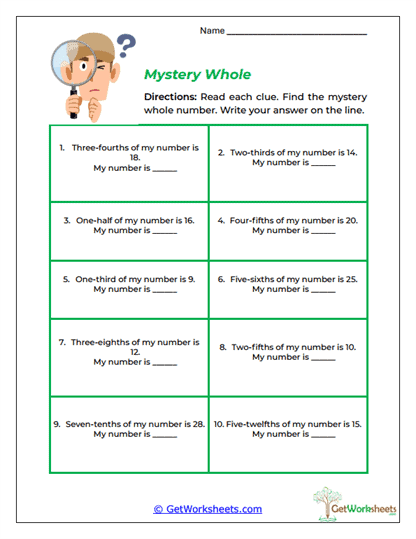
Mystery Whole
Rather than finding a fractional part, students begin with the part and work backward to discover the original number. They divide the known amount by the numerator to determine one equal section and then multiply by the denominator to rebuild the whole. Substituting the answer into the original clue provides a natural way to check the solution. This reverse process prepares learners for missing-number equations and introductory algebraic thinking.
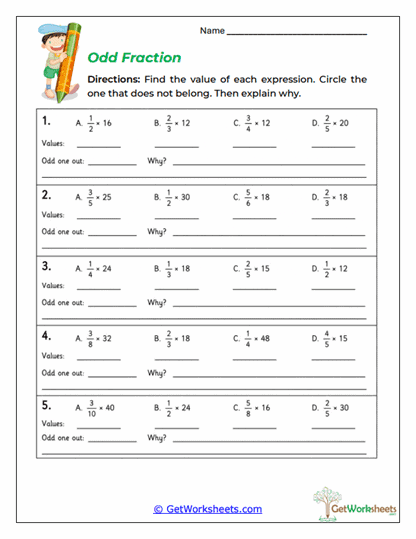
Odd Fraction
Each group contains several fraction expressions that must be solved and compared. Three produce a matching value, while one gives a different result that does not belong. Learners identify the unusual expression and explain the relationship they noticed. The activity promotes equivalence, pattern recognition, and mathematical communication rather than isolated calculation alone.
Pattern Paths
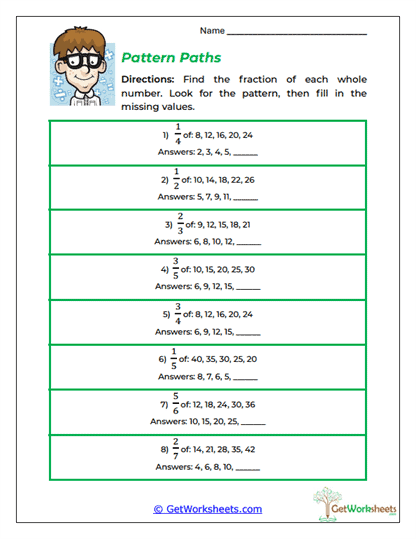
Related whole numbers are used to create sequences of fractional values. Children calculate the requested fraction of each number, study how the results change, and predict the missing final term. A result that breaks the pattern can alert them to review their arithmetic. This structure encourages efficient mental math and helps learners recognize connections across several problems.
Pixel Patch
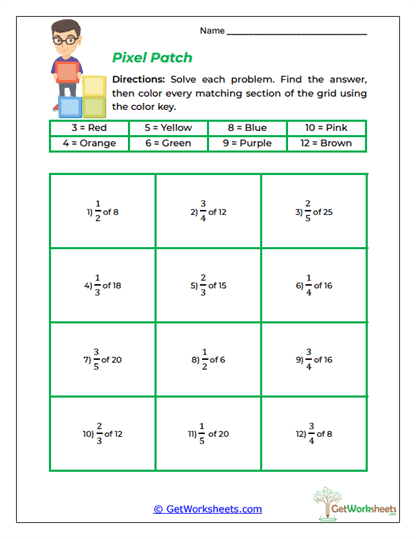
A color key transforms fraction calculations into a hidden grid design. Students solve each expression, match the answer with its assigned color, and shade the corresponding sections. Accurate work gradually produces a recognizable pixel-style picture, giving children a visual way to notice possible mistakes. The puzzle format adds motivation without taking attention away from the mathematics.
Quantity Match
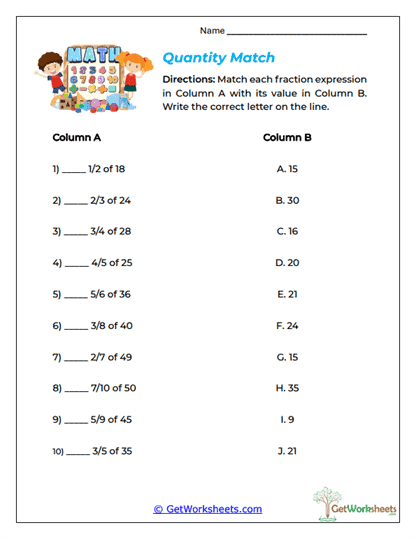
Expressions in one column must be connected with the correct values in another. Learners calculate each fraction of a whole number and record the letter of the matching answer. Since different expressions may share a result, students must organize their work carefully instead of eliminating choices too quickly. This reinforces the idea that different numerical forms can represent the same quantity.
Real Life Fractions
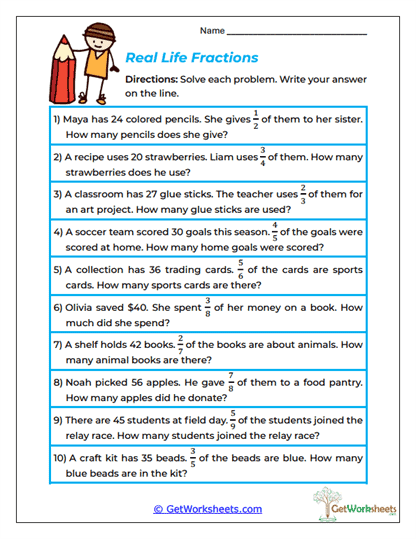
Everyday situations involving money, classroom supplies, food, books, students, and collections give practical meaning to the calculations. Children identify the total quantity, determine the requested fraction, and label the answer with the appropriate unit. Underlining the whole number and circling the fraction can help learners translate each story into a manageable equation. The activity connects mathematical procedures with familiar decisions and quantities.
Set Count
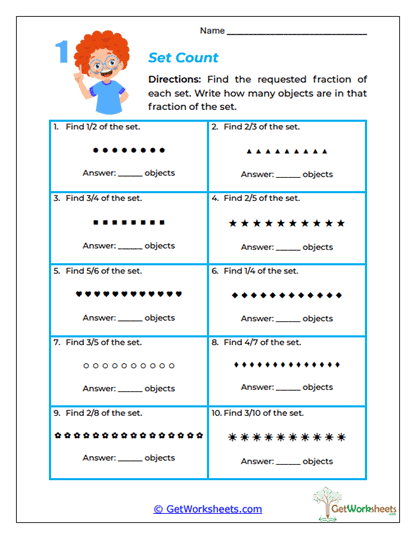
Groups of shapes provide concrete support as children find fractional amounts within collections. Learners count the objects, organize them into equal groups, and determine how many belong to the requested portion. The varied pictures encourage careful counting and can be circled or marked during the solving process. This repeated visual practice prepares students to complete similar calculations without object models.
Target Match
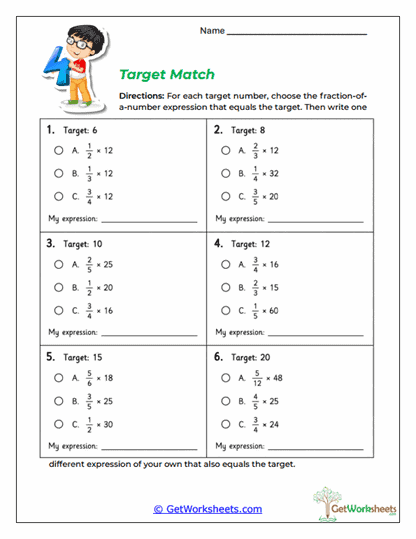
Each challenge begins with a target number rather than a completed fraction expression. Students evaluate the provided choices, select the one that reaches the target, and then create a different valid expression of their own. Working backward encourages flexible thinking about numerators, denominators, and whole numbers. It also demonstrates that the same value can be produced through several mathematically correct relationships.
Value Comparison
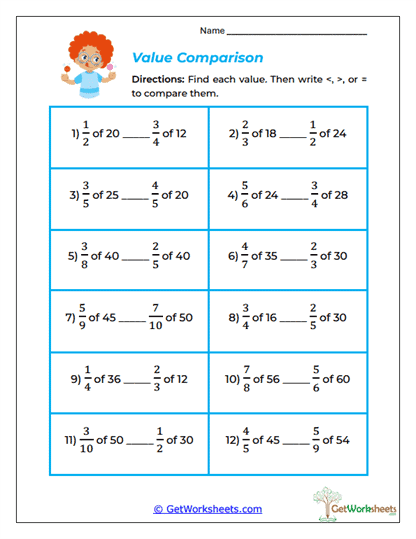
Pairs of fraction expressions must be solved before they can be compared. Children write the resulting values and place the correct less than, greater than, or equal symbol between them. The problems show that the appearance of the fractions alone does not determine the relationship because the whole numbers also affect the results. This multi-step format strengthens calculation, estimation, and comparison accuracy.
Whole Hunt
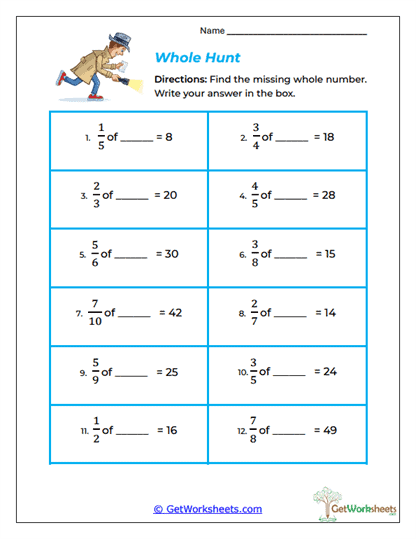
Missing whole numbers are hidden inside a series of fraction equations. Learners use the known fractional value to find one equal part and then reconstruct the complete amount. Drawing equal boxes can provide helpful support when the reverse process initially feels unfamiliar. Regular checking reinforces the connection between inverse operations and fraction reasoning.
Bookmark Us Now!
New, high-quality worksheets are added every week! Do not miss out!