Watermelon Fractions
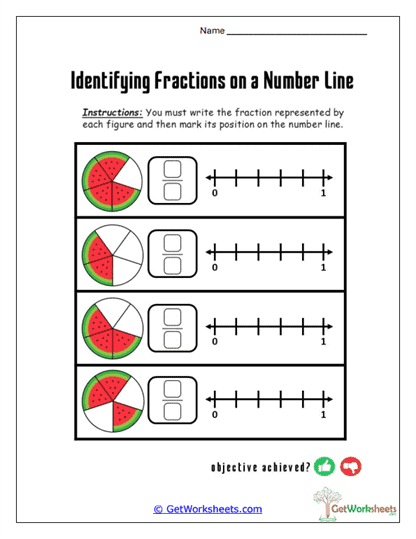
Students study four watermelon fraction models, write the fraction shown by each shaded picture, and then mark that value on a number line from zero to one. Each model is divided into equal slices, so learners must count both the total number of parts and the number of shaded parts before placing the fraction correctly. This elementary worksheet strengthens numerator and denominator understanding, visual fraction identification, equal partitioning, number-line placement, fraction magnitude, and part-whole reasoning. It is especially useful for grades 2-3 because students connect a familiar picture model with a more abstract number-line representation.
Learning Goals
- Identify the Denominator: Students count how many equal slices make up each complete watermelon.
- Find the Numerator: Learners count how many of those equal slices are shaded.
- Write the Fraction: Children record the shaded amount using correct numerator-over-denominator notation.
- Place the Value: Students mark the fraction at the matching point between zero and one.
How This Helps
- Connects Two Important Models: Students move from shaded pictures to number lines instead of learning each representation separately.
- Supports Visual Learners: The bright watermelon sections make the fractional parts easy to count and compare.
- Easy for Parents to Explain: Adults can ask, “How many equal pieces are there, and how many are colored?”
- Builds Fraction Magnitude: Children begin to understand where a fraction belongs based on how much of the whole is shaded.
- Ready for Immediate Use: The page works well for guided math, centers, intervention, tutoring, homework, or homeschool lessons.
Many children can name a shaded fraction but do not yet understand where that value belongs on a number line. This worksheet helps them see that the picture and the point represent the same amount. Students strengthen fraction notation, equal parts, numerator and denominator vocabulary, counting, number-line reasoning, visual comparison, and mathematical accuracy through four focused examples. Parents can encourage children to count the spaces on the line rather than only the tick marks. In classroom and homeschool settings, this activity builds confidence and gives students a strong bridge from concrete fraction pictures to abstract fraction values.
Bookmark Us Now!
New, high-quality worksheets are added every week! Do not miss out!