Swirl Fraction Lines
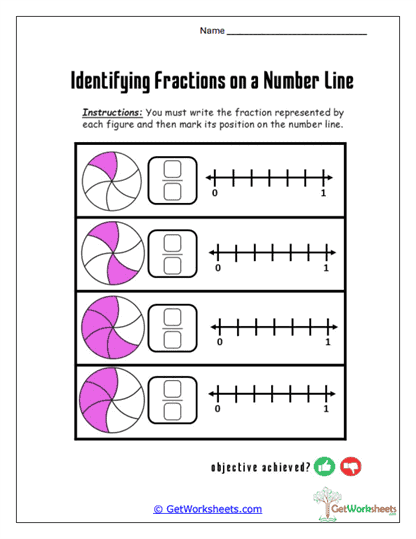
Students study four swirl-shaped circular models, write the fraction shown by each shaded region, and mark that value on a number line from zero to one. Each circle is divided into equal curved sections, giving learners practice identifying fractions when the parts are not simple straight-sided shapes. This elementary worksheet strengthens fraction recognition, equal-part understanding, numerator and denominator identification, number-line plotting, visual discrimination, and fraction magnitude. It is especially appropriate for grades 2-3 because students learn that equal fractional parts may have unusual shapes while still representing equal portions of a whole.
Key Learning Objectives
- Recognize Equal Curved Parts: Students determine how many sections make up each complete circular model.
- Write the Fraction: Learners use shaded sections for the numerator and total sections for the denominator.
- Partition the Number Line: Children divide the distance from zero to one according to the denominator.
- Locate the Value: Students mark the correct point based on the number of shaded parts.
Teaching Advantages
- Expands Visual Understanding: Students see that equal parts do not always have to look like rectangles or pizza slices.
- Supports Flexible Thinking: The curved models help prevent children from relying on one familiar picture type.
- Easy for Families to Discuss: Parents can ask whether each curved section represents the same amount of the whole.
- Builds Fraction Magnitude: Learners connect a larger shaded portion with a point farther to the right.
- Low-Prep Practice: The page works well for whole-class lessons, independent work, centers, tutoring, or homeschool instruction.
Some students think fraction parts must all have the same simple shape to be equal. This worksheet helps them focus on equal area and total amount rather than the appearance of each curved section. Students practice fraction notation, numerator and denominator reasoning, number-line placement, visual analysis, spatial reasoning, and mathematical language through four related examples. Parents can encourage children to compare the amount shaded before choosing a location on the line. In classroom and homeschool settings, this activity builds confidence and strengthens the idea that fractions describe equal portions of a whole, even when the design looks unusual.
Bookmark Us Now!
New, high-quality worksheets are added every week! Do not miss out!