Fraction Story Lines
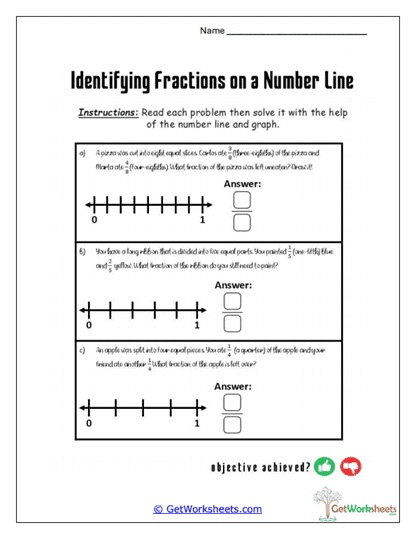
Students read three short fraction word problems and use the number lines beneath them to represent and solve each situation. The problems involve practical contexts such as pizza slices, ribbon sections, and apples, requiring learners to identify the fraction used or left and then show it on a line from zero to one. This elementary worksheet strengthens word-problem comprehension, fraction subtraction within one whole, number-line modeling, numerator and denominator reasoning, and mathematical explanation. It is especially useful for grades 3-4 because students must translate story language into a fraction and then connect that answer to a visual model.
Academic Focus
- Identify the Whole: Students determine what complete object or set represents one whole in each story.
- Find the Used Fraction: Learners identify how much was eaten, painted, given away, or otherwise removed.
- Determine the Remaining Fraction: Children subtract the used portion from one whole when the question asks what is left.
- Model the Answer: Students plot the resulting fraction on the provided number line.
Instructional Benefits
- Connects Reading and Math: Students must understand the situation before they can identify the correct fraction.
- Makes Remaining Amounts Visible: The number line helps children see the distance between the used fraction and one whole.
- Helpful for Parent Support: Adults can ask, “How much of the whole was used, and how much is still left?”
- Builds Real-World Fraction Sense: The stories show how fractions describe everyday amounts.
- Ready for Multiple Settings: The worksheet fits guided math, small groups, intervention, tutoring, homework, or homeschool lessons.
Many children can name a fraction shown in a picture but struggle when the same idea appears inside a word problem. This worksheet helps them pull out the important information, decide whether to use the given fraction or find the remaining part, and then show the answer visually. Students strengthen comprehension, fraction notation, number-line reasoning, subtraction from one whole, problem solving, and mathematical communication. Parents can encourage children to draw or shade the used amount first, then look at what remains. In classroom and homeschool settings, this activity builds confidence and prepares learners to solve more advanced fraction situations involving parts used, parts left, and positions between zero and one.
Bookmark Us Now!
New, high-quality worksheets are added every week! Do not miss out!