Geometric Fraction Lines
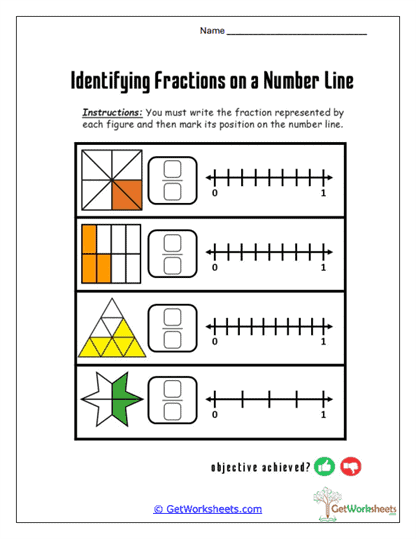
Students examine four geometric fraction models, write the fraction represented by the shaded portions, and then place each value on a number line from zero to one. The models include divided squares, rectangular grids, a triangle, and a star, so learners must carefully identify the whole and count equal parts. This elementary worksheet strengthens fraction identification, numerator and denominator understanding, equal partitioning, visual reasoning, number-line placement, and fraction magnitude. It is especially useful for grades 2-3 because students practice moving from shaded shape models to symbolic fractions and then to positions on a number line.
Learning Goals
- Identify the Whole Shape: Students decide which complete figure represents one whole.
- Count Equal Parts: Learners determine the denominator by counting all sections in the model.
- Count Shaded Parts: Children find the numerator by identifying how many equal pieces are colored.
- Plot the Fraction: Students place the fraction at the correct location between zero and one.
How This Helps
- Connects Three Representations: Students work with pictures, written fractions, and number lines on the same page.
- Builds Careful Observation: Different shapes require learners to slow down and count accurately.
- Supports Parent Guidance: Adults can ask, “How many equal parts make the whole, and how many are shaded?”
- Strengthens Number-Line Understanding: Children learn that the denominator determines the number of equal spaces.
- Ready for Immediate Use: The worksheet fits guided math, centers, homework, tutoring, intervention, or homeschool practice.
Many children can identify a fraction in a circle but become unsure when the whole is a square, grid, triangle, or star. This worksheet teaches them that fraction meaning does not depend on the shape of the model. Students strengthen part-whole reasoning, numerator and denominator vocabulary, visual fraction recognition, number-line intervals, spatial thinking, and mathematical accuracy. Parents can remind children to count equal spaces on the number line rather than only counting tick marks. In classroom and homeschool settings, this activity builds confidence and helps learners recognize the same fraction idea across many different geometric designs.
Bookmark Us Now!
New, high-quality worksheets are added every week! Do not miss out!