Comparing Fractions Worksheets
About This Worksheet Collection
Comparing fractions means determining whether one fractional amount is greater than, less than, or equal to another. To make accurate comparisons, students must think about the number of parts being considered, the size of those parts, and the relationship between the numerator and denominator. Learning to compare fractions strengthens number sense and helps children understand that fractions represent measurable values rather than simply two whole numbers written on top of one another.
This collection introduces fraction comparison through a wide range of activities, including visual fraction bars, number lines, like denominator and like-numerator problems, benchmark fractions, equivalent fractions, ordering exercises, matching tasks, error analysis, and real-world word problems. Some pages provide visual support, while others encourage learners to work independently with numerical representations and written statements. The worksheets can be used during classroom instruction, math centers, intervention groups, tutoring sessions, homework, assessment, or homeschool lessons.
As students complete the collection, they develop a more flexible understanding of fraction magnitude and learn to choose comparison strategies based on the numbers in front of them. They practice interpreting models, using comparison symbols, creating equivalent fractions, ordering values, checking mathematical claims, and explaining why one amount is larger or smaller. These skills prepare learners for later work involving fraction operations, mixed numbers, decimals, measurement, ratios, and other upper-elementary math concepts.
Detailed Descriptions Of These Worksheets
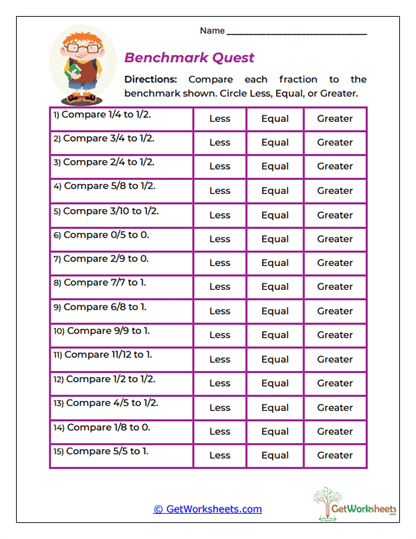
Benchmark Quest
Familiar values such as zero, one-half, and one serve as reference points throughout this activity. For every fraction, children decide whether its value falls below, matches, or rises above the given benchmark. They learn to examine the relationship between the numerator and denominator instead of completing unnecessary calculations. Using these mathematical landmarks gives students a fast and dependable strategy for estimating fraction size. The page also helps prepare learners for comparison questions commonly found in upper-elementary assessments.
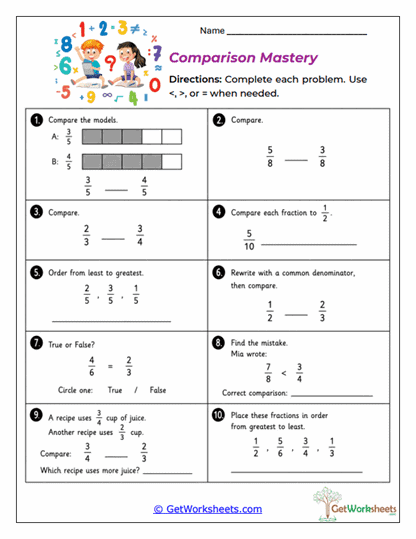
Comparison Mastery
This cumulative review brings together visual models, direct comparisons, benchmarks, ordering, equivalent fractions, error correction, and word-problem reasoning. Because the question types change throughout the page, learners must pause and select an appropriate method for each one. The mixed structure provides a clearer picture of overall understanding than a worksheet containing only one repeated skill. Teachers and parents can use missed problems to identify areas that may need additional instruction or practice. It is an effective choice for end-of-unit review, assessment, or test preparation.
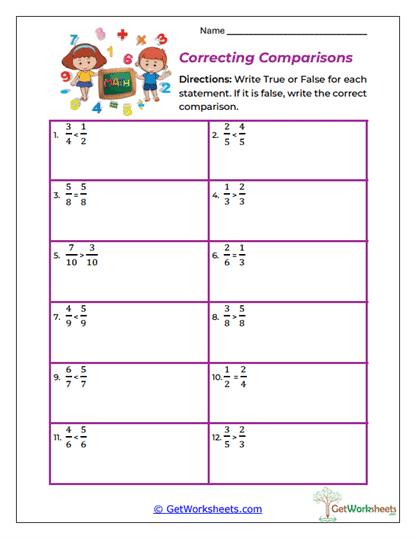
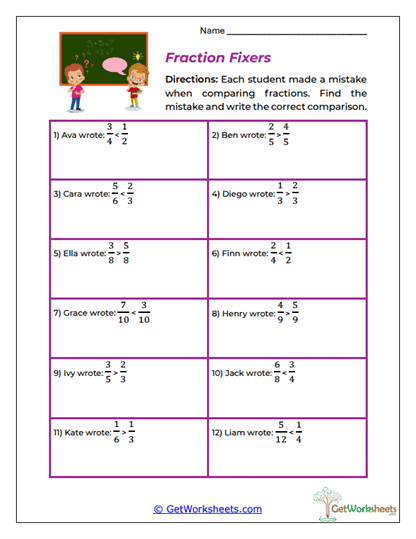
Correcting Comparisons
Twelve completed fraction statements challenge learners to decide whether the comparisons are mathematically accurate. A false statement must be repaired by replacing the incorrect symbol with the correct one. Rather than simply solving from scratch, children evaluate existing work and identify what went wrong. This process reveals misconceptions involving symbol direction, denominator size, and equivalent fractions. It also encourages students to treat checking and revising as essential parts of solving math problems.
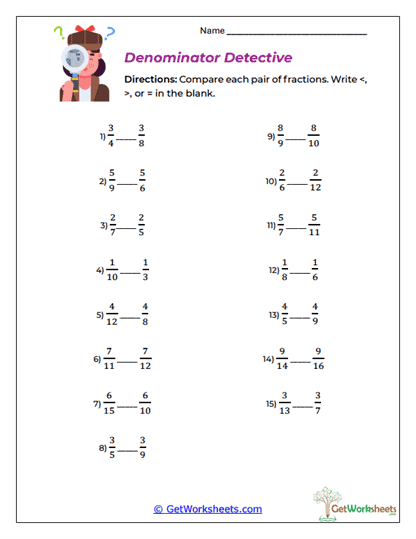
Denominator Detective
Learners investigate fraction pairs that contain matching numerators but different denominators. They must reason that dividing a whole into fewer pieces creates larger pieces, while dividing it into more pieces creates smaller ones. Familiar examples involving pizza slices or sections of a candy bar can help children explain why the fraction with the smaller denominator is often greater. This focused practice builds a stronger understanding of what the denominator actually tells us.
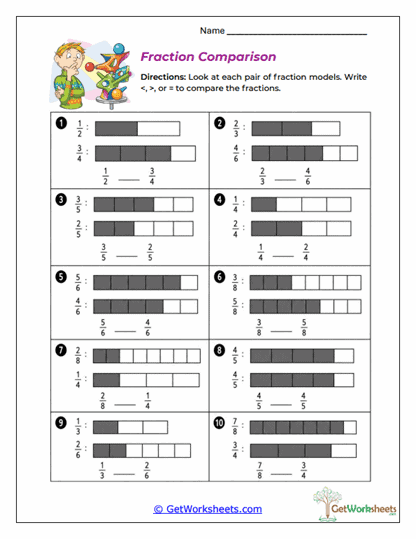
Fraction Comparison
Pairs of shaded fraction bars give learners a clear visual way to decide which amount is larger, smaller, or equal. Children study how much of each bar is shaded before placing the correct comparison symbol between the models. The activity helps correct the common belief that a fraction with a larger denominator must always have the greater value. It works especially well as an introduction to comparing fractions before students are expected to rely entirely on numerical strategies.
Fraction Fixers
Incorrect fraction comparisons give students an opportunity to act as mathematical editors. Each pair may require a different approach, including examining like denominators, reasoning about like numerators, using benchmarks, or recognizing equivalent forms. After locating the mistake, learners rewrite the relationship with the proper symbol and can explain the reasoning behind the correction. The varied examples help children become more thoughtful and less likely to apply one memorized rule to every fraction problem.
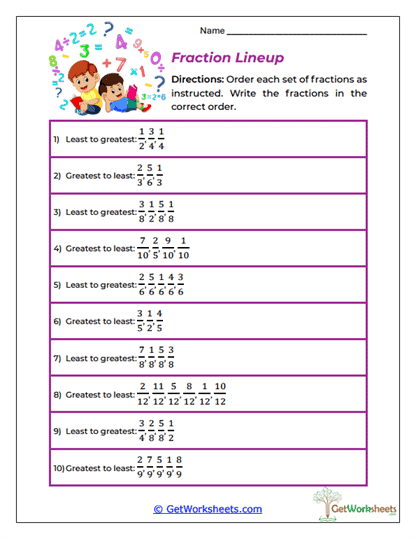
Fraction Lineup
Each problem asks learners to arrange a group of fractions in ascending or descending order. The sets vary, so children may need to use common denominators, benchmark values, matching numerators, or known equivalents to determine the correct sequence. Finding the smallest and largest values first can make the remaining fractions easier to place. The activity develops flexible thinking because no single comparison strategy works best for every set.
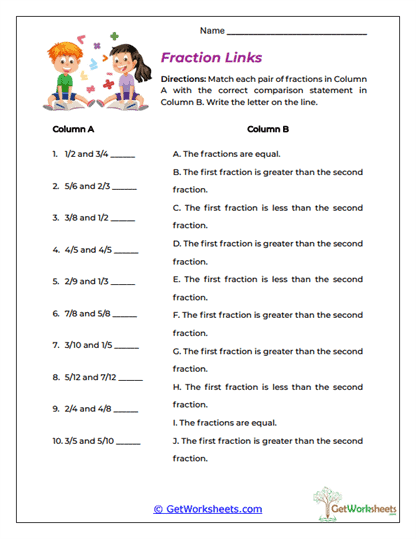
Fraction Links
Fraction pairs in one column must be connected with the written statements that correctly describe their relationships. Learners compare the numbers and then interpret language explaining whether the first fraction is greater than, less than, or equal to the second. This added reading component requires close attention to the order in which the fractions appear. Equivalent values are included so children cannot depend only on how the numerators and denominators look. The matching format offers an engaging alternative to traditional symbol-placement exercises.
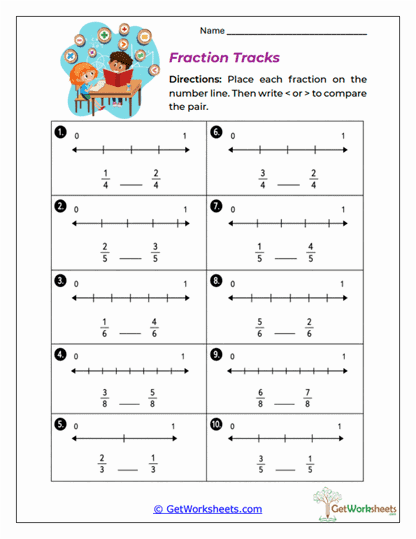
Fraction Tracks
Number lines help children view fractions as values with exact locations rather than only as shaded pieces of a shape. Learners divide each line into equal intervals, locate the two fractions, and compare their positions. A value placed farther to the right represents the greater amount, while fractions that share a location are equivalent. This visual approach strengthens spatial reasoning and supports future learning about decimals and mixed numbers.
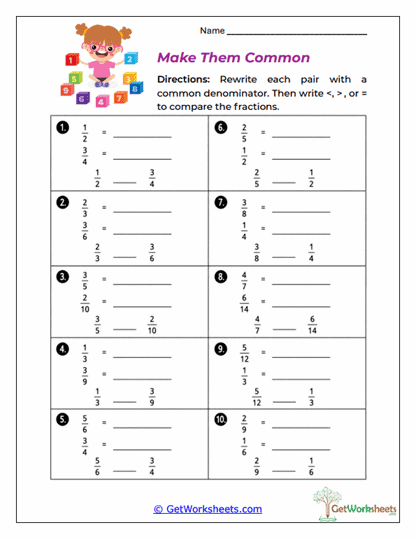
Make Them Common
Unlike fractions are rewritten so that both values use equal-sized parts. Children find an appropriate common denominator, create equivalent fractions, and then compare the resulting numerators. The multi-step process encourages careful multiplication and reinforces the rule that the numerator and denominator must be changed by the same factor. This method gives learners a reliable solution when the relative size of two fractions is not immediately obvious. It also lays important groundwork for adding and subtracting fractions with unlike denominators.
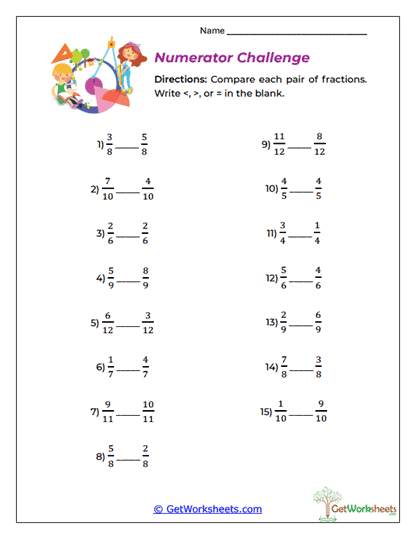
Numerator Challenge
Each problem presents two fractions divided into the same number of equal parts. Because the denominators already match, learners can concentrate on comparing the numerators and determining which fraction contains more of those parts. Repeated practice helps children recognize this pattern quickly and use the less than, greater than, and equal symbols accurately. The consistent format makes the page useful for independent review, skill checks, or targeted intervention.
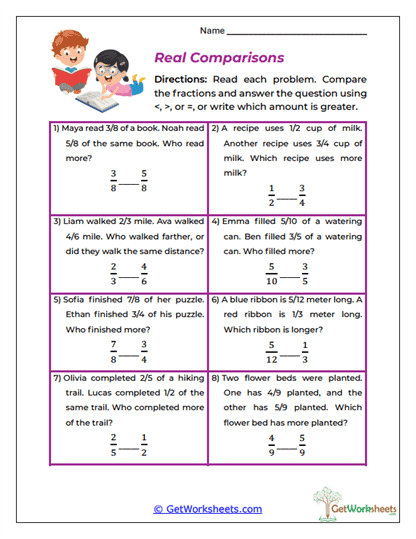
Real Comparisons
Short scenarios involving recipes, books, distances, puzzles, ribbons, and other familiar situations place fraction comparison in a practical setting. Children identify the two quantities, decide how they relate, and answer the question using a comparison symbol or a written response. Attention must also be given to what is being measured and whether the amounts refer to comparable wholes. The activity combines reading comprehension with mathematical reasoning. It helps learners understand how fraction comparisons can guide everyday decisions.
Bookmark Us Now!
New, high-quality worksheets are added every week! Do not miss out!