Simplifying Fractions Worksheets
About This Worksheet Collection
Simplifying fractions means rewriting a fraction in its lowest equivalent form without changing its value. Students do this by identifying a number that divides evenly into both the numerator and denominator, then dividing both by that same factor. Understanding simplification helps learners recognize equivalent fractions and communicate answers in the clearest, most standard form.
This collection develops simplifying skills through direct practice, factor lists, visual models, missing-number activities, sorting tasks, matching exercises, comparison problems, error analysis, and real-world word problems. Some worksheets guide learners through the greatest common factor process, while others ask them to decide whether a fraction is already reduced or to apply simplification as part of a larger task. The pages can be used during direct instruction, guided math, centers, intervention, homework, tutoring, assessment, review, or homeschool lessons.
As students complete the collection, they strengthen factor recognition, division fluency, equivalent-fraction understanding, greatest common factor reasoning, mathematical judgment, and self-checking. They also practice explaining errors, working backward, comparing reduced values, interpreting visual models, and creating fractions from practical situations. These skills prepare learners for fraction operations, ratios, proportions, probability, data analysis, and more advanced work with rational numbers.
Detailed Descriptions Of These Worksheets
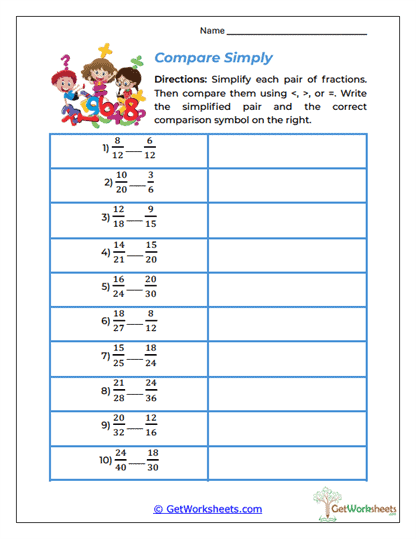
Compare Simply
Each problem requires learners to reduce two fractions before deciding how their values compare. Once both fractions are written in lowest terms, students place the correct less than, greater than, or equal symbol between them. Simplifying first often reveals familiar or equivalent values that were difficult to recognize in their original forms. The activity strengthens multi-step organization by combining fraction reduction with accurate comparison.
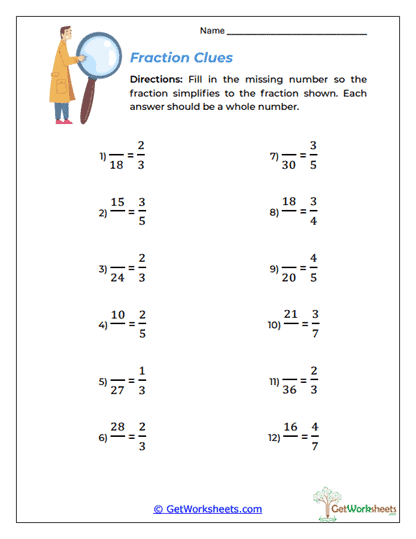
Fraction Clues
Missing-number equations challenge students to identify the factor used to simplify each fraction. Learners compare the original numerator with the reduced numerator, then confirm that the same divisor also works for the denominators. Working backward helps children understand exactly how equivalent fractions are created. The page also builds equation sense and prepares students for variables and proportional reasoning.
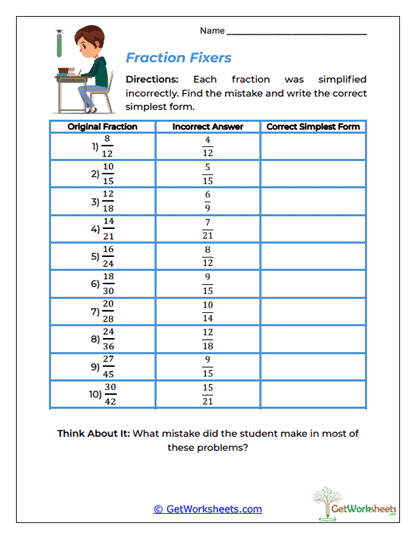
Fraction Fixers
Incorrectly simplified fractions give learners an opportunity to diagnose and repair common mistakes. Students examine whether both numbers were divided by the same factor, whether the new fraction is equivalent, and whether the work stopped too early. After locating the error, they rewrite the original fraction in its true simplest form. This approach develops stronger checking habits and makes misconceptions easier to discuss.
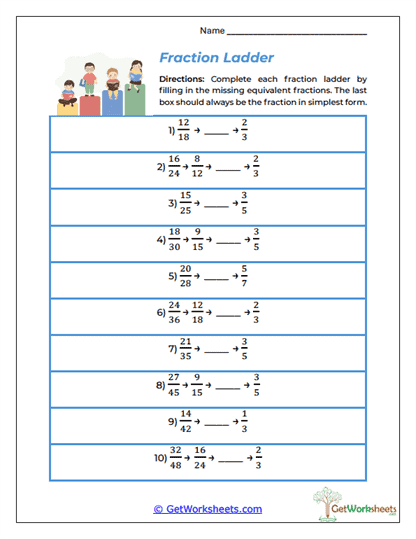
Fraction Ladder
Each ladder begins with an original fraction and ends with its lowest equivalent form. Students fill in a missing fraction that creates a logical intermediate step between the two. The activity demonstrates that simplification can happen gradually through several smaller divisions rather than only through the greatest common factor. It also encourages flexible reasoning because more than one intermediate answer may sometimes be valid.
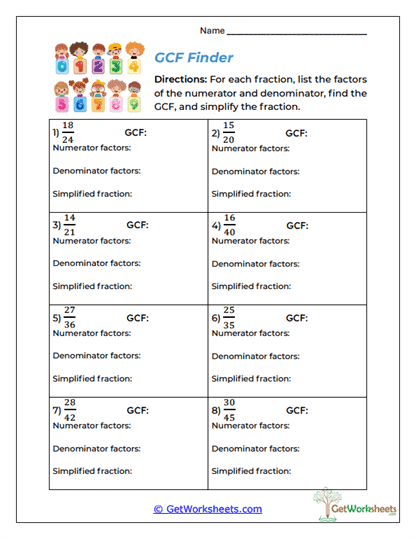
GCF Finder
Structured boxes guide learners through listing the factors of each numerator and denominator. After identifying the largest shared factor, students divide both numbers by it to simplify the fraction in one step. Showing every stage makes the reasoning behind the answer clear and easy to review. The worksheet is especially helpful for children who need an organized process for finding less obvious common factors.
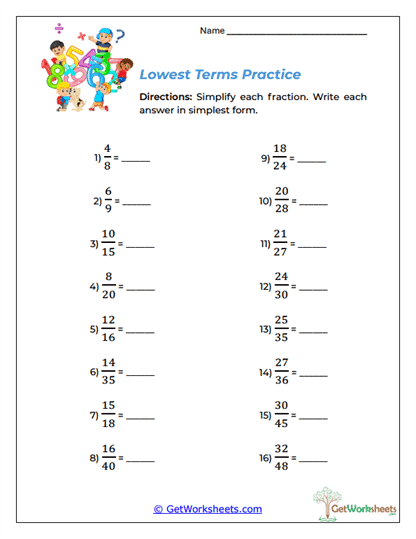
Lowest Terms Practice
Sixteen varied fractions provide repeated practice with reducing answers fully. Learners identify useful common factors, divide the numerator and denominator equally, and check that no shared factor greater than one remains. The mix of even and odd values helps students become more fluent with several factor families. This page works well for independent review, homework, intervention, or a quick skill assessment.
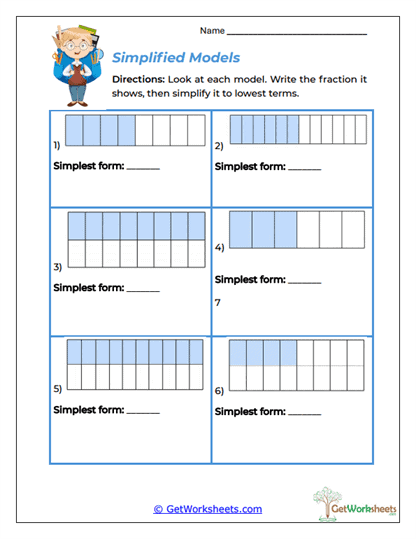
Simplified Models
Shaded bars and grids help children see how a fraction can be renamed without changing the amount represented. Students first write the fraction shown by each model and then regroup the sections to find an equivalent fraction in lowest terms. The visual connection makes it clear that the numbers may become smaller while the shaded quantity remains the same. This offers a strong bridge from picture-based reasoning to abstract simplification.
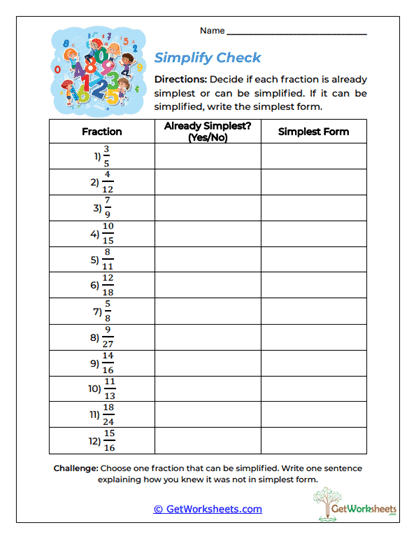
Simplify Check
A table asks learners to decide whether each fraction is already in simplest form. Fractions that can still be reduced must be rewritten correctly, while fully simplified values remain unchanged. The activity builds judgment by requiring students to check for shared factors before applying a procedure. A written-response challenge also encourages the use of vocabulary such as factor, equivalent, divide, and lowest terms.
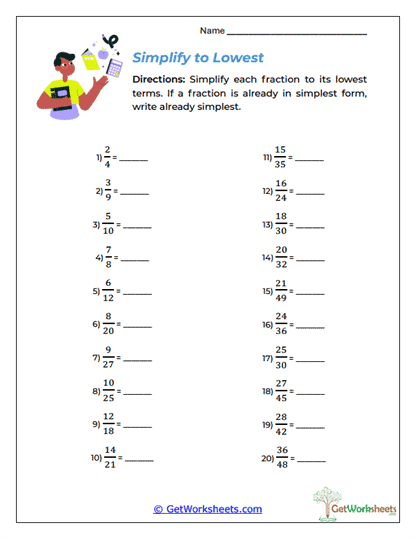
Simplify to Lowest
Twenty fractions give students broad practice reducing values and recognizing when no further work is needed. Children find a common factor, divide both parts of the fraction, and continue checking until the numerator and denominator share only one. The large problem set helps build confidence and speed while reinforcing careful completion. It is also useful for identifying whether students stop too soon during multi-step reductions.
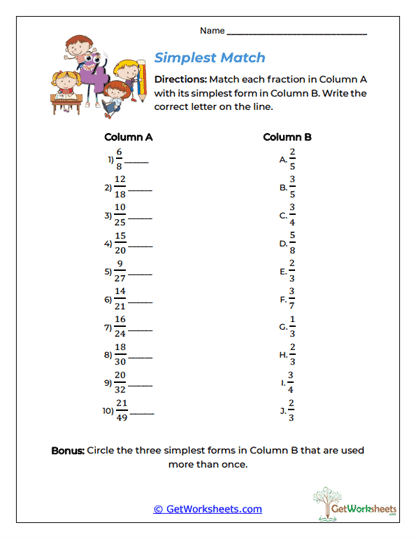
Simplest Match
Fractions in one column must be simplified and connected with their matching lowest forms in another. Learners calculate each reduced answer before selecting the appropriate letter. Several original fractions may lead to the same final value, reinforcing the meaning of equivalent fractions. The matching format provides an engaging alternative to a traditional list of simplification problems.
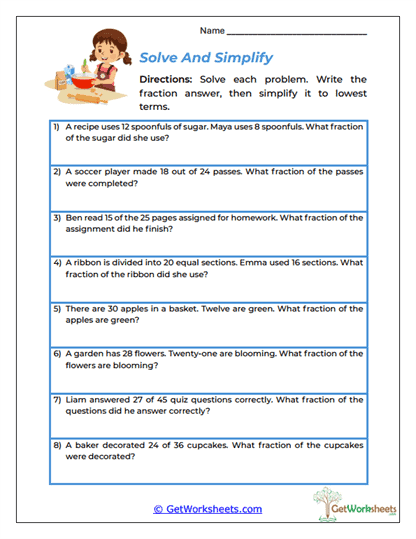
Solve and Simplify
Practical stories involving food, sports, reading, schoolwork, and collections ask learners to create and reduce fractions. Students identify the part and the whole, write the original fraction, and then simplify it to lowest terms. This requires careful reading before any calculation begins. The activity shows how reduced fractions communicate real-world relationships more clearly.
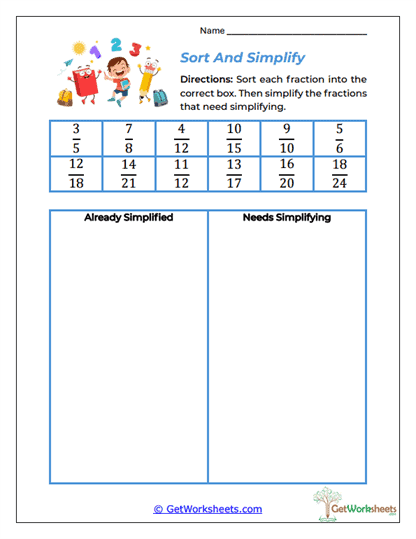
Sort and Simplify
Students classify fractions into two groups: already simplified or still needing reduction. After sorting, they simplify only the values that contain a shared factor greater than one. The task helps children understand that large numbers do not automatically mean a fraction can be reduced. It combines factor recognition, classification, and calculation in one organized activity.
Bookmark Us Now!
New, high-quality worksheets are added every week! Do not miss out!