Rounding Worksheets
About This Worksheet Collection
Rounding develops much more than the ability to change an exact number into a nearby value. Across these collections, students explore how place value, benchmarks, magnitude, fractions, comparison, and estimation work together to determine what an approximation means and how useful it is. The emphasis gradually moves from following a rounding procedure toward understanding why particular estimates make sense and how the level of precision can change depending on the problem.
The worksheets approach rounding from several complementary directions. Students work with whole numbers, multi-digit values, fractions, word problems, comparison tasks, benchmark ranges, number lines, reverse-rounding challenges, error analysis, and decisions about which place value should be used. Some activities concentrate closely on locating the correct digit, while others ask students to order estimates, defend a rounding choice, interpret real-world quantities, or reason backward from a rounded result.
Taken together, these topics build a flexible understanding of approximation and number structure. Students learn that one rounded value can represent an entire range of exact numbers, that different levels of rounding preserve different amounts of information, and that estimates can be used to predict, communicate, compare, and check mathematical results. These skills strengthen place value and number sense while supporting later work with computation, fractions, inequalities, measurement, data, and problem solving.
Detailed Descriptions Of These Worksheets
Place Value and Number Sense Word Problems
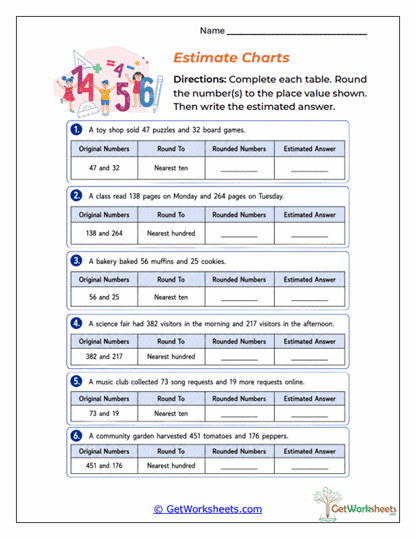
Real-world situations give students a reason to use rounding rather than practice it only with isolated numbers. Learners estimate totals and differences, choose appropriate levels of precision, inspect questionable estimates, and connect rounded values with situations involving travel, community information, collections, and other everyday quantities. Several tasks require students to explain why a particular estimate or rounding place is appropriate. This collection develops the judgment needed to decide not merely how to round, but when and why a certain approximation is useful.
Round By Place
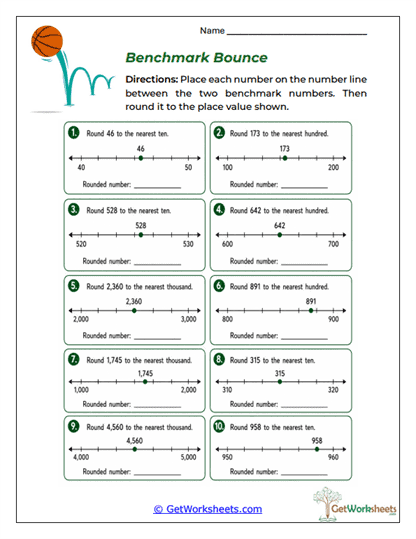
Students concentrate on how the requested place value controls the entire rounding process. Activities move among tens, hundreds, thousands, and ten-thousands while asking learners to identify target digits, inspect neighboring digits, use number lines, complete charts, compare approximations, and work backward from rounded values. Because the target changes frequently, students must pay attention to the structure of each number rather than repeat one automatic step. The collection builds accuracy while deepening understanding of how place value determines an estimate.
Rounding and Comparing Numbers
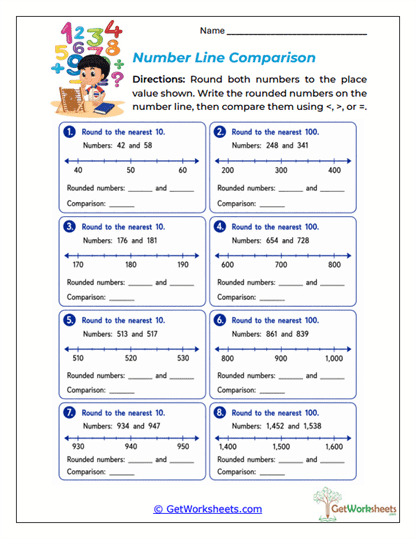
Approximation and comparison come together as students investigate what happens to numerical relationships after values are rounded. Learners compare exact and rounded numbers, order groups of estimates, use <, >, and =, work with benchmarks, inspect comparison mistakes, and explain why two different numbers may become equal estimates. These activities make the consequences of rounding more visible. Students develop stronger magnitude sense by seeing that approximation can preserve, reduce, or occasionally erase differences between numbers.
Rounding Fractions
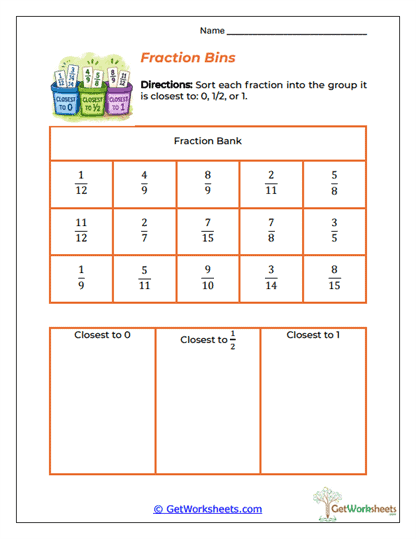
Fraction magnitude becomes the focus as students compare values with familiar benchmarks such as 0, 1/2, and 1. The collection includes sorting, matching, mixed-number rounding, measurement and recipe contexts, estimated sums and differences, and error-analysis tasks. Rather than relying immediately on decimals or common denominators, students learn to judge where a fraction sits relative to familiar reference points. This benchmark reasoning develops the flexible fraction sense needed for operations, estimation, comparison, and later work with rational numbers.
Rounding Multi-digit Whole Numbers
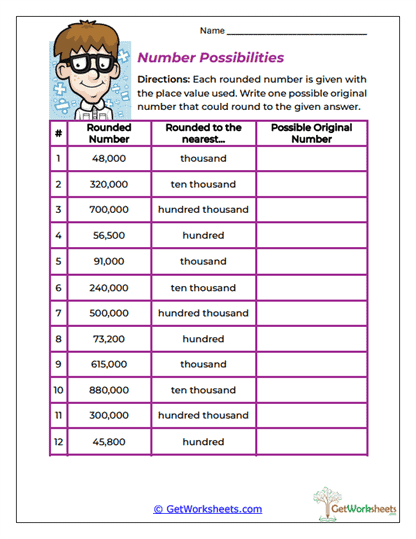
Five- and six-digit numbers give students a chance to apply familiar rounding principles at a much larger scale. Learners work across hundreds, thousands, ten-thousands, and hundred-thousands while using visual marking strategies, number lines, tables, reverse reasoning, matching, ordering, and error correction. Several activities emphasize that the size of the number does not change the core logic of rounding; it simply requires more careful place-value organization. The collection strengthens confidence with large values while introducing more sophisticated thinking about precision and rounding intervals.
Rounding Numbers
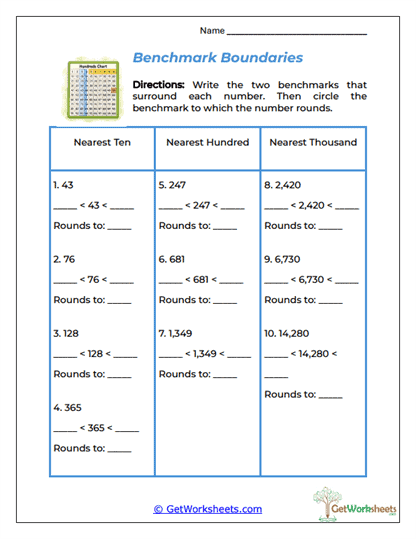
This broad collection explores both the mechanics and meaning of rounding. Students identify neighboring benchmarks, investigate midpoint values, sort numbers into benchmark ranges, round decimals, analyze population and attendance data, uncover hidden intervals, work backward from results, and use rounded values to estimate calculations. The range of activities shows that rounding is not a single isolated skill but a way of simplifying numerical information while preserving its general size. Students build a foundation for using approximation thoughtfully across many areas of mathematics.
Bookmark Us Now!
New, high-quality worksheets are added every week! Do not miss out!