Percentages Worksheets
About This Worksheet Collection
Percentages give students a powerful way to describe relationships, compare quantities, and interpret how one value relates to another. Across this collection, learners move beyond simply recognizing a percent sign and begin working with percentages as part of a larger system that includes fractions, decimals, ratios, change, measurement, and proportional reasoning. The topics progress from converting among equivalent forms to solving missing-value problems and analyzing how quantities increase, decrease, or differ from expected results.
The collection brings together several major percentage skills through a wide range of mathematical situations. Students convert decimals and fractions to percents, determine what percent a part represents of a whole, work backward to recover an unknown total, calculate percent change, and evaluate percent error and accuracy. Tables, number lines, matching tasks, visual models, error analysis, multiple-choice questions, real-world data, shopping situations, sports statistics, surveys, measurements, and scientific contexts give students many ways to encounter the same core relationships.
Working across these topics helps students develop a more connected understanding of percentage mathematics. They learn to recognize equivalent representations, identify which quantity should serve as the reference value, reason about percentages above and below 100%, and judge whether a numerical result is sensible before accepting it. These skills support later work with ratios, probability, financial mathematics, statistics, measurement, science, data analysis, and algebraic relationships.
Detailed Descriptions Of These Worksheets
Converting Decimals and Percentages
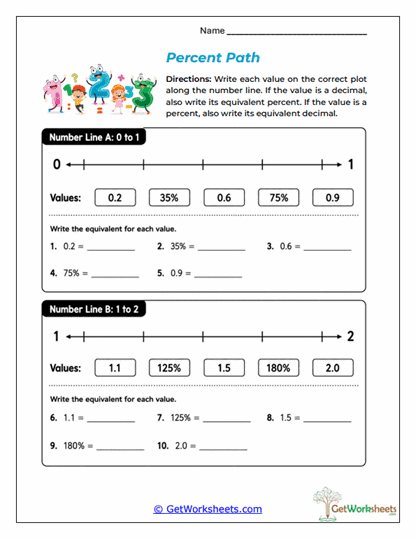
This collection focuses on the equivalence between decimal notation and percent notation. Students convert in both directions while working with common values, very small quantities, and percentages greater than 100%. Activities involving tables, matching, sorting, number lines, error analysis, and real-world situations help learners see that the quantity itself remains unchanged even when its representation changes. The work builds place-value fluency and prepares students for later percentage applications involving money, data, probability, and rates.
Converting Fractions and Percentages
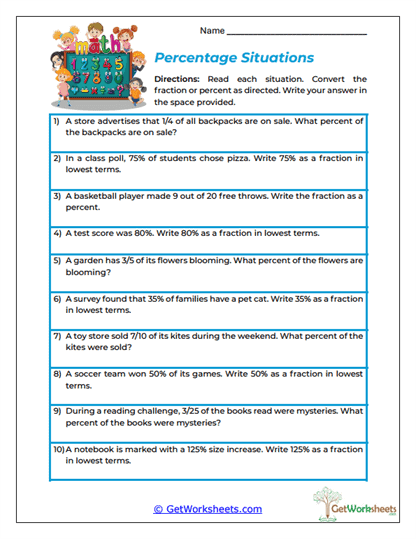
Students explore how fractions and percents can express the same portion of a whole. The worksheets include direct conversions, simplified fraction forms, matching, sorting, number-line models, error checking, and practical contexts involving recipes, sports, surveys, and scores. Familiar benchmarks such as 1/2, 1/4, and 3/4 become reference points for interpreting less familiar relationships. This collection strengthens equivalent-fraction reasoning while developing the proportional thinking needed for broader percent work.
Finding the Percent Given the Part and Whole
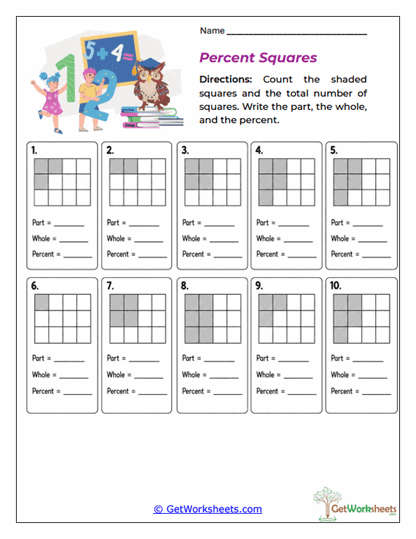
These worksheets ask students to determine what percentage one quantity represents of a total. Learners identify the part and whole, divide the part by the whole, and express the result as a percent across direct calculations, tables, shaded models, surveys, sports statistics, school data, and goal-tracking situations. Benchmark fractions help students estimate whether an answer is reasonable before completing the exact calculation. The collection builds a strong understanding of percentage as a comparison between a selected amount and the entire group.
Finding the Whole Given a Part and Percent
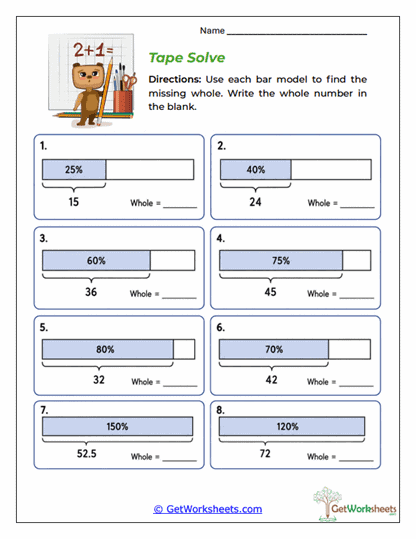
The usual percent relationship is reversed as students use a known part and percentage to recover the missing total. Tables, bar models, matching activities, equations, discounts, surveys, progress goals, and classroom scenarios require learners to interpret what the unknown whole represents before calculating it. Students also examine percentages above 100%, where the whole may actually be smaller than the given part. This collection develops inverse reasoning and helps learners recognize the same proportional structure across several different problem formats.
Percent Change
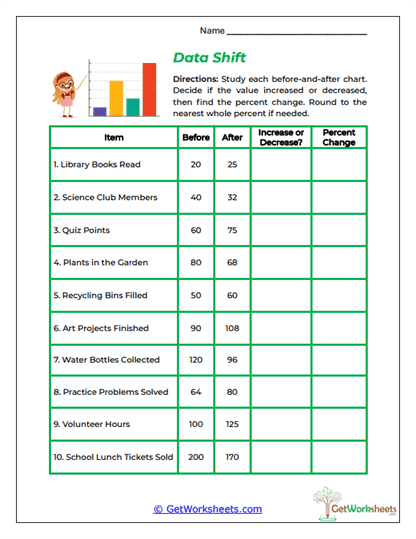
Students compare original and new values to determine how much a quantity has increased or decreased relative to its starting point. The worksheets use direct number pairs, charts, matching, error analysis, prices, sports statistics, weather measurements, and other data sets to reinforce that the original value is the reference for the calculation. Learners practice distinguishing the direction of change from the size of the change and interpreting what the resulting percentage means in context. This collection provides an important bridge from basic percent calculations to financial mathematics, statistics, and data analysis.
Percent Error and Accuracy
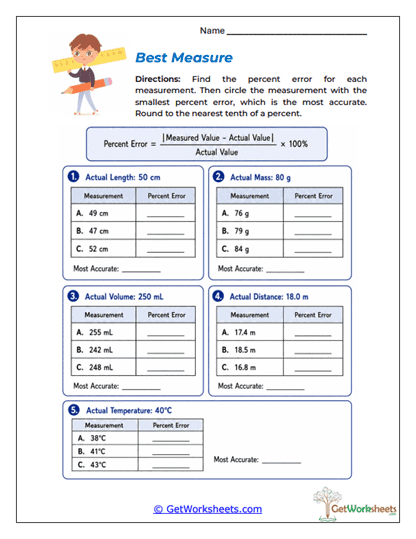
This collection uses percent error to help students evaluate how closely a measurement or estimate matches an accepted value. Learners calculate absolute error, compare it with the actual value, convert the result to a percentage, and use smaller percent errors as evidence of greater accuracy. Science experiments, measuring tools, data tables, everyday estimates, comparison tasks, and correction activities place the mathematics in meaningful settings. The work strengthens measurement reasoning and prepares students for more advanced study involving experimental data, accuracy, statistics, and STEM applications.
Bookmark Us Now!
New, high-quality worksheets are added every week! Do not miss out!