Estimation Worksheets
About This Worksheet Collection
Estimation gives students a way to make useful mathematical judgments before committing to exact calculation. Rather than treating every problem as something that must be solved to the last digit, learners practice deciding what an answer should roughly look like, how closely it needs to be known, and which numerical strategy makes the most sense. That kind of thinking strengthens number sense, place value, operation sense, mental computation, and confidence with increasingly large or unfamiliar quantities.
This collection brings together several distinct forms of estimation so students can see how the idea changes across different kinds of mathematics. Learners estimate sums, differences, products, and quotients; work with measurement and real-world word problems; and explore front-end estimation as its own strategy. Across the categories, they round, use compatible numbers, compare benchmarks, judge reasonableness, inspect mistakes, select strategies, interpret context, and decide when an approximate answer is useful enough for the task.
As students move through these topics, estimation becomes less about following a single rule and more about making thoughtful mathematical choices. They learn to anticipate results, recognize when an answer is out of range, simplify difficult calculations intelligently, connect operations with real situations, and use approximations to check exact work. Taken together, these worksheets build the flexible numerical judgment that supports stronger arithmetic, problem solving, measurement, financial reasoning, and later mathematical study.
Detailed Descriptions Of These Worksheets
Estimating Differences
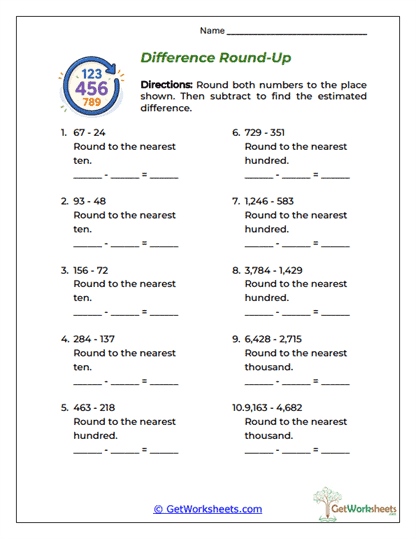
Students explore several ways to approximate subtraction results without relying immediately on exact computation. Activities involve rounding, friendly numbers, mental subtraction, comparison, error analysis, money situations, sports contexts, and decisions about which place value will produce a useful estimate. Learners also compare estimated and exact differences so they can see how approximation helps verify their work. The collection develops a stronger sense of numerical distance and helps students judge whether a subtraction result is believable.
Estimating Products
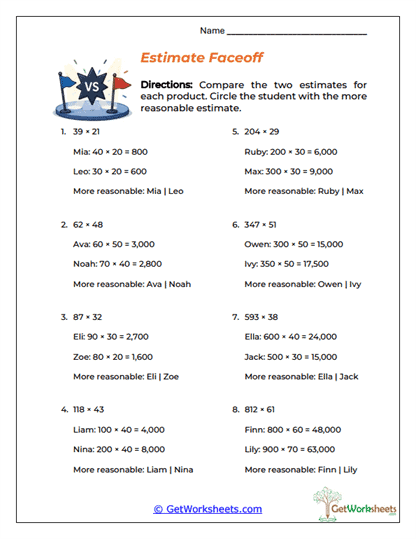
These worksheets focus on predicting the size of multiplication results by simplifying factors before multiplying. Students work with rounded values, friendly factors, benchmark comparisons, competing strategies, word problems, shopping situations, and error analysis. The emphasis gradually shifts from simply carrying out a rounding step to choosing an efficient method and evaluating the quality of an estimate. This helps learners understand product magnitude while strengthening multiplication fluency and mental computation.
Estimating Quotients
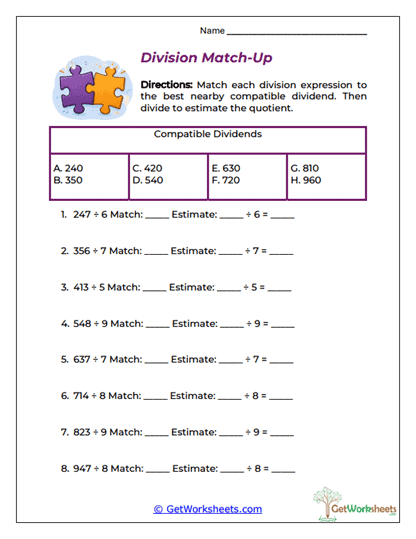
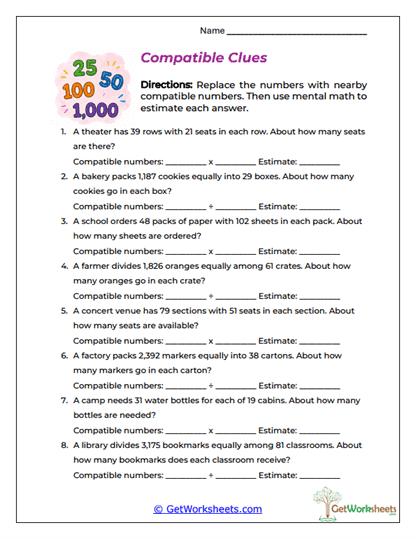
Division estimation is approached through compatible numbers, multiplication facts, rounding, benchmark values, strategy comparisons, and contextual problems. Students learn that the easiest division estimate often comes from finding a nearby dividend that works cleanly with the divisor rather than applying the same rounding rule every time. Several activities ask learners to evaluate proposed quotients, repair weak estimates, or compare one approximation with another. This develops a more connected understanding of multiplication, division, multiples, divisibility, and quotient size.
Estimating Sums
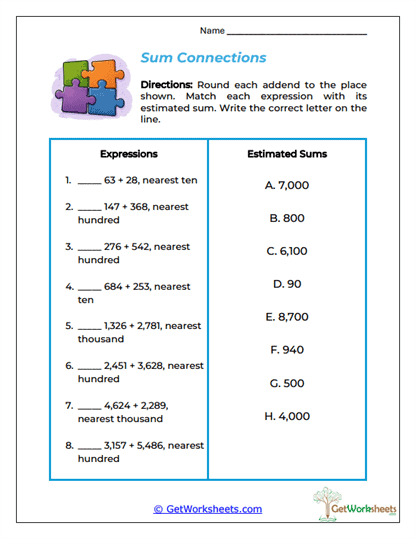
Students build approximate totals using several strategies rather than repeating one form of rounding. The collection includes standard rounding, front-end estimation, compatible addends, benchmark comparisons, place-value choices, error analysis, shopping contexts, and attendance problems. Learners also compare approximate and exact sums to see how estimation can function as a checking tool. These activities strengthen magnitude sense and help students become more deliberate about how much precision an addition problem really requires.
Estimation in Measurement
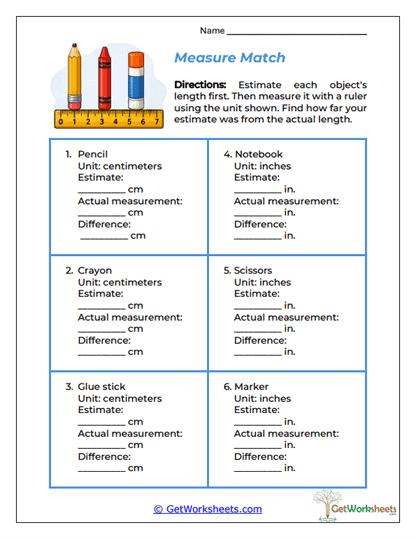
Measurement estimation asks students to connect numbers and units with objects, spaces, containers, weights, and durations they can actually imagine. Learners estimate lengths, masses, capacities, and time; choose reasonable units; compare measurements with benchmarks; sort objects by size; and correct values that are clearly unrealistic. Some activities also have students estimate first and then measure so they can see how accurate their judgment was. The collection builds practical measurement intuition alongside formal unit knowledge.
Estimation Word Problems
These worksheets place estimation inside situations where students must first make sense of what is happening. Problems may require addition, subtraction, multiplication, or division, and learners must decide which operation and estimation method fit the context before calculating. Activities involve budgeting, travel, supplies, events, grouping, shopping, and strategy comparison, with several tasks asking students to judge whether an approximate answer is useful or reasonable. The collection develops flexible problem solving by making interpretation and strategy selection part of the mathematics.
Front-End Estimation
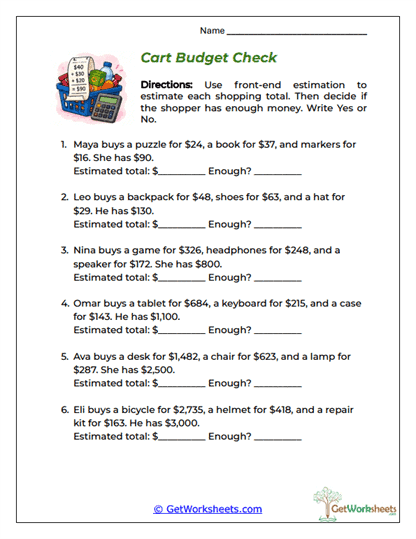
Front-end estimation teaches students to focus first on the largest place-value contribution within a number. Learners use leading digits to form quick estimates, then apply the strategy to sums, differences, money, crowds, matching activities, error analysis, and exact-answer comparisons. More advanced work asks students to compare front-end estimation with traditional rounding or improve a rough estimate by adding an adjustment. This progression helps students see approximation as something that can be fast, layered, and refined depending on the level of accuracy needed.
Bookmark Us Now!
New, high-quality worksheets are added every week! Do not miss out!