Exponents Worksheets
About This Worksheet Collection
Exponents give students a compact way to represent repeated multiplication and describe how numbers grow, shrink, and combine. A strong understanding begins with recognizing the base and exponent, then expands into exponent laws, negative exponents, powers of ten, and scientific notation. These connected skills give learners an important foundation for algebra, advanced number sense, and mathematical work involving very large or very small quantities.
This collection brings together several major exponent topics so students can build their understanding in a logical progression. Learners explore repeated multiplication, simplify expressions using exponent properties, work with negative powers and reciprocals, investigate powers of ten, and use scientific notation to represent and calculate with extreme values. The worksheets support classroom lessons, independent practice, homework, math centers, tutoring, intervention, enrichment, test preparation, and homeschool instruction.
As students move through the collection, they strengthen exponent vocabulary, pattern recognition, algebraic reasoning, place-value understanding, expression simplification, and mathematical communication. They practice moving among expanded and exponential forms, choosing appropriate exponent laws, analyzing mistakes, reasoning with reciprocals, scaling numbers by powers of ten, and interpreting scientific notation. Together, these topics help learners understand exponents as a connected mathematical system rather than a collection of unrelated rules.
Detailed Descriptions Of These Worksheets
Exponent Operations
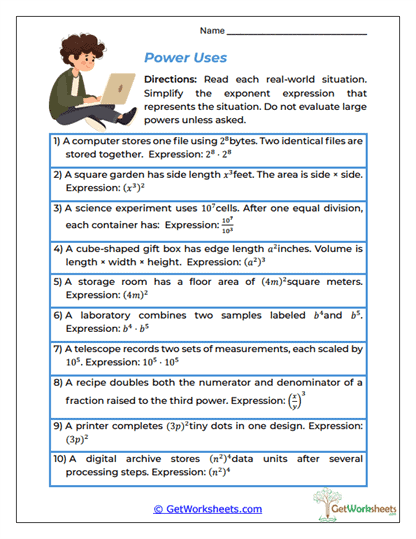
Students practice using powers within multiplication, division, grouped expressions, and powers raised to other powers. Activities encourage learners to recognize the structure of an expression before deciding which property or procedure should be used. Matching, error analysis, missing-value problems, code activities, and multi-step simplification add variety to the practice. This collection helps students become more flexible and independent when working with mixed exponent expressions.
Exponents as Repeated Multiplication
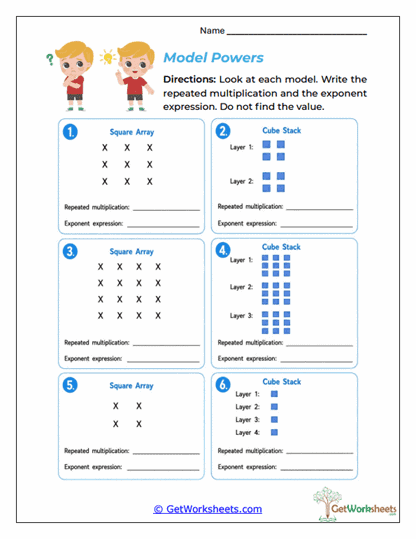
This collection introduces the meaning behind exponent notation by connecting powers with repeated factors. Students identify bases and exponents, expand powers into multiplication, convert repeated multiplication back into power form, evaluate expressions, and connect several equivalent representations. Visual models, matching activities, charts, patterns, and real-world examples make the concept easier to understand. These worksheets provide a strong starting point before students move into exponent rules and algebraic simplification.
Laws of Exponents
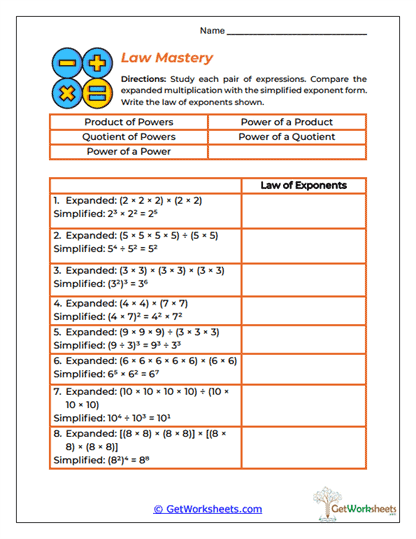
Students explore the rules that govern how powers behave during multiplication, division, grouping, and repeated powers. Rather than only memorizing shortcuts, learners examine repeated multiplication and expression structure to understand why each law works. Activities include rule identification, matching, sorting, missing-value puzzles, error correction, written reasoning, and multi-step simplification. The collection develops both procedural fluency and the deeper reasoning needed for later algebra.
Negative Exponents
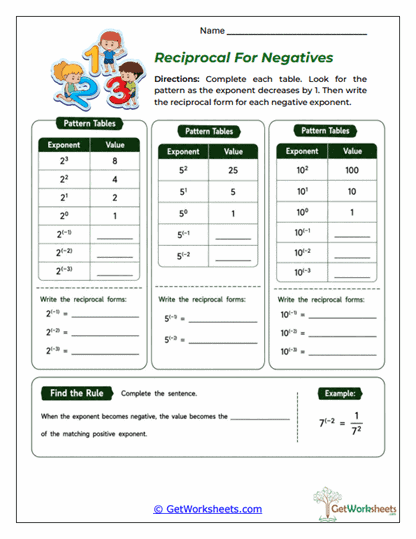
Negative powers are introduced through patterns, reciprocals, fractions, and equivalent expressions. Students learn that a negative exponent does not make the base negative but instead indicates a reciprocal relationship that can be rewritten using positive exponents. Practice includes matching equivalent forms, finding missing powers, correcting misconceptions, simplifying rational expressions, and explaining why reciprocal changes occur. More advanced pages combine negative exponents with other power laws and scientific applications.
Powers of Ten
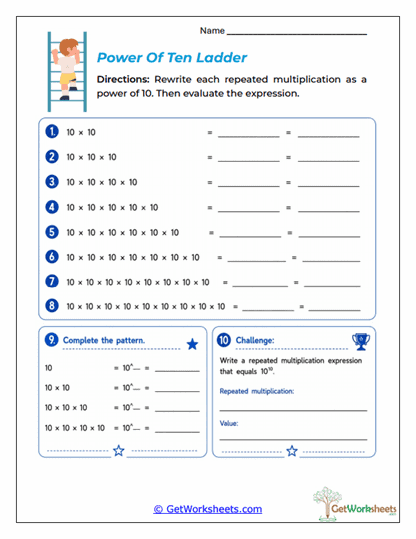
Students investigate the predictable patterns created by repeated multiplication and division by ten. They connect power notation with expanded multiplication, standard form, place value, decimal shifts, scaling, and metric conversions. Charts, matching activities, missing-value equations, true-or-false problems, and written explanations help learners understand why the digits change position. This collection also prepares students for decimal operations and scientific notation.
Scientific Notation
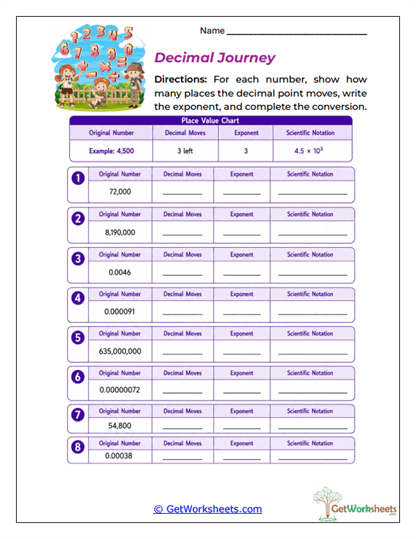
Scientific notation gives learners an efficient way to represent extremely large and extremely small numbers using coefficients and powers of ten. Students convert between standard and scientific form, determine whether exponents should be positive or negative, compare values, correct notation errors, and work with proper coefficients. More advanced activities include multiplying and dividing scientific notation and interpreting measurements from science and technology. These worksheets connect exponent skills with practical applications in algebra, chemistry, physics, astronomy, measurement, and data.
Bookmark Us Now!
New, high-quality worksheets are added every week! Do not miss out!