Proportions Worksheets
About This Worksheet Collection
Proportions bring together several important ideas in middle-school mathematics: equivalent ratios, scale factors, unit rates, tables, equations, graphs, and real-world relationships. At the center of the topic is one simple principle-a proportional relationship keeps the same multiplicative structure as quantities grow or shrink. This collection develops that idea from multiple angles so students can recognize, represent, test, and solve proportions rather than viewing them as a single procedure.
The worksheets move from foundational ratio understanding into increasingly complex proportional reasoning. Students distinguish ratios from proportions, generate and identify equivalent ratios, complete ratio tables, compare proportional and non-proportional relationships, solve word problems, and use cross multiplication to find unknown values. Visual models, tables, equations, graphs, recipes, prices, map scales, similar figures, and rate situations give learners repeated opportunities to apply the same core relationship in different forms.
Across the collection, students strengthen multiplication, division, simplification, scale-factor reasoning, unit-rate thinking, equation solving, and interpretation of real-world quantities. They also learn to choose an appropriate strategy rather than relying on one method for every problem. These skills create a strong foundation for percentages, linear relationships, slope, scale drawings, similar figures, algebraic equations, functions, and other topics that depend on proportional reasoning.
Detailed Descriptions Of These Worksheets
Cross Multiplication Method
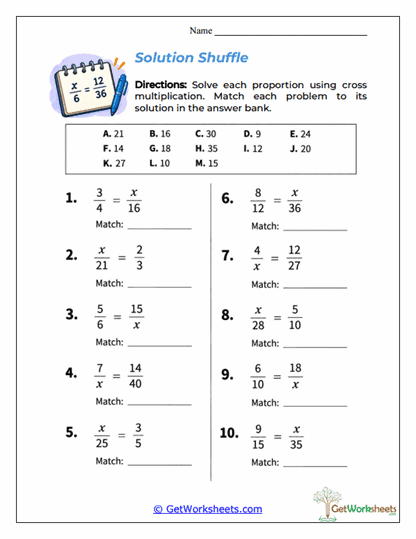
These worksheets develop cross multiplication as a method for working with two equivalent ratios. Students begin by identifying diagonal pairs and writing cross-product equations before progressing to missing values, variables, decimals, fractions, map scales, similar figures, and real-world applications. Matching and verification activities reinforce the structure of the method while more advanced problems require learners to organize corresponding quantities correctly. The collection helps students move beyond memorizing an "X" pattern toward understanding how cross products support proportion solving.
Equivalent Ratios
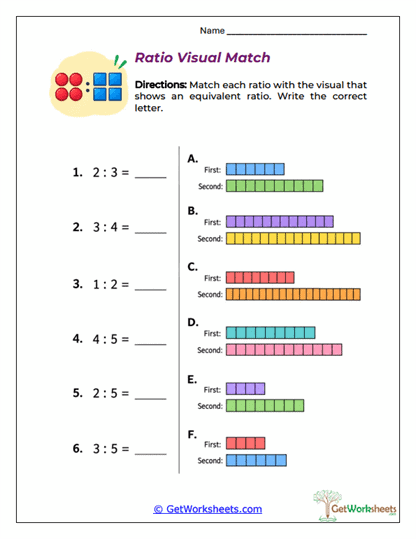
Students explore how different pairs of numbers can express the same underlying comparison. Activities include matching ratios, finding scale factors, completing tables and chains, filling missing values, sorting ratio families, using double number lines, and interpreting visual models. Recipe and mixture contexts show why both quantities must change by the same multiplicative factor. This collection establishes the equivalence reasoning that makes proportions possible.
Proportional vs. Non-Proportional Relationships
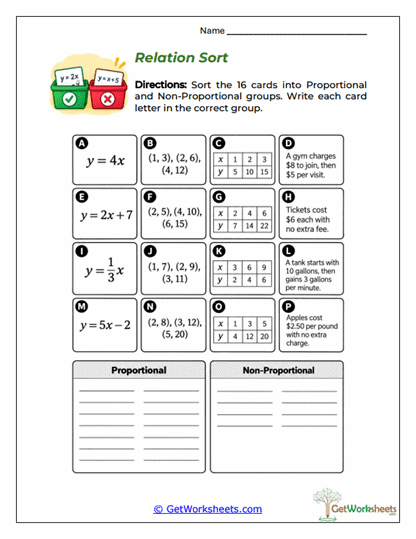
Tables, equations, graphs, ordered pairs, and real-world situations are used to distinguish relationships that preserve a constant multiplicative pattern from those that do not. Students calculate y/x, identify the constant of proportionality, recognize equations in the form y = kx, and check whether graphs pass through the origin. Starting fees and initial amounts provide practical examples of why a constant rate can still produce a non-proportional relationship. The worksheets connect proportional reasoning directly with early linear-function concepts.
Ratio and Proportion Word Problems
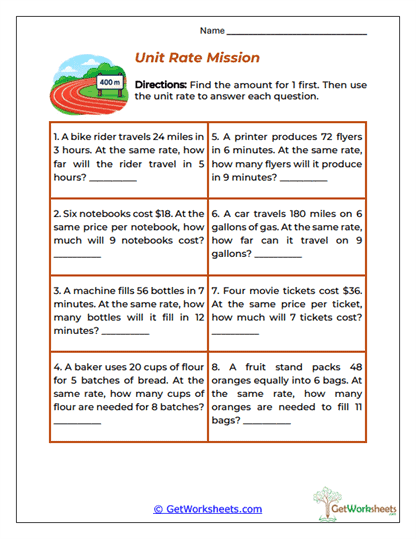
Real-world scenarios require students to identify the relationship between quantities before deciding how to solve. Problems involve prices, recipes, travel, maps, speed, similar figures, production, unit pricing, and other practical settings. Students may use scale factors, unit rates, ratio tables, or proportion equations depending on which strategy best fits the numbers. The collection emphasizes reading carefully, matching corresponding quantities, labeling answers, and checking whether results make sense in context.
Ratio Tables
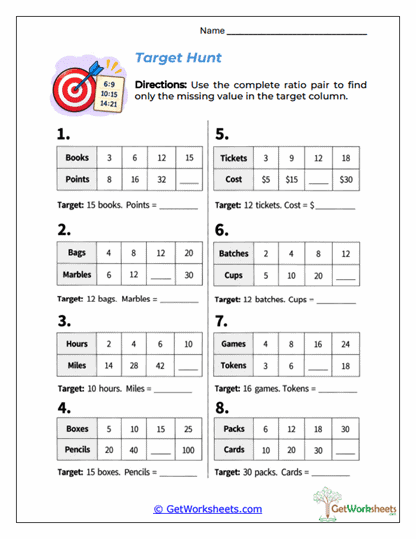
Ratio tables organize proportional relationships into paired rows or columns so students can see how quantities change together. Learners complete missing values, identify scale factors, generate and simplify equivalent ratios, find unit rates, match tables, locate target values, and translate stories into table form. Shopping and recipe activities make the patterns more concrete, while constant-of-proportionality work connects tables with y = kx. These worksheets help students treat ratio tables as connected models rather than collections of isolated numbers.
Ratios vs Proportions
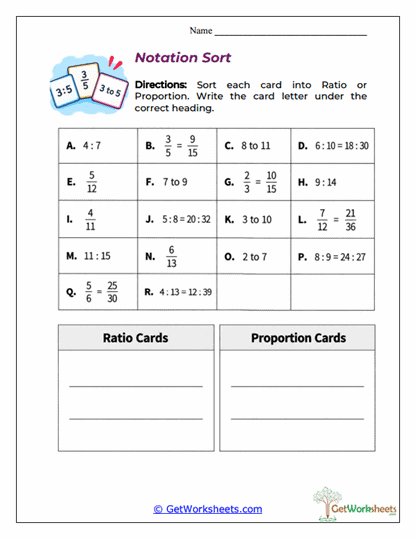
This collection establishes the distinction between a ratio, which compares two quantities, and a proportion, which states that two ratios are equivalent. Students classify expressions, sort examples by notation, identify equivalent ratios, build true proportions, verify proportional statements, and connect ratio tables or visual models with symbolic proportion equations. Written descriptions and recipe comparisons also require learners to recognize the concepts without relying solely on fraction or colon notation. The worksheets provide the vocabulary and structural understanding needed before students move into more advanced proportion solving.
Bookmark Us Now!
New, high-quality worksheets are added every week! Do not miss out!