Patterns Worksheets
About This Worksheet Collection
Patterns help students notice relationships, predict what comes next, and understand how information can follow an organized rule. Early pattern work may involve colors, shapes, sizes, quantities, or repeating units, while more advanced activities introduce numerical rules and input-output relationships. Building these skills supports sequencing, classification, number sense, logical reasoning, and early algebraic thinking.
This collection brings together several major types of pattern practice for preschool through early elementary learners. Students explore AB, AAB, ABB, and ABC sequences, color patterns, increasing and decreasing patterns, even and odd number patterns, growing patterns, and input-output tables. The worksheets use visual models, counting activities, number rules, matching, sorting, drawing, prediction, and table completion to help learners recognize and apply patterns in different forms.
As students work through the collection, they strengthen visual discrimination, working memory, number recognition, comparison, sequencing, prediction, and mathematical reasoning. They also practice identifying repeating units, recognizing growth and shrinkage, classifying even and odd numbers, extending visual and numerical sequences, and using consistent rules to generate outputs. Together, these skills help learners see mathematics as a system of relationships and predictable structures rather than a collection of isolated answers.
Detailed Descriptions Of These Worksheets
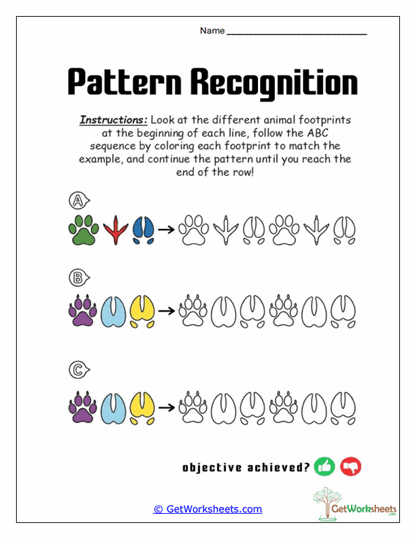
AB, AAB, ABB, ABC Pattern Recognition
Students practice identifying, copying, and extending common repeating pattern structures such as AB, AAB, ABB, and ABC. Activities use familiar colors, shapes, symbols, flowers, footprints, clouds, train cars, and other visual objects to make the repeating units easy to recognize. Learners focus on maintaining the correct order and using the pattern rule to predict what belongs next. This collection builds sequencing, visual memory, and early algebraic reasoning.
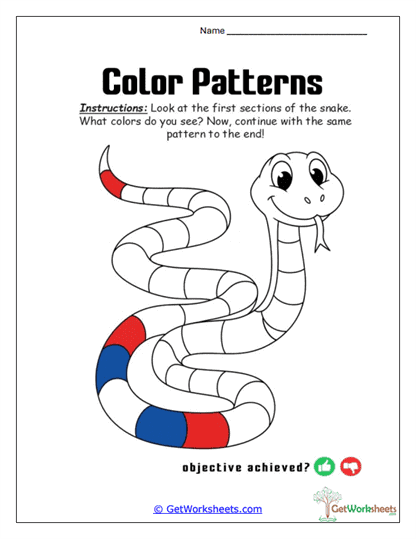
Color Patterns
Color-based activities help students recognize repeating sequences, visual order, and predictable relationships. Learners extend simple alternating patterns, continue three-part color cycles, copy detailed designs, find missing items, and work with symmetrical color arrangements. Because many of the pictures remain visually familiar, children can concentrate on the order in which the colors repeat. These worksheets strengthen color recognition, prediction, spatial awareness, and visual discrimination.
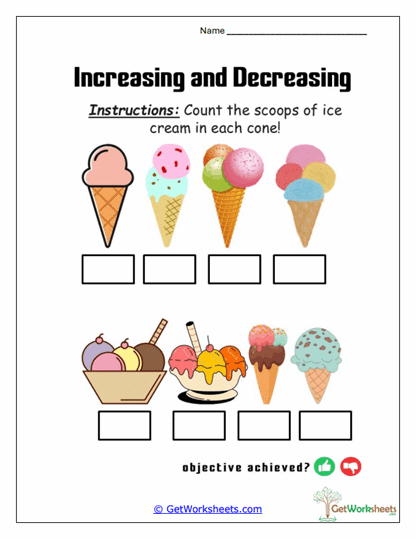
Decreasing and Increasing Patterns
Students explore sequences that grow larger, become smaller, add more objects, or reduce quantities over time. Activities include comparing sizes, counting changing groups, ordering visual stages, identifying growth or shrinkage, and drawing missing steps. The collection helps learners understand that patterns can change gradually rather than only repeat. It also strengthens early counting, comparison, measurement readiness, and number sense.
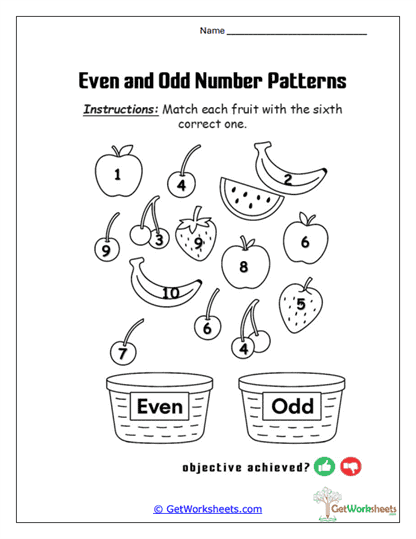
Even and Odd Number Patterns
Learners investigate the alternating structure of even and odd numbers through sorting, matching, color coding, number hunts, pairing, and visual grouping. Even numbers are connected with complete pairs, while odd numbers are shown as quantities with one item left over. These activities help students move from concrete models to faster numeral recognition. The collection strengthens classification, skip-counting awareness, number properties, and early mathematical reasoning.
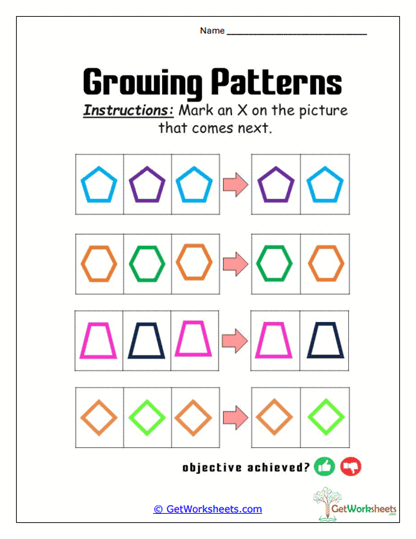
Growing Patterns
Students study patterns that develop according to a rule, including changes in size, number, shape, color, and visual structure. Activities ask learners to draw missing shapes, find the next number, choose the correct continuation, compare visual features, and identify how a sequence is changing. Some worksheets also connect growing patterns with number properties and simple classification. This variety encourages students to recognize structure and make logical predictions from the information already shown.
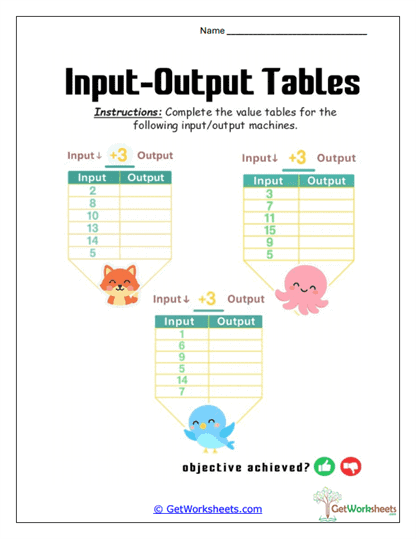
Input-Output Tables
Input-output tables introduce students to numerical patterns created by consistent addition and subtraction rules. Learners apply a fixed rule to different starting values and record the resulting outputs while observing how the relationship stays the same. Activities include mixed-rule tables, single-operation practice, growing and decreasing outputs, and themed number machines. These worksheets strengthen computation fluency, table reading, number relationships, and early function thinking.
Bookmark Us Now!
New, high-quality worksheets are added every week! Do not miss out!