Quiet Library
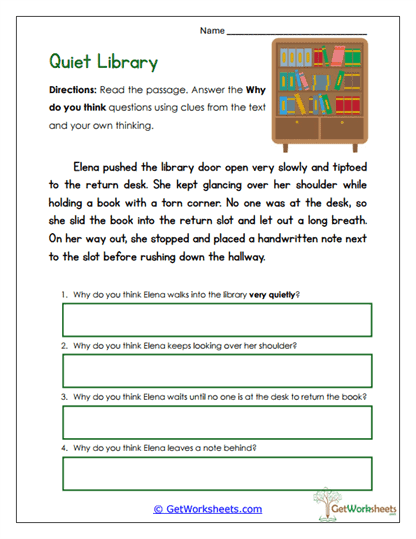
Students read a short passage about Elena quietly returning a damaged library book and answer four “why do you think” questions. They use details such as her slow movements, repeated glances, long pause, and handwritten note to figure out what she may be feeling and why she behaves that way. This upper-elementary worksheet strengthens reading comprehension, inference, character motivation, text evidence, cause and effect, close reading, and written explanation. It is especially useful for grades 3-4 because students must combine clues from the passage with their own reasonable thinking instead of copying one obvious sentence.
Learning Goals
- Make Logical Inferences: Students use story clues to determine why Elena acts carefully and nervously.
- Analyze Character Motivation: Learners explain what may be causing her choices and behavior.
- Use Text Evidence: Children support their ideas with details from the passage rather than making random guesses.
- Write Clear Explanations: Students answer open-ended questions in complete, understandable sentences.
How This Helps
- Teaches Children to Read Between the Lines: Students learn that authors do not always state every feeling or reason directly.
- Supports Parent Guidance: Adults can ask, “What did Elena do that made you think that?”
- Builds Confidence With Open Responses: The questions show that more than one answer may work when it is supported by the text.
- Useful Across Reading Levels: Students can give a simple answer or a more detailed explanation depending on ability.
- Ready for Immediate Use: The worksheet works well in reading groups, homework, tutoring, intervention, or homeschool instruction.
Many children believe every reading question should have an answer they can copy word for word. This worksheet teaches them that some answers must be built by combining text clues with careful thinking. Students strengthen inference, comprehension, character analysis, motivation, evidence use, reasoning, and written expression while reading a realistic situation involving responsibility and honesty. Parents should encourage the child to explain how each clue supports the answer, even when the passage never directly names Elena’s feelings. In the classroom or at home, this activity helps students become more thoughtful readers who can understand hidden meaning, recognize character emotions, and defend their ideas with evidence.
Bookmark Us Now!
New, high-quality worksheets are added every week! Do not miss out!