Sticker Robot
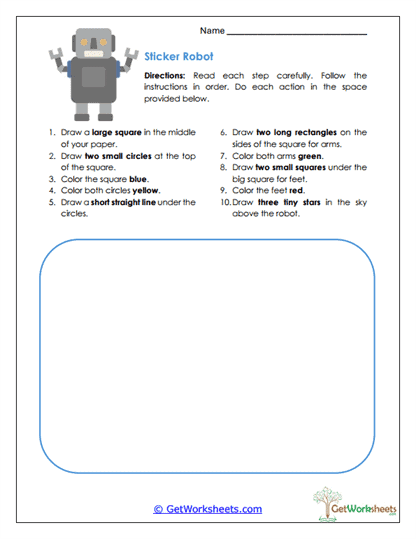
For many students, carefully following directions can be surprisingly challenging once multiple steps, colors, shapes, and positions are involved. This creative activity asks children to build a robot drawing by following a long sequence of detailed instructions in the correct order, paying close attention to size, placement, colors, and shapes along the way. The task combines reading comprehension with visual processing, sequencing, spatial awareness, listening-style direction following, and attention to detail in a format that feels fun instead of intimidating. Ideal for grades 2-4, this worksheet gives students meaningful practice with procedural reading while allowing creativity and success to happen at the same time.
Academic Focus
- Multi-Step Direction Following – Students practice completing instructions accurately in the correct sequence.
- Spatial and Visual Processing – Learners interpret positional words and visual details within directions.
- Attention to Detail – Children strengthen focus by carefully reading colors, shapes, and placement cues.
- Procedural Comprehension – Students connect written instructions directly to completed actions.
Learning Benefits
- Highly Engaging Activity – Drawing-based tasks often motivate reluctant readers and active learners.
- Strengthens Listening-Style Skills – Reinforces the same attention skills needed during oral classroom directions.
- Easy for Independent Practice – Students can complete the activity with minimal adult support.
- Blends Art and Literacy – Integrates creativity with important comprehension and sequencing practice.
- Helpful for Diverse Learners – Especially supportive for visual and hands-on learners.
Activities like this show students that reading directions is not only about answering questions on paper – it is about understanding information well enough to successfully complete a task. As children work through the robot instructions, they strengthen sequencing, comprehension, concentration, visual interpretation, and procedural literacy skills without feeling overwhelmed by heavy reading passages. The drawing component also helps students immediately recognize the importance of accuracy because missing one detail can change the final result. Teachers and parents value this kind of practice because it keeps students engaged while reinforcing careful reading habits that transfer into every subject area.
Bookmark Us Now!
New, high-quality worksheets are added every week! Do not miss out!