Real Comparisons
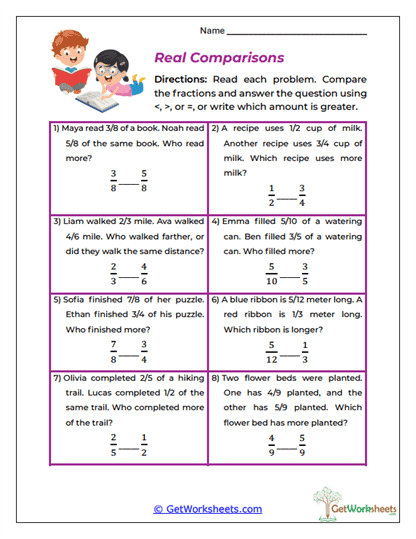
Students read eight short real-world problems involving books, recipes, walking distances, watering cans, puzzles, ribbons, hiking trails, and flower beds. They compare the fractions in each situation and answer the question using a comparison symbol or by naming the greater amount. This upper-elementary worksheet strengthens fraction comparison, word-problem comprehension, mathematical modeling, unit awareness, reasoning, and written response skills. It is especially appropriate for grades 4-5 because students must understand the situation before deciding how the fractions relate.
Key Learning Objectives
- Identify the Quantities: Students determine which two fractions are being compared in each problem.
- Use Context Clues: Learners connect the fraction values to pages, cups, miles, liters, meters, or completed work.
- Choose a Strategy: Children compare using common denominators, benchmarks, equivalent fractions, or known relationships.
- Answer the Actual Question: Students state who used more, walked farther, finished more, or completed the greater portion.
Teaching Advantages
- Shows Why Fractions Matter: Students apply comparison skills to familiar situations instead of isolated number pairs.
- Builds Reading and Math Together: Children must understand the wording before solving.
- Helpful for Parent Support: Adults can ask, “What is being measured, and are the wholes the same size?”
- Encourages Complete Reasoning: Students can explain both the comparison and what it means in the story.
- Low-Prep and Flexible: The page works well for independent practice, homework, small groups, tutoring, or homeschool lessons.
Some students can compare fractions on a worksheet but become confused when the same skill appears inside a story problem. This activity helps them translate words into mathematical relationships and then connect the answer back to the real situation. Students strengthen fraction sense, comprehension, comparison strategies, measurement vocabulary, reasoning, accuracy, and problem solving across eight practical examples. Parents can encourage children to underline the two fractions and circle the question being asked before solving. In classroom and homeschool settings, this worksheet builds confidence and prepares students to use fractions in measurement, recipes, distances, and everyday decision-making.
Bookmark Us Now!
New, high-quality worksheets are added every week! Do not miss out!