Comparison Mastery
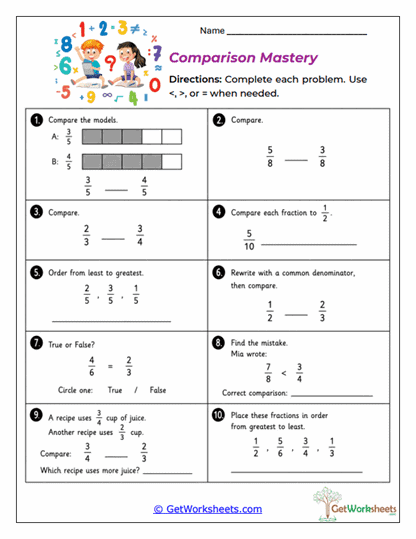
Students complete a ten-problem review that combines visual models, direct fraction comparison, benchmark reasoning, ordering, common denominators, true-or-false analysis, error correction, and a real-world word problem. The mixed format requires learners to choose the correct strategy instead of applying the same rule to every question. This upper-elementary worksheet strengthens fraction magnitude, visual modeling, equivalent fractions, benchmark comparison, ordering, error analysis, and mathematical problem solving. It is best suited for grades 4-5 as a cumulative review, skill check, or end-of-unit assessment.
Academic Focus
- Interpret Fraction Models: Students compare shaded bars and connect the pictures to written fractions.
- Compare and Order Values: Learners use symbols and arrange multiple fractions from least to greatest.
- Use Benchmarks and Equivalence: Children compare fractions with one-half, rewrite using common denominators, and recognize equal values.
- Analyze Mistakes: Students decide whether a statement is true and correct an inaccurate comparison.
- Apply Skills in Context: Learners solve a short recipe problem using fraction reasoning.
Instructional Benefits
- Checks Several Skills at Once: Teachers and parents can see which fraction strategies are secure and which need more practice.
- Encourages Flexible Thinking: Students must select a method based on the problem type.
- Useful for Assessment: The varied questions provide a broader picture than a page of identical exercises.
- Supports Review and Reteaching: Missed problems point directly to skills such as benchmarks, equivalence, ordering, or symbol use.
- Ready for Multiple Settings: The worksheet works well for class review, test preparation, tutoring, homework, or homeschool instruction.
Students may understand one fraction strategy but still need practice deciding when to use it. This worksheet brings several important comparison skills together so learners must think carefully about each problem. Students strengthen fraction sense, visual reasoning, equivalence, benchmark use, ordering, error correction, word-problem comprehension, and mathematical accuracy through a balanced review. Parents can encourage children to pause before solving and name the strategy they plan to use. In classroom and homeschool settings, this activity builds confidence and shows whether students are ready to compare fractions independently across models, symbols, number relationships, and real-world situations.
Bookmark Us Now!
New, high-quality worksheets are added every week! Do not miss out!