Fraction Comparison
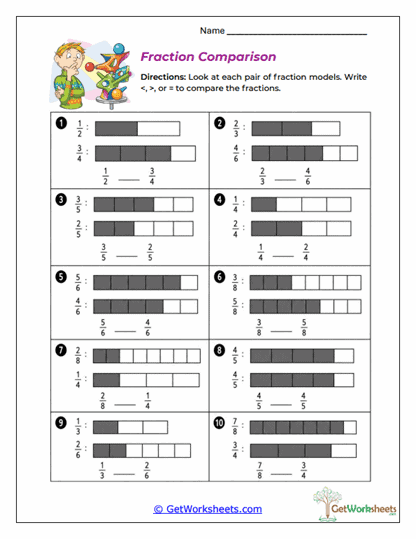
Students examine ten pairs of shaded fraction bars and write the correct comparison symbol between each pair. The visual models help children compare fractions with equal numerators, equal denominators, and different-sized parts before relying only on numbers and rules. This upper-elementary worksheet strengthens fraction sense, visual reasoning, numerator and denominator understanding, equivalent-fraction awareness, comparison symbols, and mathematical accuracy. It is especially useful for grades 3-4 because students can see the amount represented by each fraction instead of being expected to compare abstract symbols without support.
Learning Goals
- Interpret Fraction Models: Students connect the shaded sections of each bar with the numerator and the total sections with the denominator.
- Compare Fraction Amounts: Learners decide which model represents a greater amount, a smaller amount, or an equal amount.
- Use Comparison Symbols: Children correctly apply less than, greater than, and equal signs between fraction pairs.
- Notice Fraction Patterns: Students observe that fractions with the same denominator can be compared by their numerators, while equal numerators require attention to part size.
How This Helps
- Makes Fractions Easier to See: The shaded bars show children what each fraction actually represents.
- Supports Developing Learners: Visual models reduce the pressure of comparing fractions through memorized rules alone.
- Easy for Parents to Explain: Adults can ask, “Which bar has more of the whole shaded?”
- Builds Toward Abstract Work: Students connect pictures, written fractions, and mathematical symbols on the same page.
- Ready for Immediate Use: The worksheet fits whole-class lessons, math centers, intervention, tutoring, homework, or homeschool instruction.
Many children become confused when they see a larger denominator and assume it automatically means a larger fraction. This worksheet helps correct that misunderstanding by showing that more total pieces usually means each individual piece is smaller. Students strengthen fraction comparison, visual modeling, number sense, part-whole relationships, symbol use, reasoning, and mathematical vocabulary through repeated practice. Parents can encourage children to look at the shaded amount first and explain what they notice before choosing a sign. In classroom and homeschool settings, this activity builds confidence and gives students a concrete foundation for comparing fractions without models later.
Bookmark Us Now!
New, high-quality worksheets are added every week! Do not miss out!