Denominator Detective
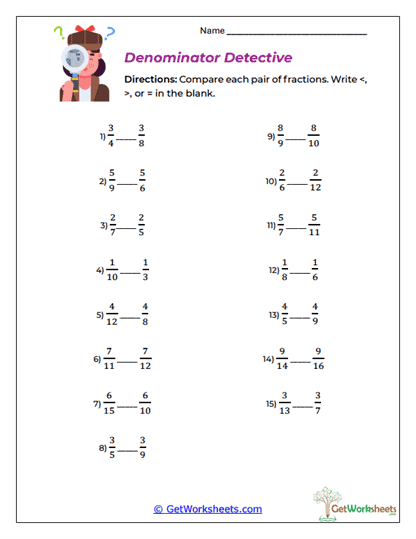
Students compare fifteen pairs of fractions that have the same numerator but different denominators. They write the correct comparison symbol by reasoning about how the size of each fractional part changes when a whole is divided into more or fewer equal pieces. This upper-elementary worksheet strengthens denominator understanding, like-numerator comparison, fraction magnitude, unit-fraction reasoning, comparison symbols, and mathematical logic. It is especially appropriate for grades 3-4 because it addresses one of the most common fraction misunderstandings: believing that a larger denominator creates a larger fraction.
Academic Focus
- Recognize Equal Numerators: Students notice that each pair contains the same number of selected parts.
- Compare Part Size: Learners understand that fewer total divisions create larger individual pieces.
- Use Denominator Reasoning: Children compare fractions by thinking about the size of the parts rather than treating the denominator as a whole-number value.
- Apply Mathematical Symbols: Students use less than, greater than, and equal signs to record each comparison.
Instructional Benefits
- Targets a Common Misconception: The problems directly challenge the idea that a larger denominator means a larger fraction.
- Supports Visual Thinking: Parents and teachers can connect the problems to cutting the same pizza into different numbers of slices.
- Builds Strong Fraction Sense: Students learn why the rule works instead of simply memorizing it.
- Encourages Verbal Explanation: Children can say, “The fourths are larger pieces than the eighths,” before writing a symbol.
- Ready for Multiple Settings: The worksheet fits math lessons, small groups, intervention, homework, tutoring, or homeschool practice.
Fractions with matching numerators often confuse children because the whole-number instinct tells them that eight should be greater than four. This worksheet helps students understand that denominators describe the size of the pieces, not how many pieces are being selected. Learners strengthen denominator reasoning, unit-fraction understanding, comparison, mathematical language, number sense, accuracy, and logical thinking through repeated examples. Parents can explain that one piece from a pizza cut into four sections is larger than one piece from the same pizza cut into eight sections. In classroom and homeschool settings, this activity builds confidence and gives students the reasoning they need to compare unfamiliar fractions correctly.
Bookmark Us Now!
New, high-quality worksheets are added every week! Do not miss out!