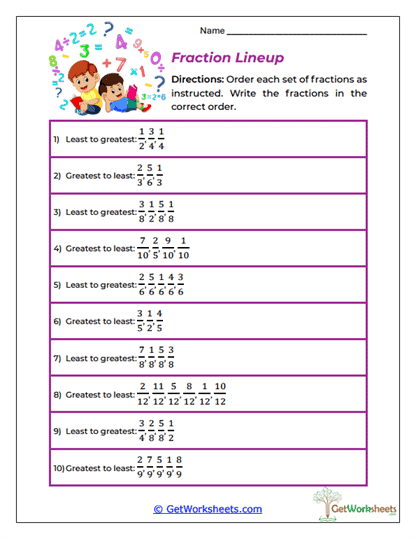
Fraction Lineup
Students arrange ten sets of fractions from least to greatest or greatest to least. Each set includes fractions that may share a denominator, share a numerator, or require comparison through benchmarks and equivalent values. This upper-elementary worksheet strengthens fraction magnitude, ordering, numerator and denominator reasoning, benchmark comparison, equivalent fractions, and mathematical accuracy. It is especially appropriate for grades 4-5 because students must compare more than two fractions at a time and maintain the correct order across an entire group.
Learning Goals
- Compare Several Fractions: Students determine the relative size of three, four, or five fractions in one problem.
- Use Efficient Strategies: Learners decide whether matching denominators, matching numerators, benchmarks, or equivalent fractions offer the quickest method.
- Order Accurately: Children place every fraction in the requested sequence without reversing the direction.
- Check the Full Set: Students review neighboring fractions to confirm that the order remains correct from beginning to end.
How This Helps
- Builds Flexible Thinking: Students learn that different fraction sets may require different comparison strategies.
- Supports Careful Reading: Children must notice whether each problem asks for least to greatest or greatest to least.
- Easy for Parents to Guide: Adults can ask the child to identify the smallest and largest fractions first, then place the remaining values between them.
- Prepares Students for Advanced Math: Ordering fractions supports later work with decimals, mixed numbers, measurement, and data.
- Ready for Immediate Use: The worksheet fits independent practice, math centers, homework, tutoring, intervention, or homeschool instruction.
Many students can compare one pair of fractions but become confused when several values must be arranged together. This worksheet teaches them to compare systematically rather than guessing from the appearance of the numbers. Students strengthen fraction sense, ordering, comparison, equivalent-fraction reasoning, benchmark use, mathematical vocabulary, and self-checking through repeated practice. Parents can encourage children to use zero, one-half, and one as landmarks when the fractions look difficult. In classroom and homeschool settings, this activity builds confidence and helps students organize fraction values accurately from smallest to largest or largest to smallest.
Bookmark Us Now!
New, high-quality worksheets are added every week! Do not miss out!