Fraction Links
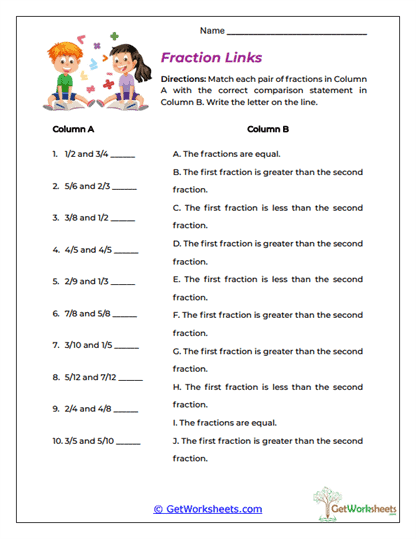
Students compare ten pairs of fractions in Column A and match each pair with the correct statement in Column B. The statements explain whether the fractions are equal or whether the first fraction is greater than or less than the second. This upper-elementary worksheet strengthens fraction comparison, mathematical language, equivalent-fraction recognition, numerator and denominator reasoning, close reading, and logical matching. It is well suited for grades 4-5 because students must interpret both the numerical relationship and the written statement that describes it.
Key Learning Objectives
- Compare Fraction Pairs: Students determine the relationship between each pair using an appropriate strategy.
- Interpret Written Statements: Learners connect symbols and fraction values with complete mathematical sentences.
- Recognize Equivalent Fractions: Children identify pairs that represent the same amount even when the numbers look different.
- Match With Precision: Students carefully pair each problem with one unique answer choice.
Teaching Advantages
- Connects Math Symbols to Language: Students practice explaining comparisons in words rather than relying only on signs.
- Builds Reading Accuracy: Children must pay attention to whether a statement refers to the first or second fraction.
- Helpful for Parent Support: Adults can ask the child to say each comparison aloud before choosing a letter.
- Encourages Multiple Strategies: Students may use benchmarks, common denominators, cross-products, or known equivalents.
- Low-Prep Practice: The worksheet works well for centers, review, assessment, tutoring, homework, or homeschool lessons.
Some children solve a fraction comparison correctly but misread the wording of the answer choice. This worksheet helps them connect the numerical result with clear mathematical language. Students practice fraction magnitude, equivalence, comparison vocabulary, reasoning, reading comprehension, accuracy, and answer matching through ten focused examples. Parents can remind children that “the first fraction” means the fraction written on the left side of the pair. In classroom and homeschool settings, this activity builds confidence and helps students explain fraction relationships more clearly in both spoken and written form.
Bookmark Us Now!
New, high-quality worksheets are added every week! Do not miss out!