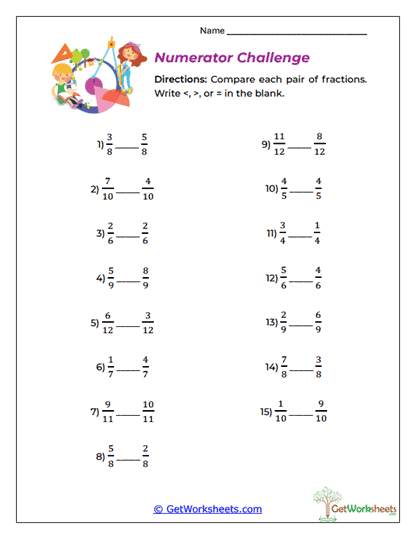
Numerator Challenge
Students compare fifteen pairs of fractions that have matching denominators and write the correct less than, greater than, or equal symbol in each blank. Because the denominator stays the same within every pair, students can focus on how the numerator changes the amount represented. This upper-elementary worksheet strengthens numerator understanding, like-denominator comparison, fraction magnitude, comparison-symbol use, number sense, and mathematical fluency. It is best suited for grades 3-4 as students move from visual fraction models toward faster and more independent symbolic comparison.
Key Learning Objectives
- Recognize Equal Denominators: Students notice that both fractions in a pair are divided into the same-sized parts.
- Compare Numerators: Learners understand that the fraction with more selected parts is greater when the denominators match.
- Use Symbols Accurately: Children place the correct comparison sign between each fraction pair.
- Build Comparison Fluency: Students solve several examples using the same dependable mathematical pattern.
Teaching Advantages
- Focuses on One Clear Rule: The matching denominators make the comparison process easier to understand and practice.
- Helps Parents Give Simple Support: Adults can explain that the pieces are the same size, so students only need to compare how many pieces are taken.
- Strengthens Mental Math: Students can compare each pair without drawing models or finding common denominators.
- Useful for Quick Assessment: Teachers can easily see whether a child understands the role of the numerator.
- Low-Prep Practice: The page works well for independent work, review, homework, tutoring, intervention, or homeschool lessons.
Some children see two fractions and compare every number separately without considering what the numerator and denominator mean. This worksheet teaches them to notice the shared denominator first and then compare the number of equal parts being counted. Students practice fraction magnitude, numerator reasoning, symbol recognition, mathematical vocabulary, accuracy, fluency, and self-checking through a consistent set of problems. Parents can remind children that when the pieces are the same size, having more pieces means having more of the whole. In classroom and homeschool settings, this activity builds confidence and prepares students for ordering fractions, solving word problems, and comparing more complex fractions.
Bookmark Us Now!
New, high-quality worksheets are added every week! Do not miss out!