Claim Chain
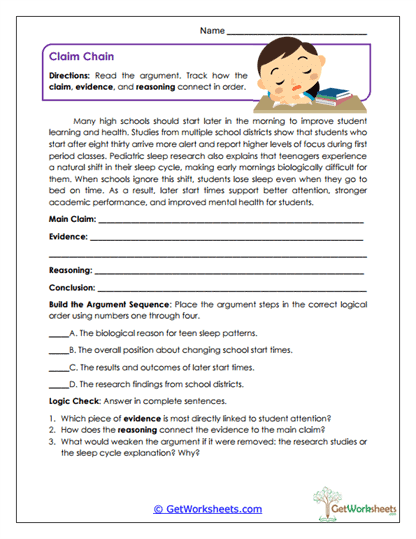
Students read an argument about why high schools should begin later in the morning and identify the main claim, evidence, reasoning, and conclusion. They then place four parts of the argument in the most logical order and answer questions about how the evidence supports the writer’s position. This fifth-grade worksheet develops reading comprehension, argument structure, logical sequencing, claim identification, evidence analysis, reasoning, and written response skills. It teaches students that a strong argument is not simply a personal opinion but a carefully organized chain of ideas.
Key Learning Objectives
- Identify the Main Claim: Students state the central position the author wants readers to accept.
- Separate Evidence and Reasoning: Learners distinguish research findings from the explanation of why those findings matter.
- Build a Logical Sequence: Children arrange the argument from background information to results and conclusion.
- Judge Evidence Quality: Students decide which evidence most directly supports a specific point in the argument.
Instructional Benefits
- Makes Arguments Easier to Understand: The claim-evidence-reasoning format gives students a clear structure to follow.
- Supports Critical Reading: Children learn not to accept a claim without examining the proof behind it.
- Helpful for Families: Parents can ask, “What fact does the writer use, and how does that fact support the claim?”
- Prepares Students for Writing: The activity provides a useful model for opinion essays and constructed responses.
- Low-Prep and Flexible: The page can be used in reading, writing, test preparation, tutoring, or homeschool instruction.
Many students can tell whether they agree with an argument but have trouble explaining how the writer built it. This worksheet teaches them to slow down and follow the chain from claim to evidence, from evidence to reasoning, and from reasoning to conclusion. Students strengthen comprehension, sequencing, argument analysis, text evidence, logical thinking, academic vocabulary, and complete-sentence writing while examining a topic that affects students directly. Parents should remind children that evidence is the fact or research, while reasoning explains why that evidence proves the point. In the classroom or at home, this activity builds confidence and helps students become more careful readers, stronger writers, and more thoughtful decision-makers.
Bookmark Us Now!
New, high-quality worksheets are added every week! Do not miss out!