Sequence Repair
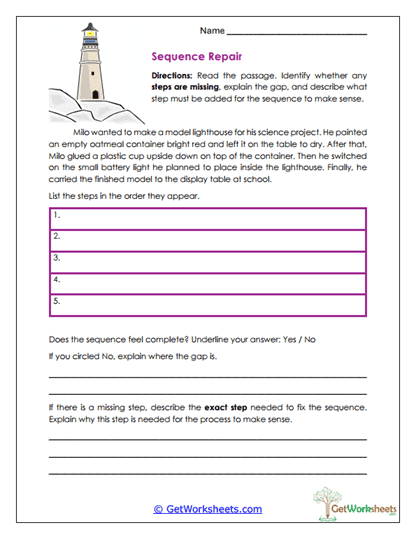
Students read a passage about building a model lighthouse and list the steps in the order they appear. They then decide whether the sequence is complete, locate any gap, and describe the exact missing step needed to make the process logical. This upper-elementary worksheet strengthens reading comprehension, procedural sequencing, logical reasoning, gap detection, cause and effect, explanatory writing, and problem solving. It is well suited for grades 4-5 because students must evaluate the quality of the sequence rather than simply copy the events.
Instructional Objectives
- List the Existing Steps: Students identify and record the actions described in the lighthouse-building process.
- Evaluate Completeness: Learners decide whether the sequence includes everything needed for the finished model to make sense.
- Locate a Logical Gap: Children identify where an important action is missing between two stated steps.
- Propose a Repair: Students describe the missing step and explain why it is necessary.
Instructional Support
- Builds Real-World Reasoning: The activity mirrors situations in which directions are incomplete or poorly organized.
- Encourages Careful Reading: Students must notice that one item cannot simply appear in place without being attached or installed.
- Supports Parent Conversation: Adults can ask, “Could the next step happen if this action was never completed?”
- Useful Beyond Reading Class: Sequence repair supports science procedures, math explanations, writing revision, and everyday instructions.
- Flexible and Low Prep: The worksheet can be used for independent practice, small groups, assessment, or homeschool lessons.
Some children can repeat a sequence exactly as written but do not notice when the process contains a missing or impossible step. This worksheet teaches them to read with logic, not just memory, and to ask whether each action truly leads to the next. Students develop sequencing, comprehension, procedural thinking, inference, cause-and-effect reasoning, problem solving, and explanatory writing while evaluating a hands-on building task. Parents should encourage the child to imagine actually completing the project, because visualizing the process often reveals the missing action. In both classroom and homeschool settings, this activity builds confidence and helps students become more thoughtful readers who can detect gaps, question unclear directions, and repair broken sequences.
Bookmark Us Now!
New, high-quality worksheets are added every week! Do not miss out!