Great Wall Connections
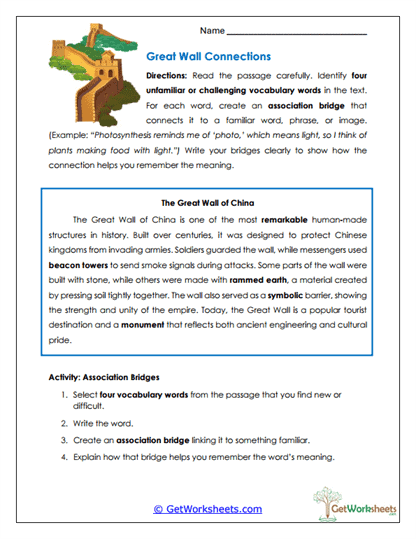
Students read a nonfiction passage about the Great Wall of China and identify four vocabulary words that may be unfamiliar or difficult. For each word, they create an association bridge by connecting it to a familiar word, picture, sound, place, or idea. This upper-elementary activity strengthens reading comprehension, context clues, vocabulary development, word meaning, memory, historical understanding, and written explanation. It gives fifth-grade students a practical way to handle challenging words instead of skipping them or becoming frustrated.
Academic Focus
- Identify Challenging Words: Students choose four terms from the passage that they do not fully understand or want to remember more clearly.
- Use Context Clues: Learners study the surrounding sentences to determine what each word means in the passage.
- Build Association Bridges: Children connect each new term to something they already know, creating a personal memory link.
- Explain Word Meaning: Students describe how each connection helps them understand and recall the vocabulary.
Teaching Advantages
- Helpful for Growing Readers: The activity shows children what to do when they meet a difficult word instead of simply telling them to look it up.
- Easy for Parents to Support: Adults can ask simple questions such as, “What does that word remind you of?” without needing special training.
- No-Prep Design: The worksheet can be printed and used immediately in class, tutoring, intervention, or homeschool lessons.
- Supports Different Ability Levels: Students may choose simpler or more advanced vocabulary depending on their reading needs.
- Connects Reading and Social Studies: Learners improve literacy skills while studying an important historical structure.
Many fifth graders can read the words in a passage but still have trouble understanding or remembering what those words mean. This worksheet teaches them to slow down, notice difficult vocabulary, and connect new information to something already stored in their minds. Students practice context clues, word meaning, historical vocabulary, comprehension, memory, and written reasoning in a way that feels personal and manageable. Parents should understand that the connection does not have to be perfect or impressive; it only needs to help the child remember. In the classroom or at home, this strategy can build confidence and help students become more independent when reading science, history, and other nonfiction texts.
Bookmark Us Now!
New, high-quality worksheets are added every week! Do not miss out!