Simple True or False
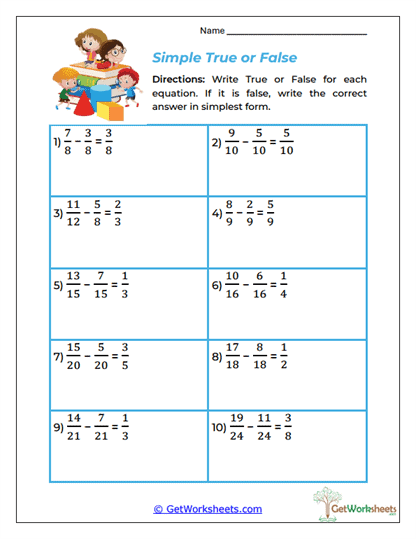
Simple True or False asks students to decide whether completed fraction subtraction equations are correct. Students solve or verify each problem, write True when the answer is accurate, and write the correct simplified answer when the equation is false. This activity strengthens fraction subtraction, equation checking, numerator computation, denominator recognition, equivalent fractions, simplification, and error analysis. It is well suited for students in grades 4-5 who need practice reviewing work carefully instead of assuming a printed answer is correct.
Key Learning Objectives
- Verify each difference: Students subtract the numerators and compare their result with the answer shown.
- Keep like denominators: Learners confirm that the denominator stays unchanged during subtraction.
- Check simplest form: Students decide whether the stated answer has been reduced completely.
- Correct false equations: Children replace inaccurate differences with mathematically correct answers.
Instructional Benefits
- Builds self-checking habits: Students learn that solving and reviewing are both important parts of mathematics.
- Targets common mistakes: The problems may include incorrect subtraction or answers that were not simplified properly.
- Encourages explanation: Parents and teachers can ask children to explain exactly why an equation is true or false.
- Useful for review or assessment: The page works well for independent practice, homework, small groups, or homeschool instruction.
- Ready to use: No extra materials or preparation are required.
True-or-false practice encourages children to slow down and inspect every part of an equation. They must check the numerator subtraction, make sure the denominator stayed the same, and decide whether the final fraction is in lowest terms. For example, a numerical difference may be correct but still need to be simplified before the whole equation is fully complete. This worksheet develops fraction fluency, error detection, simplification, reasoning, mathematical communication, and confidence. In classroom and homeschool settings, it reinforces the valuable habit of proving that an answer is correct rather than accepting it without checking.
Bookmark Us Now!
New, high-quality worksheets are added every week! Do not miss out!